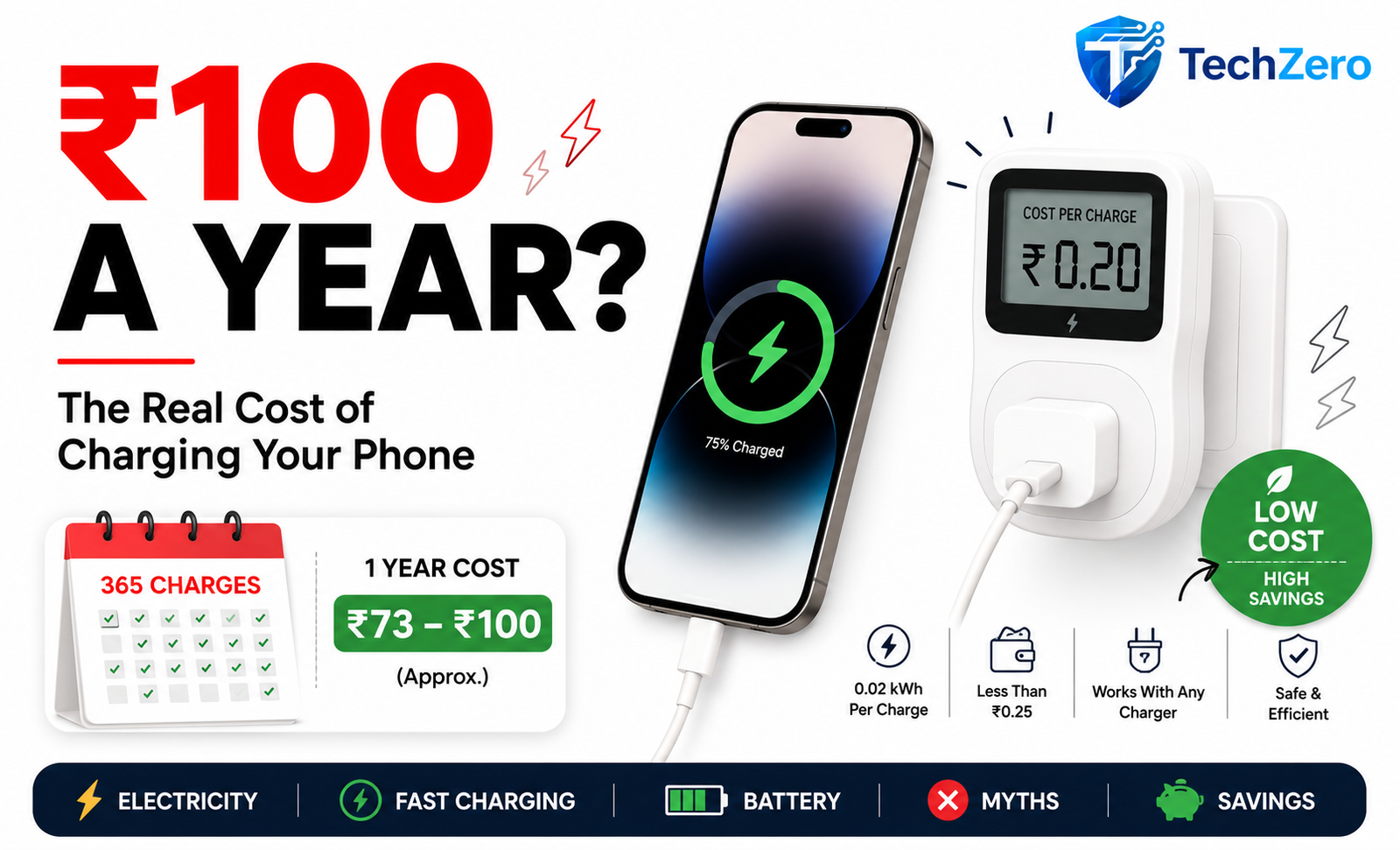
How Much Does It Really Cost to Charge Your Phone for a Year? The Answer May Surprise You

Category: Smartphones | Battery | Electricity
Introduction
Your smartphone is probably the electronic device you charge most often.
Whether you plug it in overnight, top it up during the day, or use an ultra-fast charger, charging your phone has become a daily habit.
But have you ever wondered how much that habit actually costs?
Is it ₹50 a year? ₹500? Or even ₹1,000?
The answer is surprisingly low.
In fact, charging your smartphone every single day for an entire year costs less than many people spend on a single pizza or movie ticket. Let’s do the math and separate facts from myths.
The Math Behind Smartphone Batteries
Most modern smartphones feature batteries between 4,500 mAh and 6,000 mAh.
A typical 5,000 mAh battery stores approximately:
- 19–20 Wh (Watt-hours)
- 0.020 kWh (Kilowatt-hours)
That means one complete charge stores only around 0.02 units of electricity.
Charger Efficiency Matters
No charger is perfectly efficient.
Some electricity is always lost as heat.
Typical efficiencies are:
| Charger Type | Efficiency |
|---|---|
| Basic Charger | ~80% |
| Standard USB-C PD Charger | 85–90% |
| Premium GaN Charger | 90–94% |
Considering these losses, a full charge of a 5,000 mAh phone actually draws approximately:
0.023–0.025 kWh
from your wall socket.
The Real Cost of Charging Your Phone
Let’s assume your electricity tariff is ₹8 per unit (kWh).
| Full Charges | Electricity Used | Cost |
|---|---|---|
| 1 Charge | 0.025 kWh | ₹0.20 |
| 5 Charges | 0.125 kWh | ₹1.00 |
| 30 Charges (1 Month) | 0.75 kWh | ₹6.00 |
| 365 Charges (1 Year) | 9.1 kWh | ₹73 |
The Bottom Line
Even if you charge your smartphone every single day, you’ll spend only about ₹70–₹80 per year.
Even in areas where electricity costs ₹10 per unit, the annual cost still remains below ₹100.
What If Electricity Costs More in Your City?
Electricity tariffs vary across India.
Here’s what the annual charging cost looks like at different rates.
| Electricity Tariff | Annual Cost |
|---|---|
| ₹5/unit | ₹46 |
| ₹6/unit | ₹55 |
| ₹8/unit | ₹73 |
| ₹10/unit | ₹91 |
| ₹12/unit | ₹109 |
Even at the highest domestic tariffs, charging a smartphone remains one of the cheapest uses of electricity in your home.
What If Your Family Owns Multiple Phones?
Most households have more than one smartphone.
Here’s how the cost scales.
| Number of Phones | Approx. Annual Cost |
|---|---|
| 1 | ₹73 |
| 2 | ₹146 |
| 3 | ₹219 |
| 4 | ₹292 |
Even a family of four spends less than ₹300 per year charging all their phones.
Fast Charging vs Normal Charging
Many people believe 80W, 100W or even 120W chargers consume huge amounts of electricity.
That’s actually a myth.
Fast charging changes how quickly energy is delivered, not how much energy your battery stores.
Whether your phone charges in:
- 20 minutes
- 45 minutes
- 90 minutes
the battery still needs roughly the same total amount of energy.
Fast charging does create a little more heat, so efficiency may be slightly lower, but the difference on your electricity bill is almost impossible to notice.
Wired vs Wireless Charging
Wireless charging is convenient, but it isn’t quite as efficient.
| Charging Method | Efficiency | Approx. Annual Cost |
|---|---|---|
| Wired Charging | 90–94% | ₹70–₹80 |
| Wireless Charging | 70–80% | ₹85–₹110 |
| Reverse Wireless Charging | 60–70% | ₹100–₹130 |
Even wireless charging adds only a few dozen rupees to your yearly electricity bill.
Does Overnight Charging Waste Electricity?
Modern smartphones are designed to stop charging once they reach 100%.
After that, they draw only tiny amounts of electricity to maintain the battery level.
Leaving your phone plugged in overnight may cost only a few extra paise over an entire month.
The bigger concern isn’t electricity—it is battery health. Keeping lithium-ion batteries at 100% charge for long periods can slightly accelerate battery aging over several years.
How Does Your Phone Compare With Other Appliances?
Here’s where things become interesting.
| Device | Approx. Annual Electricity Cost |
|---|---|
| Smartphone Charging | ₹70–₹100 |
| Wi-Fi Router | ₹600–₹1,000 |
| Laptop | ₹500–₹1,500 |
| Ceiling Fan | ₹800–₹2,000 |
| LED TV | ₹1,000–₹2,000 |
| Refrigerator | ₹3,000–₹6,000 |
| 1.5-Ton Inverter AC | ₹8,000–₹30,000+ |
Your smartphone is one of the cheapest electronic devices to operate.
What Uses More Electricity in Just One Hour?
| Device | Approx. Power Consumption |
|---|---|
| Smartphone Charging | 20–30 Wh |
| LED Bulb | 9–12 Wh |
| Ceiling Fan | 70–80 Wh |
| Laptop Charger | 65–140 Wh |
| LED TV | 100–150 Wh |
| Microwave Oven | 1,000–1,500 Wh |
| 1.5-Ton AC | 900–2,000 Wh |
A single hour of air conditioner usage can consume as much electricity as dozens of smartphone charges.
Did You Know?
A typical 1.5-ton inverter AC running for just one hour can consume enough electricity to fully charge a modern smartphone around 50 times.
That’s why reducing AC usage by even one hour has a far bigger impact on your electricity bill than worrying about your phone charger.
Where Does Your Electricity Bill Actually Go?
For a typical household:
- Air Conditioner — 50–60%
- Refrigerator — 10–15%
- Water Heater (Geyser) — 10–15%
- Washing Machine — 5–8%
- Television & Entertainment — 5%
- Lighting — 5%
- Smartphone Charging — Less than 1%
If your goal is to reduce electricity costs, focus on appliances that consume hundreds or thousands of watts—not your smartphone.
Charging Tips That Actually Matter
Although the savings are small, these habits improve efficiency and battery longevity.
- Use certified chargers.
- Avoid counterfeit adapters.
- Keep chargers in cool, ventilated areas.
- Don’t charge under pillows or blankets.
- Charge between 20% and 80% when practical.
- Avoid exposing your phone to excessive heat while charging.
Myth vs Reality
| Myth | Reality |
|---|---|
| Fast charging doubles electricity bills. | ❌ False. It mainly reduces charging time. |
| Overnight charging wastes huge amounts of electricity. | ❌ Modern phones draw very little power after reaching 100%. |
| Bigger chargers always consume more electricity. | ❌ Chargers supply only the power requested by the phone. |
| Charging every day is expensive. | ❌ A full year’s charging often costs less than one fast-food meal. |
Frequently Asked Questions
Does a 120W charger always consume 120W?
No. It only delivers high power during certain stages of charging, and only if the phone supports it.
Does charging from a laptop cost more?
No. The electricity ultimately comes from the same source. The total energy required to charge the phone remains nearly identical.
Does using the phone while charging increase electricity consumption?
Yes, slightly. The charger powers both the phone’s operation and the battery, so charging may take longer.
Does Airplane Mode charge faster?
Yes. Since radios like cellular, Wi-Fi and Bluetooth consume less power in Airplane Mode, a slightly larger share of incoming power goes toward charging the battery.
Does wireless charging cost more?
Yes, but only slightly. Wireless charging is less efficient than wired charging and wastes more energy as heat.
Is charging twice a day expensive?
Not really. Even two full charges every day typically cost only around ₹150–₹200 per year.
Which costs more to charge: a laptop or a smartphone?
A laptop usually consumes several times more electricity because it has a much larger battery and often operates while charging.
TechZero Verdict
The next time someone tells you that charging your phone every day is driving up your electricity bill, show them the numbers.
For most users, a full year of daily smartphone charging costs less than ₹100—less than a movie ticket in many cities and a tiny fraction of a household’s annual electricity bill.
If you’re serious about saving money, don’t obsess over your phone charger. Instead, focus on reducing the usage of high-power appliances such as air conditioners, electric geysers, refrigerators and room heaters.
Sometimes, the smallest gadget has the smallest impact on your wallet.
Final Take: Charge your phone without guilt. Your electricity bill has much bigger things to worry about.


[…] How Much Does It Cost to Charge Your Phone? […]