
Introduction
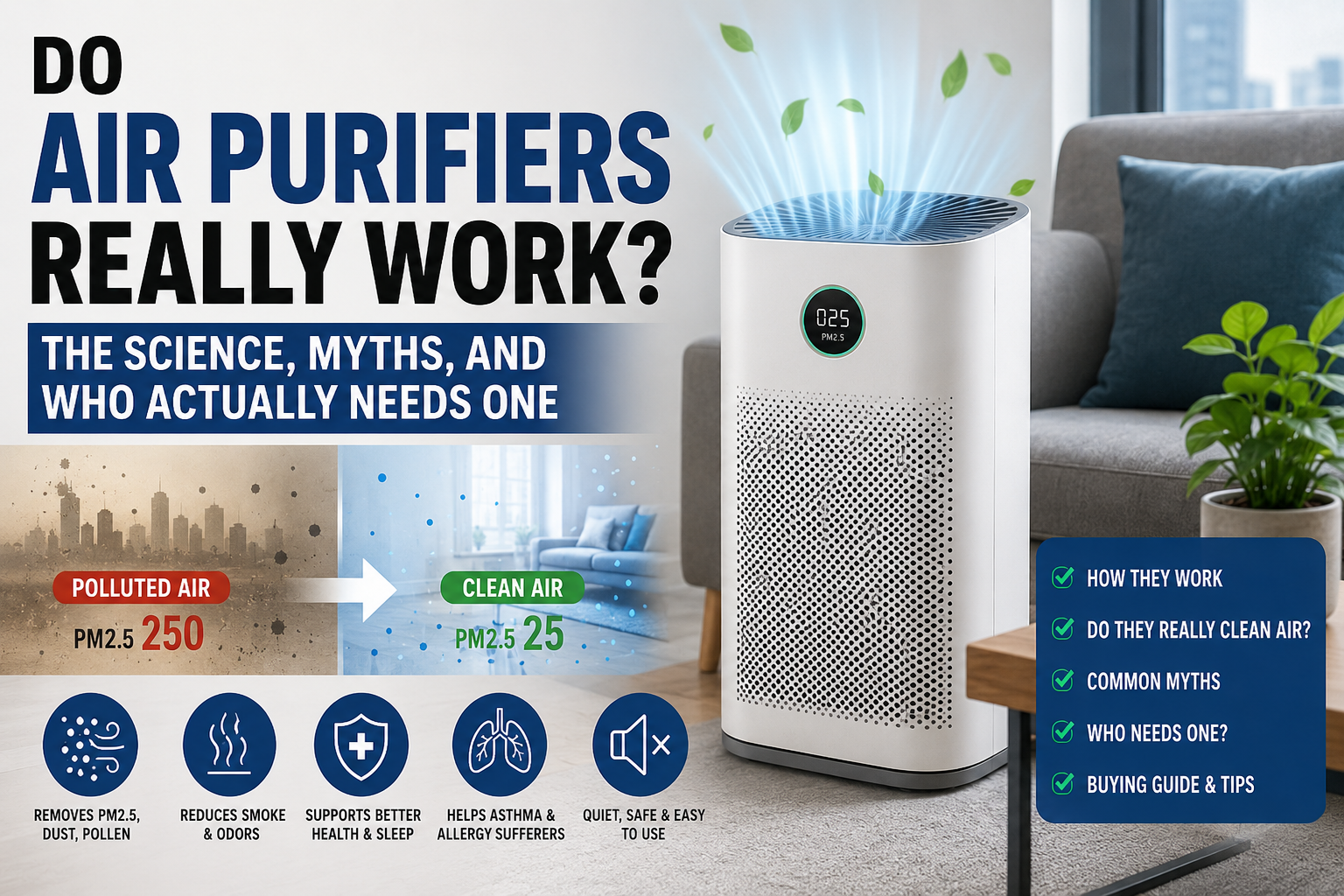
Walk into any electronics store, browse Amazon, or watch a few YouTube videos during winter, and you’ll quickly come across a familiar promise: buy an air purifier and breathe cleaner, healthier air.
Manufacturers claim their devices remove 99.97% of harmful particles, eliminate allergens, reduce asthma triggers, capture smoke, and even help protect against airborne diseases. Some models go even further, advertising UV sterilization, ionization, smart sensors, AI-powered operation, and “medical-grade” filtration.
But how much of this is marketing, and how much is backed by science?
Do air purifiers genuinely improve indoor air quality, or are they simply expensive fans with filters? If they do work, who benefits most from using one? Are they necessary for everyone, or only for people living in highly polluted cities? Can they protect against viruses, dust, pollen, pet dander, and PM2.5 pollution? Most importantly, are they worth the ongoing cost of electricity and filter replacements?
These questions have become increasingly important, especially in countries like India where air pollution regularly reaches dangerous levels. Cities such as Delhi, Noida, Ghaziabad, Gurugram, Kanpur, Lucknow, and many others experience severe air quality deterioration during winter months. During these periods, the Air Quality Index (AQI) often exceeds 300, 400, or even 500—levels classified as hazardous by global health standards.
At the same time, indoor air quality has emerged as a significant health concern. Most people spend approximately 80–90% of their time indoors, whether at home, in offices, schools, shopping centers, or public transport. Indoor air can contain dust, allergens, cooking fumes, volatile organic compounds (VOCs), mold spores, smoke particles, and outdoor pollution that enters through doors, windows, and ventilation systems.
This raises a critical question:
If we spend most of our lives indoors, does cleaning indoor air make a meaningful difference to our health?
The short answer is yes—but only if you understand what air purifiers can and cannot do.
This article explores the science behind air purification, examines real-world performance, debunks common myths, explains the different technologies used in modern purifiers, and helps you determine whether buying one makes sense for your situation.
Understanding Air Pollution: What Are We Actually Breathing?
Before discussing air purifiers, we need to understand what they are trying to remove.
When people hear the term “air pollution,” they often imagine smoke coming from factories or vehicle exhaust. In reality, the air around us contains a complex mixture of particles and gases.
The most concerning pollutants include:
PM10
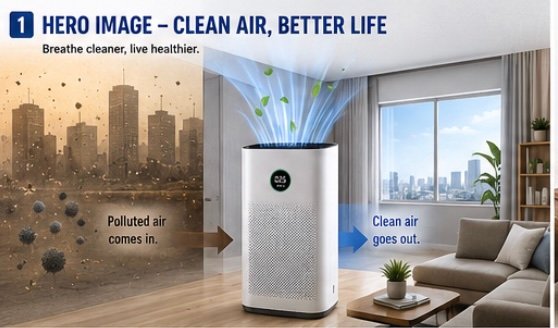
PM10 refers to particulate matter with a diameter of less than 10 micrometers.
Examples include:
- Dust from roads
- Construction debris
- Pollen
- Mold spores
These particles can enter the nose and upper respiratory tract but are generally too large to penetrate deeply into the lungs.
PM2.5
PM2.5 consists of particles smaller than 2.5 micrometers.
These are considered far more dangerous because they can penetrate deep into the lungs and even enter the bloodstream.
Common sources include:
- Vehicle emissions
- Industrial pollution
- Diesel exhaust
- Biomass burning
- Firecrackers
- Forest fires
PM2.5 pollution is strongly associated with:
- Asthma
- Chronic bronchitis
- Reduced lung function
- Heart disease
- Stroke
- Premature death
Ultrafine Particles
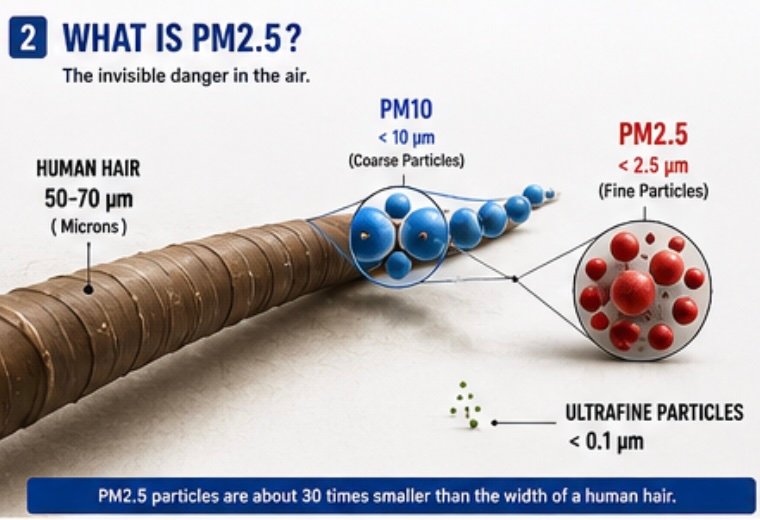
These particles are even smaller than PM2.5.
Because of their microscopic size, they can travel through biological barriers and potentially affect multiple organs.
Allergens
Indoor allergens include:
- Dust mites
- Pet dander
- Pollen
- Mold spores
Although not necessarily toxic, they can trigger allergies and respiratory symptoms.
Volatile Organic Compounds (VOCs)
VOCs are gases released from:
- Paints
- Furniture
- Cleaning products
- Adhesives
- Air fresheners
Long-term exposure to certain VOCs may contribute to respiratory irritation and other health issues.
Smoke
Smoke from cooking, cigarettes, incense sticks, mosquito coils, and outdoor burning contains a complex mixture of harmful particles and chemicals.
Many of these particles are small enough to remain suspended in the air for hours.
How Air Purifiers Actually Work
At their core, most air purifiers operate on a surprisingly simple principle.
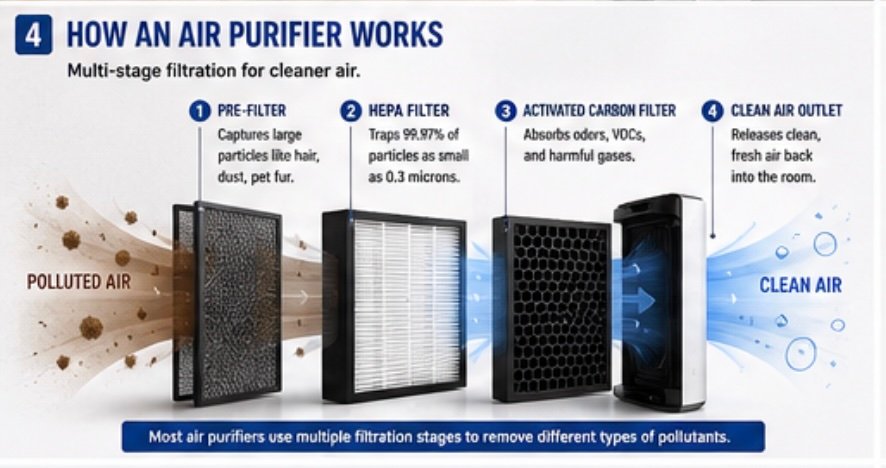
They continuously pull air through a series of filters and release cleaner air back into the room.
Think of them as vacuum cleaners for airborne particles.
The process usually follows four steps:
Step 1: Air Intake
A built-in fan draws room air into the purifier.
The amount of air processed every minute depends on the device’s fan speed and design.
Step 2: Pre-Filter
The first layer is usually a pre-filter.
This captures larger contaminants such as:
- Hair
- Pet fur
- Dust clumps
- Visible debris
Removing large particles protects the more expensive filters behind it.
Step 3: HEPA Filtration
This is where most of the real work happens.
HEPA stands for High-Efficiency Particulate Air.
A genuine HEPA filter is capable of capturing extremely small airborne particles with remarkable efficiency.
Contrary to popular belief, HEPA filters do not function like simple sieves.
They rely on multiple mechanisms:
Interception
Particles following airflow paths stick to fibers as they pass nearby.
Impaction
Larger particles cannot follow sudden airflow changes and collide directly with filter fibers.
Diffusion
Very tiny particles move randomly due to Brownian motion and eventually collide with filter fibers.
The combination of these mechanisms allows HEPA filters to capture particles across a wide range of sizes.
Step 4: Activated Carbon Filtration
While HEPA filters capture particles, they are not effective at removing gases.
Activated carbon addresses this limitation.
The porous carbon material adsorbs:
- Odors
- Cooking smells
- Smoke compounds
- Certain VOCs
This is why air purifiers with substantial carbon filters are often better at odor control.
Why the 99.97% Claim Is Often Misunderstood
Many manufacturers advertise that their HEPA filters remove 99.97% of particles.
This figure is technically accurate but frequently misunderstood.
The 99.97% efficiency refers to laboratory testing against particles approximately 0.3 microns in size, often considered the most difficult particle size to capture.
Interestingly, HEPA filters can sometimes capture both larger and smaller particles with even greater efficiency.
However, this does not mean that a purifier removes 99.97% of all pollution from an entire room instantly.
Real-world effectiveness depends on:
- Room size
- Air leakage
- Fan speed
- Filter condition
- Placement
- Outdoor pollution levels
This distinction is crucial because laboratory efficiency and actual room performance are not the same thing.
Part 2: Real-World Performance, Health Benefits, and Common Myths
CADR: The Most Important Specification Nobody Understands
When shopping for an air purifier, most buyers focus on filter type, smart features, app connectivity, or brand reputation.
However, the single most important specification is often hidden in the technical sheet:
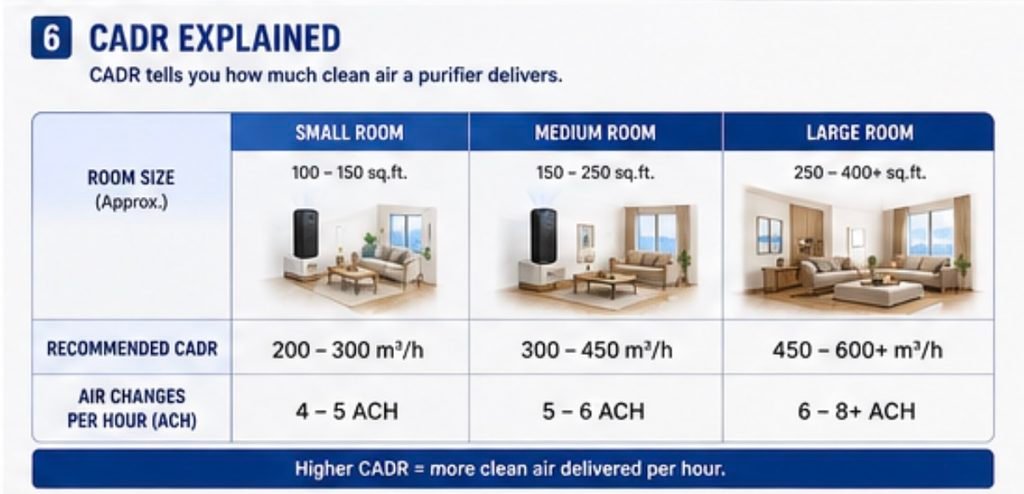
CADR (Clean Air Delivery Rate).
CADR measures how much clean air a purifier can deliver per unit of time.
It is usually expressed in cubic meters per hour (m³/h).
Think of CADR as the horsepower of an air purifier.
A purifier with an excellent HEPA filter but weak airflow may clean air very slowly.
Conversely, a purifier with strong airflow but poor filtration may circulate air quickly while removing fewer pollutants.
CADR combines both factors.
For example:
- CADR 150 m³/h → Suitable for small rooms
- CADR 300 m³/h → Suitable for medium rooms
- CADR 500+ m³/h → Suitable for large rooms
Many buyers mistakenly purchase a purifier designed for a 100-square-foot bedroom and place it in a 350-square-foot living room.
The result?
Disappointing performance.
The purifier may technically work, but it cannot process enough air to significantly improve room-wide air quality.
Air Changes Per Hour (ACH)
Another critical concept is Air Changes Per Hour (ACH).
ACH refers to how many times the purifier can clean the room’s entire air volume in one hour.
For example:
A room measuring:
- 12 ft × 12 ft
- Ceiling height: 10 ft
Contains approximately:
1,440 cubic feet of air.
If a purifier processes 7,200 cubic feet every hour:
ACH = 5
This means the purifier effectively filters the room’s air volume five times per hour.
Experts generally recommend:
- 4–5 ACH for everyday use
- 5–8 ACH for allergy sufferers
- 6–10 ACH for healthcare environments
This is why room-size matching is essential.
A high-quality purifier operating at insufficient ACH will underperform regardless of filter quality.
What Happens Inside a Polluted Room?
Many people assume indoor air is automatically cleaner than outdoor air.
This is only partially true.
In reality, indoor air is constantly affected by both indoor and outdoor pollution sources.
Outdoor pollutants enter through:
- Open windows
- Doors
- Ventilation systems
- Tiny cracks in buildings
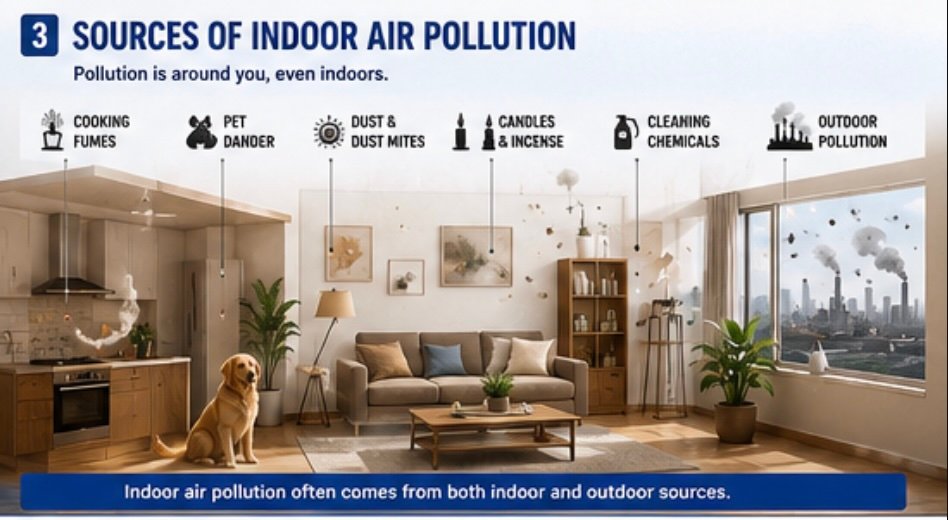
Meanwhile, indoor activities generate pollution such as:
- Cooking
- Frying food
- Incense burning
- Candles
- Smoking
- Cleaning chemicals
- Pet activity
In urban areas, indoor PM2.5 levels can reach surprisingly high levels even when all windows remain closed.
Researchers have repeatedly found that indoor pollution often reaches 50–80% of outdoor levels in poorly sealed homes.
This means an outdoor AQI of 300 can easily translate into indoor AQI levels exceeding 150.
That is still unhealthy.
Do Air Purifiers Actually Reduce PM2.5?
This is where air purifiers perform best.
Multiple independent studies have shown that properly sized HEPA air purifiers can reduce indoor PM2.5 concentrations by:
- 40–60% in average conditions
- 70–90% in well-sealed rooms
- More than 95% under ideal circumstances
This reduction can occur surprisingly quickly.
A powerful purifier operating in a closed bedroom may reduce PM2.5 levels from 250 to below 50 within 30–60 minutes.
This is why many users observe dramatic AQI improvements during winter pollution events.
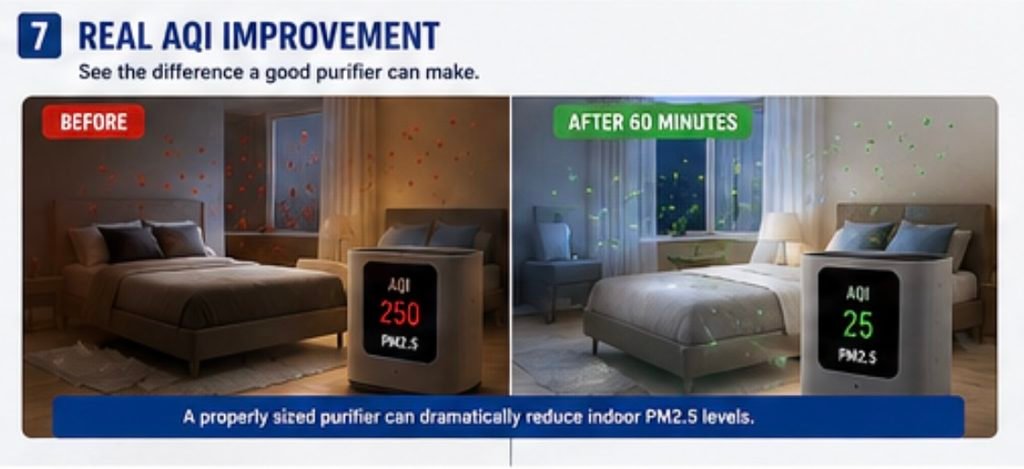
However, results vary depending on:
- Outdoor AQI
- Window usage
- Room leakage
- Purifier capacity
- Fan speed settings
A purifier is not creating clean air from nothing.
It is continuously fighting incoming pollution.
The cleaner and more sealed the room, the better the results.
Do Air Purifiers Help With Allergies?
For allergy sufferers, the answer is often yes.
Many common allergy triggers are airborne particles.
These include:
- Pollen
- Pet dander
- Dust mite fragments
- Mold spores
HEPA filters excel at capturing these particles.
Numerous studies have reported reductions in allergy symptoms such as:
- Sneezing
- Nasal congestion
- Itchy eyes
- Runny nose
People with seasonal allergies frequently report significant improvements when using air purifiers in bedrooms.
The reason is simple.
Humans spend approximately one-third of their lives sleeping.
Reducing allergen exposure for eight hours every night can substantially lower overall daily exposure.
What About Asthma?
Asthma sufferers are among the groups most likely to benefit from air purification.
Asthma attacks are commonly triggered by:
- PM2.5 pollution
- Smoke
- Dust
- Pet allergens
- Mold spores
- Pollen
Since HEPA filters effectively remove many of these triggers, air purifiers can reduce exposure levels.
However, it is important to understand a crucial distinction:
An air purifier does not treat asthma.
It reduces environmental triggers that may worsen asthma symptoms.
Think of it as removing obstacles from a road.
The purifier makes breathing conditions better but is not a medical treatment.
People with severe asthma should continue following medical advice and prescribed treatments.
Can Air Purifiers Protect Against Viruses?
This question gained enormous attention during the COVID-19 pandemic.
The answer is nuanced.
Air purifiers cannot create an invisible shield around people.
However, they can reduce airborne particles that may carry viruses.
When an infected person coughs, talks, sneezes, or breathes, tiny aerosol particles enter the air.
Many of these aerosols fall within the capture range of HEPA filters.
Therefore:
HEPA filtration can reduce airborne viral particles in indoor environments.
This is why hospitals, clinics, and healthcare facilities frequently employ advanced air filtration systems.
However, effectiveness depends heavily on:
- Room size
- Ventilation
- Occupancy levels
- Purifier placement
- Airflow patterns
An air purifier should be viewed as one layer of protection rather than a complete solution.
Can Air Purifiers Remove Bad Smells?
The answer depends on the filter design.
A HEPA filter alone does not remove odors.
Odors are gases, not particles.
This is where activated carbon becomes important.
Activated carbon contains millions of microscopic pores that adsorb gaseous compounds.
High-quality carbon filters can reduce:
- Cooking smells
- Pet odors
- Cigarette smoke odors
- VOC emissions
- Household chemical smells
However, many budget air purifiers include very small carbon filters that provide limited odor-removal capability.
Consumers often overestimate the effectiveness of these tiny carbon layers.
For serious odor control, substantial activated carbon volume is required.
The Biggest Air Purifier Myths
Myth 1: Air Purifiers Create Oxygen
This is one of the most widespread misconceptions.
Air purifiers do not generate oxygen.
They simply remove contaminants from existing air.
The oxygen concentration remains virtually unchanged.
If a room feels stuffy because of high carbon dioxide levels, an air purifier will not solve the problem.
Opening windows or improving ventilation is necessary.
Myth 2: One Purifier Can Clean an Entire House
Most residential air purifiers are designed for individual rooms.
Air does not move freely throughout an entire house.
Walls, doors, furniture, and room layouts restrict airflow.
A purifier in the living room cannot effectively clean air in distant bedrooms.
This is why many households place purifiers in the rooms where occupants spend the most time.
Myth 3: Higher Price Means Better Performance
Not always.
Some premium models justify their price through:
- Better filtration
- Higher CADR
- Lower noise
- Smart controls
Others primarily add luxury features.
A ₹40,000 purifier is not automatically twice as effective as a ₹20,000 purifier.
CADR, filter quality, and maintenance costs matter more than marketing claims.
Myth 4: UV Technology Makes Every Purifier Better
UV sterilization sounds impressive.
In practice, many consumer-grade UV systems provide limited benefits because air passes through the device too quickly for meaningful exposure.
HEPA filtration typically does most of the heavy lifting.
UV should be viewed as a supplementary feature rather than a primary reason to buy a purifier.
Myth 5: Air Purifiers Eliminate Dust Completely
No purifier can permanently eliminate dust.
Dust is continuously generated through:
- Clothing fibers
- Human skin cells
- Outdoor infiltration
- Household activity
Purifiers reduce airborne dust.
They do not stop dust formation.
You will still need regular cleaning and vacuuming.
The Most Misleading Marketing Terms
Be cautious when manufacturers advertise:
- “Medical Grade”
- “Hospital Grade”
- “99.9999% Purification”
- “Virus Killer”
- “Oxygen Booster”
- “Pollution-Proof Home”
These phrases often sound impressive but may provide little practical information.
Focus instead on measurable specifications:
✓ CADR
✓ True HEPA certification
✓ Room coverage
✓ Noise levels
✓ Filter replacement cost
✓ Energy consumption
These numbers reveal far more than advertising slogans.
Part 3: HEPA Ratings, Ionizers, Hidden Costs, and Why Some Air Purifiers Fail
Understanding HEPA Filters: H11, H13, H14, and HEPA-Type
One of the most confusing aspects of buying an air purifier is understanding HEPA filter ratings.
Manufacturers frequently advertise terms such as:
- True HEPA
- Medical Grade HEPA
- H13 HEPA
- H14 HEPA
- HEPA-Type
- HEPA-Like
- HEPA Style
To an average buyer, these labels sound similar.
In reality, they can represent very different filtration standards.
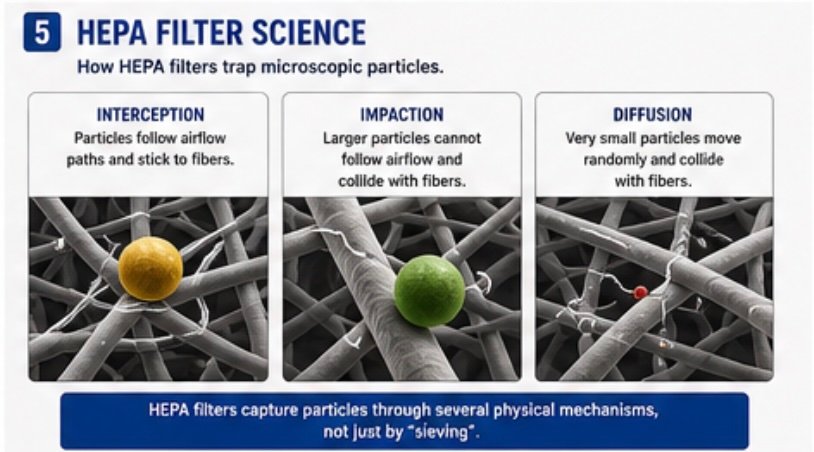
HEPA filters capture particles through several physical mechanisms rather than acting like simple sieves.
What Is a True HEPA Filter?
HEPA stands for High-Efficiency Particulate Air.
To qualify as a genuine HEPA filter, it must meet strict performance standards.
The filter must capture a very high percentage of particles at the Most Penetrating Particle Size (MPPS), approximately 0.3 microns.
This particle size is particularly challenging because it falls between large particles that are easily intercepted and ultrafine particles that are captured through diffusion.
A genuine HEPA filter has undergone testing to verify its efficiency.
HEPA Classifications Explained
H11
Typical efficiency:
95–99%
Suitable for:
- General dust control
- Basic allergen reduction
Often found in budget air purifiers.
H12
Typical efficiency:
99.5%
Provides improved particle removal.
Frequently used in mid-range air purifiers.
H13
Typical efficiency:
99.95%
This is generally considered the sweet spot for residential use.
Benefits include:
- Excellent PM2.5 removal
- Strong allergen filtration
- Effective smoke particle capture
Most high-quality consumer air purifiers now use H13 filters.
H14
Typical efficiency:
99.995%
Often marketed as hospital-grade filtration.
Provides marginally higher efficiency than H13.
However, in real-world residential environments, the performance difference between H13 and H14 is usually much smaller than marketing materials suggest.
Why H14 Is Not Always Better
Many consumers assume H14 must be significantly superior because the number is higher.
However, higher filtration efficiency comes with trade-offs.
A denser filter creates:
- Greater airflow resistance
- Increased fan workload
- Higher power consumption
- Potentially more noise
If airflow decreases significantly, overall room cleaning performance may not improve as much as expected.
Remember:
A filter that captures more particles but processes less air is not necessarily more effective than a slightly less efficient filter moving larger volumes of air.
This is why CADR remains more important than HEPA class alone.
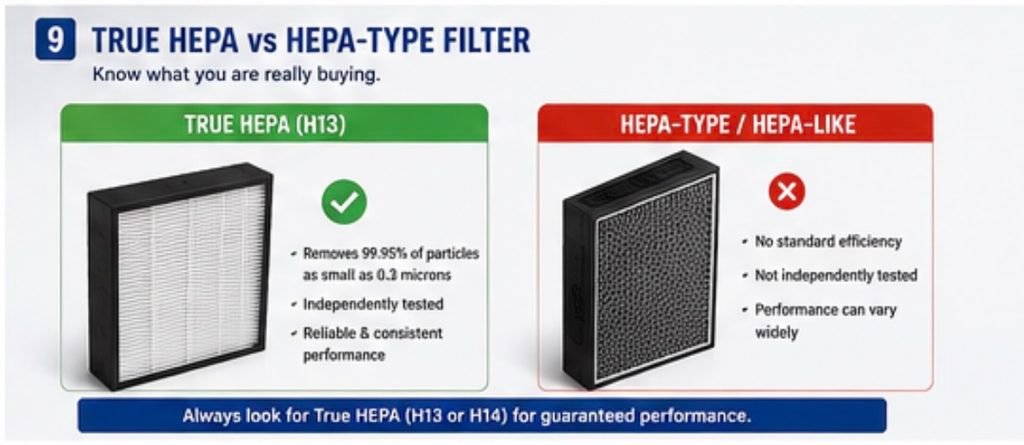
The Truth About HEPA-Type Filters
This is where many consumers get misled.
Terms such as:
- HEPA-Type
- HEPA-Style
- HEPA-Like
are not regulated standards.
Manufacturers can use these phrases even if the filter does not meet true HEPA certification requirements.
Some HEPA-type filters perform reasonably well.
Others fall far short of genuine HEPA performance.
Whenever possible, look for:
- H13 certification
- True HEPA certification
- Independent testing documentation
Marketing language alone should not be trusted.
Ionizers: Helpful Technology or Hidden Risk?
Many air purifiers include ionization technology.
Manufacturers often describe it as:
- Plasma purification
- Negative ion generation
- Electrostatic purification
- Ion-assisted cleaning
The concept sounds appealing.
The purifier releases electrically charged ions into the air.
These ions attach themselves to airborne particles.
As particles become heavier, they are more likely to:
- Fall onto surfaces
- Stick to collection plates
- Be captured by filters
In theory, ionization can improve particle removal.
However, there is a catch.
The Ozone Problem
Some ionization technologies generate ozone as a byproduct.
Ozone is beneficial high in the atmosphere where it blocks ultraviolet radiation.
At ground level, ozone becomes a pollutant.
Exposure may cause:
- Throat irritation
- Coughing
- Chest discomfort
- Breathing difficulty
- Asthma aggravation
Ironically, a device intended to improve air quality may introduce another pollutant.
Modern reputable brands typically maintain ozone production within regulatory limits.
Nevertheless, consumers should be cautious about devices heavily marketed around ionization rather than filtration.
Why HEPA Filtration Remains the Gold Standard
The reason HEPA technology dominates hospitals, laboratories, and clean rooms is simple:
It works consistently.
Unlike ionization:
- It does not depend on particle charging.
- It does not release substances into the air.
- It does not require chemical reactions.
HEPA removes contaminants physically.
That predictability is one reason why filtration remains the preferred approach worldwide.
Why Some Air Purifiers Fail in Indian Homes
A surprising number of buyers report disappointing results after purchasing air purifiers.
In many cases, the purifier is not defective.
The problem lies elsewhere.
Mistake 1: Buying an Undersized Purifier
This is the most common issue.
Consider a living room measuring:
18 × 20 feet
A purifier designed for a small bedroom may be unable to process sufficient air volume.
The result:
- AQI remains high
- Dust accumulation continues
- User assumes purifier is ineffective
The purifier is simply overwhelmed.
Mistake 2: Open Windows
Many people operate air purifiers while keeping windows partially open.
Imagine trying to drain a bathtub while the tap remains fully open.
That is essentially what happens.
Pollution continuously enters while the purifier tries to remove it.
During severe pollution episodes, keeping windows open can drastically reduce effectiveness.
Mistake 3: Ignoring Filter Replacement
Filters are consumables.
Over time they accumulate:
- Dust
- Smoke particles
- Allergens
A clogged filter restricts airflow.
Reduced airflow means reduced cleaning performance.
Many users expect years of operation without maintenance.
That expectation is unrealistic.
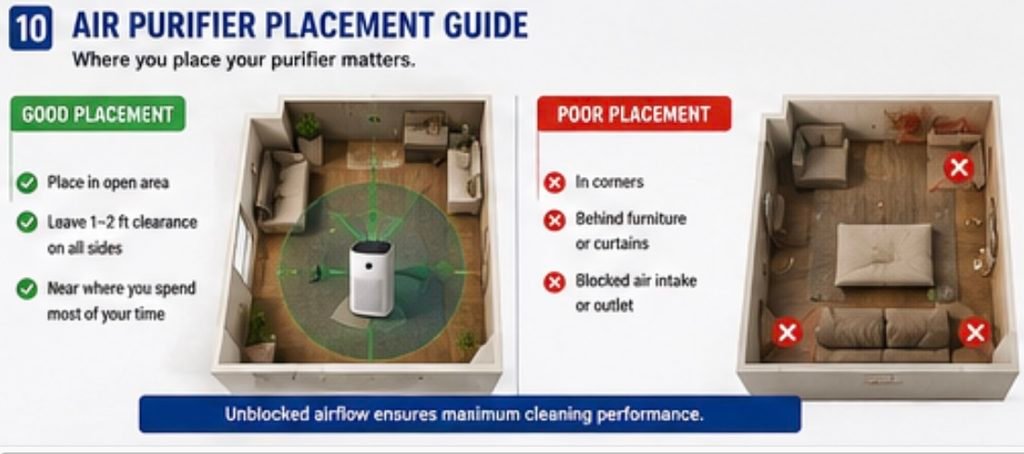
Mistake 4: Poor Placement
Some people place air purifiers:
- Behind curtains
- Under tables
- Inside corners
- Behind sofas
Airflow becomes restricted.
The purifier cannot circulate air effectively.
Ideally, a purifier should have adequate clearance around its intake and exhaust.
The Economics of Air Purifiers
Many buyers focus exclusively on purchase price.
This can be a costly mistake.
The real expense often lies in long-term ownership.
Initial Purchase Cost
Typical pricing in India:
Budget models:
₹5,000–₹10,000
Mid-range models:
₹10,000–₹20,000
Premium models:
₹20,000–₹50,000+
Ultra-premium models:
₹50,000–₹100,000+
Filter Replacement Cost
Most HEPA filters require replacement every:
6–24 months
depending on pollution levels.
Typical replacement costs:
Budget purifier:
₹1,500–₹3,000
Mid-range purifier:
₹3,000–₹6,000
Premium purifier:
₹5,000–₹12,000
Over five years, filter costs can exceed the original purchase price.
This is why filter availability matters.
Buying a cheap purifier from an unknown brand can become problematic if replacement filters disappear from the market.
Electricity Consumption
Fortunately, electricity costs are usually modest.
Most residential air purifiers consume:
20–70 watts
For comparison:
- LED TV: 80–150 watts
- Refrigerator: 100–250 watts
- Air conditioner: 1,000–2,000 watts
Even continuous operation rarely creates a major electricity bill increase.
Five-Year Ownership Example
Assume:
Purifier cost:
₹15,000
Annual filter replacement:
₹4,000
Electricity:
₹1,000 annually
Five-year cost:
Purchase:
₹15,000
Filters:
₹20,000
Electricity:
₹5,000
Total:
₹40,000
This calculation illustrates why buyers should evaluate total ownership cost rather than purchase price alone.
Are Expensive Air Purifiers Worth It?
Sometimes yes.
Sometimes no.
Premium models often justify higher prices through:
- Better CADR
- Quieter operation
- Superior sensors
- Longer filter life
- Better app integration
- Improved build quality
However, paying double does not necessarily produce double the air quality improvement.
The largest performance jump usually comes from moving from a poor purifier to a good purifier.
The difference between a good purifier and a luxury purifier is often much smaller.
The Most Important Buying Rule
If your budget is limited, prioritize:
- Genuine H13 HEPA filtration
- Adequate CADR
- Reliable replacement filters
- Suitable room coverage
before spending extra money on:
- Touchscreens
- Wi-Fi controls
- Voice assistants
- Fancy displays
- Marketing buzzwords
Clean air comes primarily from filtration and airflow—not from smartphone apps.
Part 4: Air Purifiers vs Ventilation, ACs, Plants, and Who Actually Needs One
Air Purifiers vs Ventilation: Which Is More Important?
One of the biggest misconceptions about air purifiers is that they can replace proper ventilation.
They cannot.
In fact, ventilation and air purification solve different problems.
An air purifier removes particles already present in indoor air.
Ventilation replaces stale indoor air with fresh outdoor air.
Think of it this way:
If your room is a swimming pool:
- Ventilation adds fresh water and removes old water.
- Air purification filters contaminants from the existing water.
Ideally, you want both.
The Carbon Dioxide Problem
Many people blame poor air quality when they feel:
- Sleepy
- Tired
- Unfocused
- Headachy
Sometimes the actual culprit is carbon dioxide (CO₂).
When people occupy a closed room for extended periods, CO₂ levels gradually rise.
High CO₂ levels may reduce:
- Concentration
- Alertness
- Cognitive performance
Air purifiers do not remove carbon dioxide.
This is a crucial limitation.
A room may have:
- Excellent PM2.5 levels
- Excellent dust control
yet still feel stuffy because CO₂ concentrations are elevated.
The solution is ventilation.
Not air purification.
Why Ventilation Is Difficult in Polluted Cities
In an ideal world, opening windows would solve the problem.
Unfortunately, many cities face severe outdoor pollution.
Consider a winter day in Delhi NCR:
Outdoor AQI:
350–450
Opening windows introduces fresh oxygen but also introduces large quantities of PM2.5.
This creates a dilemma:
- Better oxygen
- Worse pollution
This is one reason air purifiers became popular in heavily polluted urban areas.
Residents often use:
- Controlled ventilation
- Short-duration window opening
- Air purification
to balance oxygen levels and particle exposure.
Air Purifiers vs Air Conditioners
Another common misunderstanding is that modern air conditioners clean air.
Most do not.
What an Air Conditioner Actually Does
The primary purpose of an air conditioner is:
- Cooling
- Dehumidification
- Air circulation
Most ACs contain only basic dust filters.
These filters primarily protect internal AC components.
They are not designed to remove significant quantities of:
- PM2.5
- Smoke particles
- Allergens
- Fine pollutants
As a result:
A room can be cool and comfortable while still containing unhealthy levels of airborne particles.
What About ACs With Air Purification?
Some premium ACs advertise:
- PM2.5 filtration
- Air purification modes
- Plasma technology
These systems can provide some benefit.
However, they usually have limitations:
- Smaller filtration surface area
- Lower airflow through filters
- Less efficient filtration compared to dedicated purifiers
A high-quality standalone air purifier generally outperforms integrated AC filtration systems.
Air Purifiers vs Indoor Plants
Perhaps no topic generates more confusion than indoor plants.
Many people believe a few houseplants can replace an air purifier.
Unfortunately, science says otherwise.
Where the Myth Came From
The belief originated largely from laboratory studies showing that certain plants could absorb volatile organic compounds (VOCs).
Popular examples include:
- Snake Plant
- Areca Palm
- Peace Lily
- Spider Plant
- Money Plant
Under laboratory conditions, plants demonstrated measurable pollutant reduction.
The problem?
Laboratory conditions are very different from real homes.
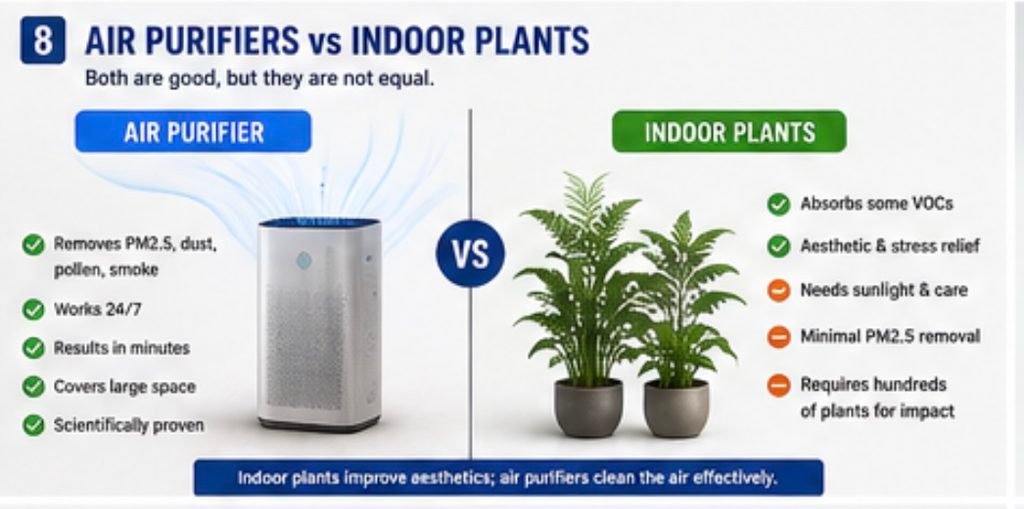
The Real-World Problem
To achieve meaningful air-cleaning performance through plants alone, researchers estimate you would need an impractically large number of plants.
Depending on room size, estimates range from:
50 plants
to
hundreds of plants
for noticeable air-cleaning effects.
That is obviously unrealistic for most households.
What Plants Are Actually Good For
Indoor plants still provide benefits:
- Aesthetic appeal
- Psychological well-being
- Stress reduction
- Humidity moderation
But they should not be viewed as substitutes for air purification.
A ₹10,000 air purifier can process hundreds of cubic meters of air per hour.
A plant cannot.
Air Purifiers in Different Indian Cities
India’s air quality varies enormously.
The need for an air purifier depends heavily on location.
Delhi NCR, Ghaziabad, Noida, Gurugram, Faridabad
This region experiences some of the world’s worst seasonal air pollution.
Major contributors include:
- Vehicular emissions
- Construction dust
- Industrial activity
- Crop residue burning
- Winter temperature inversions
During severe episodes:
AQI frequently exceeds 300–500.
For residents of this region, an air purifier is often a practical health investment rather than a luxury appliance.
Particularly important for:
- Children
- Elderly people
- Asthma patients
- Allergy sufferers
Mumbai
Mumbai generally experiences better air quality than Delhi NCR.
However:
- Traffic corridors
- Industrial zones
- Coastal humidity
- Construction activity
can still create localized air-quality challenges.
Air purifiers are useful, especially for sensitive individuals.
For healthy adults, necessity depends on neighborhood and exposure.
Bengaluru
Bengaluru historically enjoyed cleaner air.
However, rapid urbanization has increased:
- Traffic emissions
- Dust pollution
- Construction-related particulate matter
Air purifiers are increasingly beneficial but not as universally necessary as in Delhi NCR.
Hyderabad
Hyderabad’s air quality generally falls between Bengaluru and Delhi.
Residents near:
- High-traffic roads
- Construction sites
- Industrial areas
may benefit significantly from air purification.
Chennai
Chennai often benefits from coastal air movement.
While pollution exists, severe PM2.5 episodes are generally less frequent than in North India.
Many residents may not require year-round purification.
Tier-2 and Tier-3 Cities
The decision becomes more dependent on local conditions.
Factors include:
- Traffic density
- Nearby industry
- Construction activity
- Seasonal burning
- Local AQI trends
Checking local AQI data for several months is often more useful than relying on national averages.
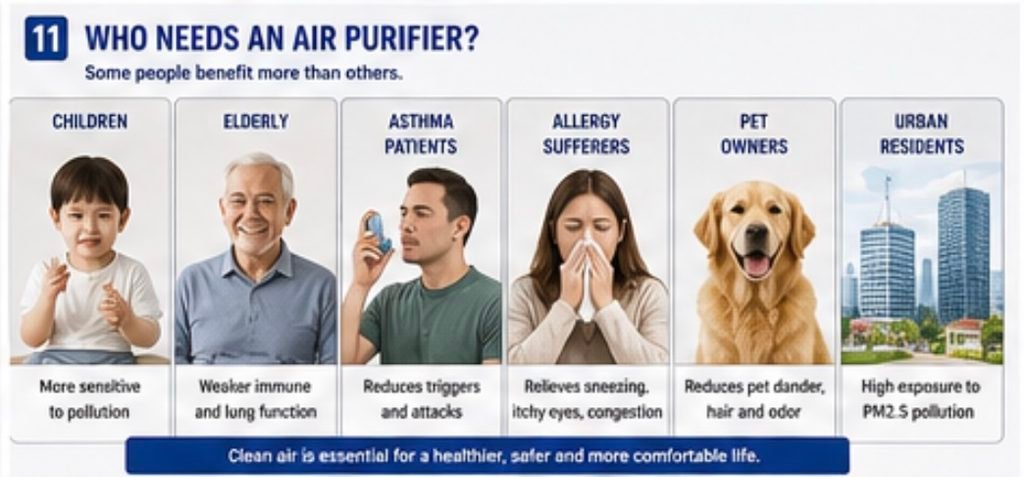
Who Definitely Needs an Air Purifier?
Not everyone needs one.
But certain groups are likely to benefit significantly.
People With Asthma
Airborne triggers can worsen symptoms.
Reducing exposure often improves comfort and quality of life.
Allergy Sufferers
HEPA filtration can substantially reduce:
- Pollen
- Dust mite particles
- Pet dander
- Mold spores
Many allergy sufferers notice improvements within days.
Families With Young Children
Children breathe faster than adults and may be more sensitive to poor air quality.
Reducing pollution exposure during developmental years can be beneficial.
Elderly Individuals
Older adults often have:
- Reduced lung capacity
- Chronic respiratory conditions
- Cardiovascular vulnerabilities
Cleaner indoor air may reduce environmental stressors.
Pet Owners
Cats and dogs continuously shed:
- Hair
- Dander
- Microscopic skin particles
Air purifiers can significantly reduce airborne pet allergens.
People Living Near Major Roads
Traffic generates:
- PM2.5
- Diesel particulates
- Tire wear particles
- Road dust
Homes located near busy roads often experience elevated indoor particle levels.
Homes Near Construction Sites
Construction dust can remain airborne for long periods.
Air purification can dramatically reduce indoor accumulation.
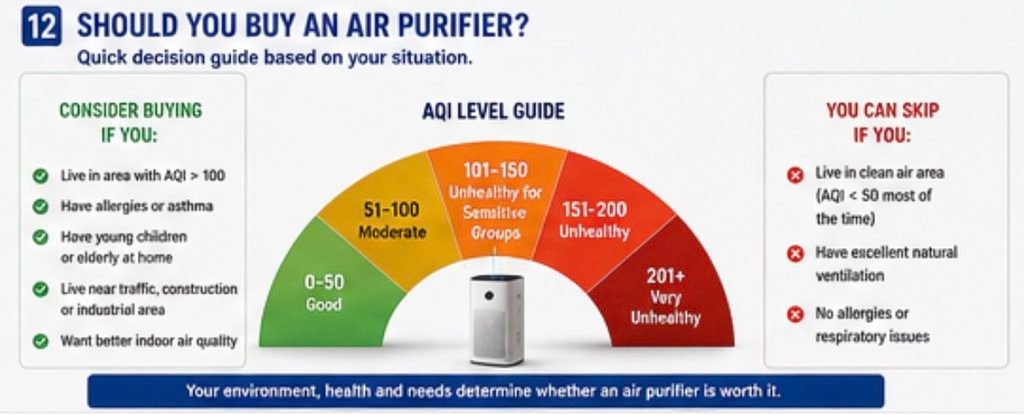
Who Probably Doesn’t Need One?
There are situations where purchasing an air purifier may provide minimal benefit.
People Living in Clean-Air Regions
If outdoor AQI consistently remains:
Below 50
air purification may offer limited measurable improvement.
Homes With Excellent Ventilation and Low Pollution
In some locations, natural ventilation may already provide excellent indoor air quality.
People Expecting Miraculous Health Transformations
An air purifier is not:
- A medical treatment
- A weight-loss device
- An energy booster
- A cure for respiratory disease
It addresses air quality.
Nothing more.
The AQI-Based Buying Rule
A simple framework can help determine whether you need an air purifier.
AQI Below 50
Generally unnecessary.
AQI 50–100
Nice to have but not essential.
AQI 100–150
Worth considering.
AQI 150–200
Recommended.
AQI 200–300
Strongly recommended.
AQI Above 300
Highly recommended, especially for children, elderly individuals, and those with respiratory conditions.
The Most Practical Question
Instead of asking:
“Do air purifiers work?”
Ask:
“Does my indoor air quality need improvement?”
If the answer is yes, a properly sized HEPA air purifier can be one of the most effective tools available for reducing airborne particulate pollution.
The key is understanding both its strengths and its limitations.
Part 5: Final Verdict, Buying Guide, FAQs, and Expert Recommendations
The Final Verdict: Do Air Purifiers Actually Work?
After examining the science, technology, real-world performance, and limitations, we can finally answer the question that brought you here:
Yes, air purifiers work—but not in the way many advertisements suggest.
A properly sized air purifier equipped with a genuine HEPA filter can significantly reduce:
- PM2.5 pollution
- Dust
- Pollen
- Pet dander
- Mold spores
- Smoke particles
Numerous scientific studies and real-world measurements consistently demonstrate substantial reductions in airborne particulate matter when quality air purifiers are used correctly.
However, air purifiers are not magic boxes.
They cannot:
❌ Create oxygen
❌ Eliminate carbon dioxide
❌ Cure asthma
❌ Prevent all infections
❌ Replace ventilation
❌ Clean an entire house from one corner
❌ Instantly make unhealthy environments healthy
The most accurate way to think about an air purifier is this:
It is a pollution reduction device, not a health miracle device.
Just as water filters reduce contaminants in drinking water, air purifiers reduce contaminants in the air you breathe.
The health benefits come from reducing exposure—not from treating disease.
The Single Biggest Determinant of Success
Surprisingly, the most important factor isn’t the brand.
It isn’t the price.
It isn’t even the filter rating.
It is:
Choosing the right purifier for the room size.
A ₹15,000 purifier correctly sized for a room will outperform a ₹50,000 purifier that is undersized.
When selecting an air purifier, CADR and room coverage should always be evaluated before cosmetic features.
The Air Purifier Buying Checklist
Before purchasing, use this checklist.
Must-Have Features
✅ True HEPA or H13 HEPA filter
✅ Adequate CADR for room size
✅ Readily available replacement filters
✅ Activated carbon filter
✅ Low noise levels
✅ Energy-efficient operation
Nice-to-Have Features
✓ AQI display
✓ Auto mode
✓ Smartphone app
✓ Child lock
✓ Timer functions
✓ Filter life indicator
Features That Should Not Influence Your Decision Too Much
✗ Voice assistants
✗ Touchscreen displays
✗ Fancy lighting
✗ Marketing buzzwords
✗ “Medical-grade” labels
✗ AI-powered claims
The quality of air purification depends far more on airflow and filtration than on software features.
How to Calculate the Right Room Size
Many manufacturers exaggerate coverage numbers.
A practical approach is to slightly oversize your purifier.
For example:
Small Bedroom
100–150 sq. ft.
Target CADR:
200–300 m³/h
Medium Bedroom
150–250 sq. ft.
Target CADR:
300–450 m³/h
Large Bedroom or Living Room
250–400 sq. ft.
Target CADR:
450–600 m³/h
Open Living Spaces
400+ sq. ft.
Target CADR:
600+ m³/h
Choosing a slightly larger purifier often allows operation at lower fan speeds, reducing noise while maintaining air quality.
The Five Biggest Mistakes Buyers Make
Mistake #1: Buying Based on Price Alone
The cheapest purifier may become the most expensive if:
- Filters are unavailable
- Performance is poor
- Build quality is weak
Ownership costs matter more than sticker price.
Mistake #2: Ignoring Filter Replacement Costs
Many consumers never check replacement filter prices.
A purifier may cost:
₹10,000
while annual filter replacement costs exceed:
₹5,000
Always evaluate long-term ownership expenses.
Mistake #3: Buying an Oversmart Purifier
Consumers often pay extra for:
- Apps
- Smart assistants
- Cloud features
while neglecting CADR and filtration quality.
A powerful purifier without Wi-Fi is preferable to a weak purifier with advanced software.
Mistake #4: Running the Purifier Only Occasionally
Air pollution is continuous.
Running a purifier for:
30 minutes
then switching it off for the remainder of the day provides limited benefit.
Consistent operation generally produces the best results.
Mistake #5: Expecting Immediate Health Changes
Some buyers expect dramatic transformations within days.
While certain users notice improvements quickly, others experience gradual benefits over weeks or months.
Air purification reduces exposure risk.
It does not guarantee immediate symptom relief.
Is an Air Purifier Worth the Money?
The answer depends entirely on your environment.
Let’s consider three scenarios.
Scenario 1: Delhi NCR During Winter
AQI:
250–500+
Recommendation:
Absolutely worth it.
This is arguably one of the strongest use cases anywhere in the world.
Potential benefits:
- Reduced PM2.5 exposure
- Better sleep quality
- Reduced respiratory irritation
- Lower allergen burden
Scenario 2: Bengaluru Residential Area
AQI:
50–120
Recommendation:
Useful but not essential for everyone.
Particularly beneficial if:
- You have allergies
- You live near traffic
- Construction is nearby
Scenario 3: Small Town With AQI Under 50
Recommendation:
Usually unnecessary.
The money may provide greater value elsewhere.
Air Purifier ROI: Health vs Cost
Unlike smartphones, TVs, or laptops, air purifiers do not provide obvious entertainment value.
Their return on investment comes from risk reduction.
Potential benefits include:
- Lower pollution exposure
- Reduced allergen load
- Improved sleeping environment
- Better indoor comfort
The value becomes particularly apparent for:
- Children
- Elderly individuals
- Asthma sufferers
- Allergy sufferers
For healthy adults in clean-air regions, the return may be far less significant.
Recommendations by User Type
Best Choice for Families
Look for:
- H13 HEPA
- Large CADR
- Low noise
- Affordable filters
Focus on reliability over premium branding.
Best Choice for Asthma and Allergy Sufferers
Prioritize:
- High ACH
- H13 HEPA
- Strong CADR
- Continuous operation
Avoid relying solely on ionization technologies.
Best Choice for Pet Owners
Look for:
- Large pre-filter
- HEPA filtration
- Substantial carbon filter
Pet-related odors and dander require both particle and gas filtration.
Best Choice for Delhi NCR Residents
Prioritize:
- High CADR
- Genuine HEPA filtration
- Easy filter availability
- Strong after-sales support
Filter availability becomes critical during heavy pollution seasons.
Best Choice for Budget Buyers
Spend more on:
- Filtration
- Airflow
Spend less on:
- Displays
- Apps
- Marketing features
Frequently Asked Questions
Should I Keep the Air Purifier Running All Day?
Generally yes.
Continuous operation maintains lower particle concentrations and prevents pollution from accumulating again.
Should I Sleep With an Air Purifier On?
Yes.
Many people place air purifiers in bedrooms because sleep occupies approximately one-third of daily life.
Use sleep mode if noise is a concern.
How Long Does It Take to Clean a Room?
Typically:
20–60 minutes
depending on:
- Room size
- CADR
- Pollution levels
Can Air Purifiers Remove Cooking Smells?
Partially.
The effectiveness depends on the amount of activated carbon present.
HEPA filters alone do not remove odors.
Can Air Purifiers Remove Cigarette Smoke?
They can significantly reduce smoke particles.
Odor removal depends on carbon filtration quality.
Do Air Purifiers Help During Firecracker Season?
Yes.
This is one of their strongest use cases.
Firecrackers generate enormous quantities of PM2.5 particles.
Do Air Purifiers Prevent COVID-19?
No.
However, they can reduce airborne particles that may carry viruses.
They should be viewed as one layer of protection, not a complete solution.
Conclusion
Air purifiers are neither useless gadgets nor miracle machines.
They occupy a practical middle ground.
The science is clear:
A well-designed HEPA air purifier can dramatically reduce indoor airborne particulate pollution.
For people living in heavily polluted cities, households with allergies, asthma sufferers, pet owners, and families with young children, this reduction can be meaningful.
For others living in clean-air environments, the benefits may be smaller and may not justify the ongoing costs.
The smartest question is not:
“Do air purifiers work?”
The evidence shows they do.
The smarter question is:
“Does my indoor air quality need improvement?”
If the answer is yes, few consumer appliances can improve indoor particulate air quality as effectively as a properly selected HEPA air purifier.
In an era where most people spend nearly 90% of their lives indoors, cleaner air may be one of the most overlooked investments in everyday health and comfort.
Final TechZero Rating
Technology Effectiveness: ★★★★★ (5/5)
Marketing Claims Accuracy: ★★★☆☆ (3/5)
Value in Polluted Cities: ★★★★★ (5/5)
Value in Clean-Air Regions: ★★☆☆☆ (2/5)
Overall Verdict: Recommended when indoor air quality is genuinely a problem; unnecessary when it isn’t.