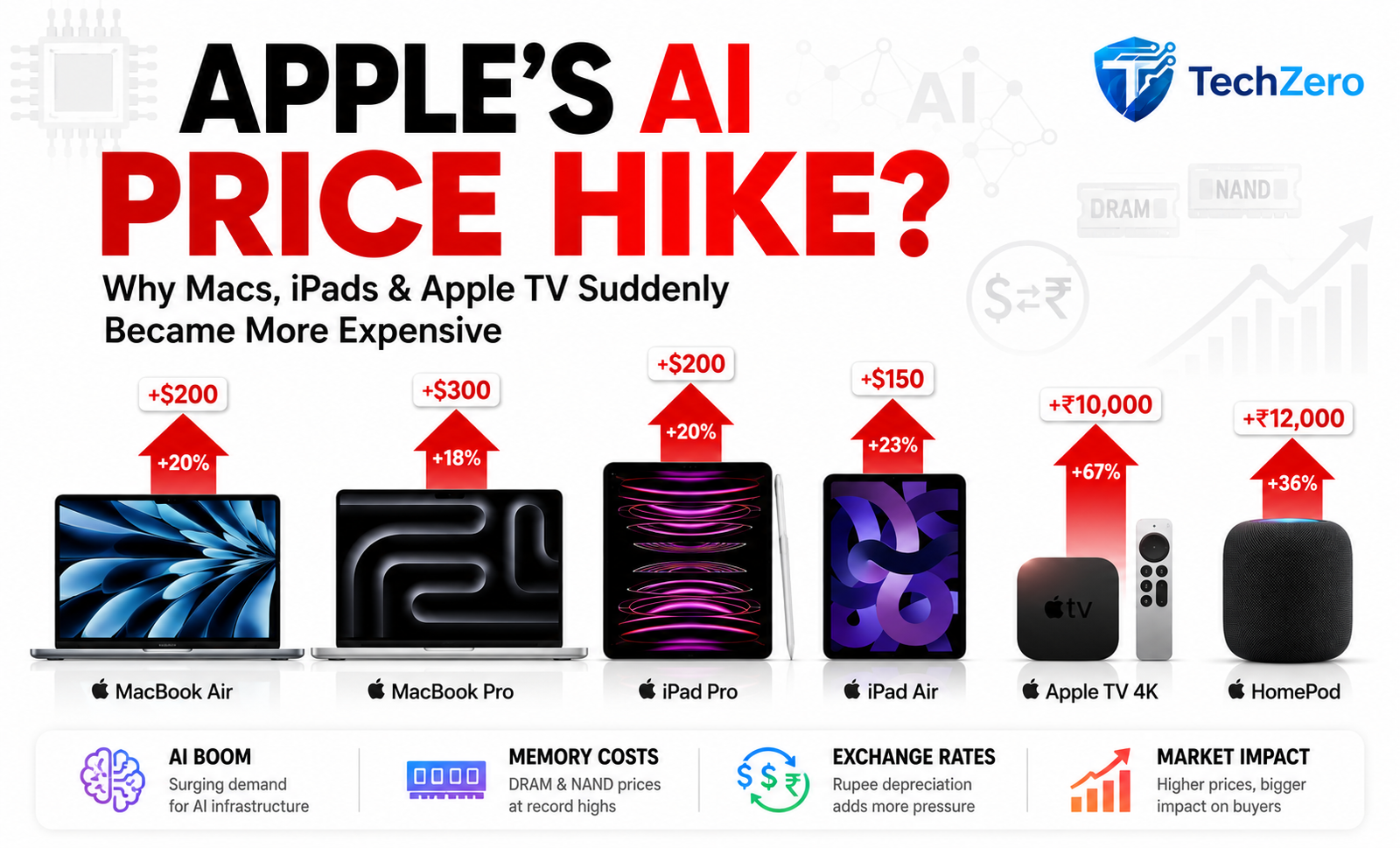
Apple’s Surprise Price Hike Explained: Why Macs, iPads, and Apple TV Suddenly Became More Expensive

Apple has rarely increased product prices in the middle of a product cycle. Traditionally, prices remain unchanged until a new generation launches. That is why yesterday’s announcement caught many consumers completely by surprise.
The company increased prices across several major product categories, including MacBooks, iPads, Apple TV, HomePod, and desktop Macs, citing rapidly rising memory and storage component costs driven by the AI boom. The move is expected to have ripple effects across the broader consumer electronics market and may even signal similar price increases from other manufacturers in the coming months.
If you are planning to buy an Apple product, here is what happened, why it happened, and what it means for you.
Apple Price Increase at a Glance
Note: The table below features base variants and is intended as a quick reference. Individual configurations vary significantly by custom storage and memory configurations.
| Product (Base Variant) | USA (Old → New) | India (Old → New) |
| MacBook Air 13-inch | $999 → $1,199 | ₹1,19,900 → ₹1,49,900 |
| MacBook Pro 14-inch | $1,699 → $1,999 | ₹1,69,900 → ₹2,39,900 |
| iPad Air 11-inch | $599 → $749 | ₹64,900 → ₹89,900 |
| iPad Pro 11-inch | $999 → $1,199 | ₹99,900 → ₹1,39,900 |
| Mac mini | $599 → $799 | ₹59,900 → ₹94,900 |
| iMac | $1,299 → $1,499 | ₹1,34,900 → ₹1,74,900 |
| HomePod | $299 → $399 | ₹32,900 → ₹44,900 |
| HomePod mini | $99 → $129 | ₹10,900 → ₹15,900 |
| Apple TV 4K 64GB | $129 → $199 | ₹14,900 → ₹25,900 |
| Apple TV 4K 128GB | $149 → $249 | ₹16,900 → ₹31,900 |
Why Did Apple Increase Prices?
Unlike previous price revisions that followed new product launches, this sudden increase was driven entirely by surging component costs rather than new hardware introductions.
The single biggest catalyst is the explosive growth of Artificial Intelligence. Companies building massive AI data centers are consuming enormous quantities of DRAM (system RAM) and NAND flash storage—the exact same core components used inside Macs, iPads, and other consumer electronics.
Memory manufacturers are heavily prioritizing these highly lucrative, large-scale enterprise AI server orders. This has created an unprecedented global consumer hardware shortage, pushing raw component prices sharply higher. Apple noted that it has absorbed these compounding costs for months but has finally hit a ceiling where it can no longer shield consumer margins. In short, the global AI infrastructure race is now directly inflating the cost of everyday consumer tech.
Why Were Indian Price Hikes Different From the US?
Many buyers noticed that several products became disproportionately more expensive in India compared to the direct currency conversion of the United States pricing.
Apple’s Indian pricing structure relies on a multi-layered economic funnel. When a global component crisis hits, the local price is heavily amplified by several distinct factors:
- Compounding Input Costs: Soaring global component and assembly expenses.
- Exchange Rate Volatility: Minor macroeconomic shifts and decline between the Indian Rupee (INR) and the US Dollar (USD) require more local currency to purchase globally traded components.
- Import Duties and Logistics: High-volume entry devices are assembled locally, but lower-volume configurations and specialized components remain imported completely built-up (CBU), racking up basic customs duties (BCD).
- Local Taxes: Direct implementation of GST on top of newly inflated base values creates a compounding tax effect.
Because of this multiplier effect, a $200 increase in the US retail price can scale into a far steeper adjustment on Indian storefronts once import overhead and local taxes are mathematically factored in.
Why Did Apple TV See Such a Huge Increase?
One of the biggest surprises of this pricing shift belongs to the Apple TV lineup, where the top-tier 128GB variant practically saw its price double in India.
While Apple typically keeps individual product algorithms private, a mix of volume and supply chain dynamics explains this sudden anomaly:
- Low-Volume Import Dynamics: Unlike select iPhones and iPads which now enjoy regional Indian manufacturing ecosystems, smart home devices like Apple TV and HomePods are imported entirely as CBUs. This subjects them to immediate import tax penalties when global base prices rise.
- NAND Flash Exposure: The Apple TV line packs higher baselines of flash storage relative to its retail price. As NAND costs exploded, the device’s bill of materials grew unsustainably high for its original price point.
- Strategic Repositioning: Apple is intentionally moving away from low-margin competition against budget streaming sticks, effectively anchoring the Apple TV as a premium, long-term ecosystem hub for the smart home.
What Does This Mean for Customers?
For consumers, the immediate impact is plain to see: entering or expanding within the Apple ecosystem has become a significantly more expensive endeavor. However, the long-term effects offer a bit more nuance.
If you already own a relatively recent Mac or iPad, this mid-cycle hike naturally pushes up the baseline value of the secondary market, helping to preserve or even increase the resale and trade-in value of your current device.
For new buyers—particularly students, creative professionals, and first-time platform switchers—these prices change the math entirely. The higher entry barrier will likely encourage buyers to delay non-urgent purchases, rely heavily on educational discounts, or seek value through authorized refurbished channels.
Opportunity for Competitors
Apple’s pricing shift carves out a massive window of opportunity for rival ecosystems to capture value-conscious premium buyers:
- In the Laptop Segment: Premium Windows ecosystems powered by high-efficiency silicon (such as Snapdragon X Elite and Intel Core Ultra architectures) from brands like ASUS, Lenovo, Dell, and HP suddenly look much more competitive against an inflated MacBook lineup.
- In the Tablet Market: Flagship Android tablets from Samsung and Xiaomi now offer incredibly strong value propositions, matching high-refresh displays and included styling pens at a fraction of the new iPad Air and iPad Pro price brackets.
While Apple holds an incredibly high user-retention rate due to its interconnected ecosystem ecosystem, pure hardware pricing remains a critical tipping point for platform-agnostic consumers.
What About Older Inventory?
This is one of the most critical, immediate consequences of the overnight price hike. Third-party retailers, large-format electronics chains, and Apple Premium Resellers do not instantly update the sticker price of devices sitting physically in their godowns and warehouses.
Because these distributors purchased their current stock under Apple’s older wholesale price structures, they have a window of time where they can offer significant competitive advantages. For a brief period, smart buyers can scout these retailers to find existing inventory sold at original MRP rates, potentially saving tens of thousands of rupees before old stocks are depleted and replenishment cycles force them into the new pricing tiers.
Is This a One-Time Event?
Unfortunately, evidence suggests it might not be. Industry tracking analysts project that the AI-driven data center demand tightening our global memory supply could easily persist for several consecutive quarters.
If raw material and component costs stay at these historic highs, other major personal computer and mobile device manufacturers will eventually face the exact same margin squeeze. Apple’s mid-cycle correction serves as an early bellwether, and the company has already signaled that upcoming hardware lines—including future flagship smartphones—could see higher introductory pricing if structural component costs do not ease up by autumn.
Editor’s Take
This price hike is about much more than Apple. For the first time, everyday consumers are directly experiencing the hidden, physical costs of the ongoing artificial intelligence boom.
The exact same high-bandwidth memory chips and storage structures powering global cloud infrastructure, ChatGPT, and Gemini are the exact same physical resources required to build a MacBook, an iPad, or a smart home device. As global tech giants pour billions into securing AI infrastructure, consumer hardware brands are forced to contend with what remains.
If you are planning an Apple purchase in the immediate future, do not panic—but do change your strategy. Cross-reference prices across multiple physical and digital third-party retailers immediately. Sourcing warehouse stock or holding out for upcoming platform promotional sales will be the absolute best way to navigate consumer tech’s new economic reality.