
📌 Quick Summary
- 📖 Reading Time: 18–20 minutes
- 🍏 What You’ll Discover
- Why Apple’s prices keep climbing.
- How the latest price hikes compare with gold, property and stocks.
- What the extra ₹10,000–₹70,000 could buy instead.
- Whether Samsung, OnePlus and others are now better value.
- Why Wall Street gave Apple a 6% “discount.”
- Whether higher component costs really justify the new prices.
- A fun courtroom trial where Apple defends itself before Judge TeeZee.
- TechZero’s final verdict on Apple’s pricing strategy.
Apple Then & Now
How One Apple Discovered Gravity and Another Discovered Premium Pricing
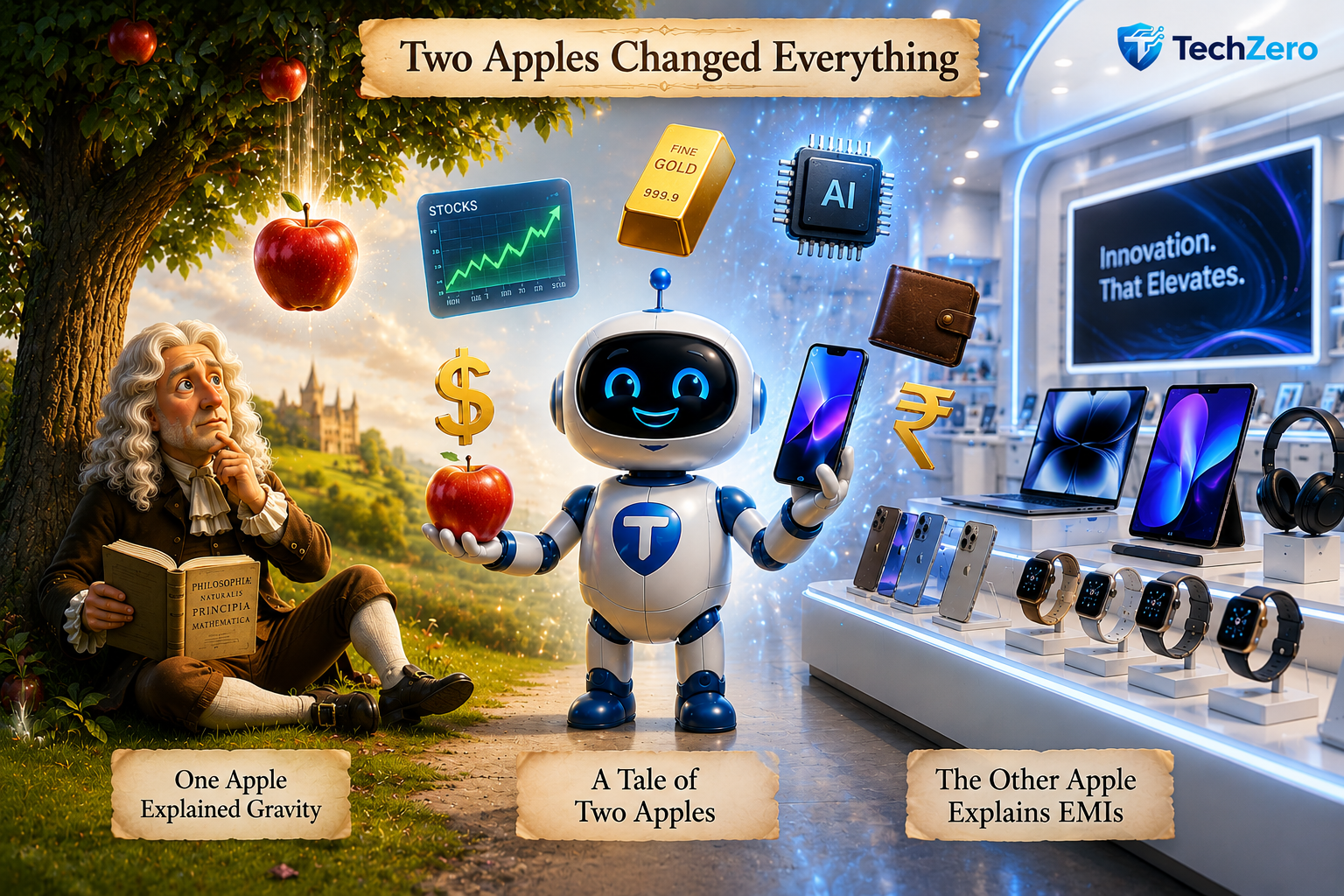
One Apple explained gravity. The other explains EMIs.
Prologue
The Apple That Changed the World… Twice
If Sir Isaac Newton were alive today, he might have to update one of his most famous observations.
“What goes up must come down… except Apple prices.”
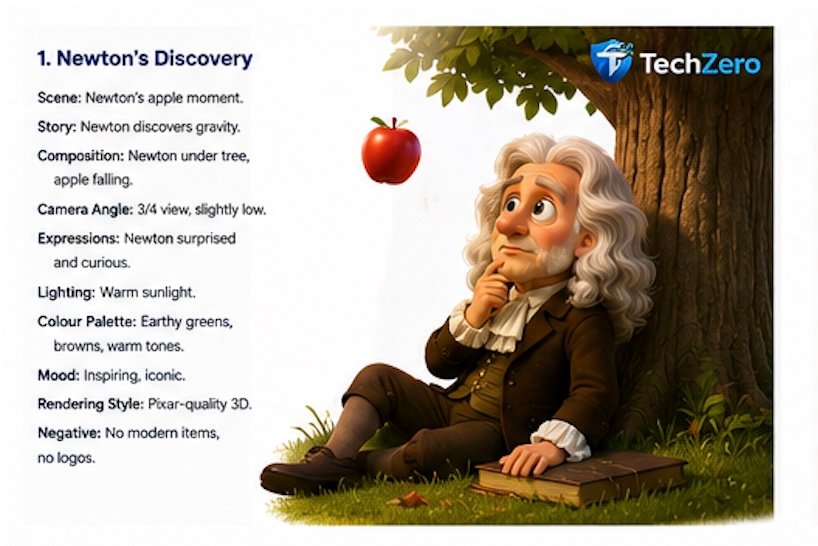
According to the popular legend, an ordinary apple falling from a tree in the 1660s inspired Newton to ask a simple question: Why did it fall downward? That moment eventually helped humanity understand gravity and changed the course of science forever.
Nearly three centuries later, another Apple appeared.
Not hanging from a tree—but born in a modest California garage.
Instead of changing physics, it transformed personal computing, music, smartphones, tablets, smartwatches, and eventually… our monthly budgets.
One Apple taught us why objects fall.
The other taught us why credit card bills rise.
Coincidence?
TeeZee doesn’t think so.
🍏 TeeZee Interrupts
“I checked with Newton.
He confirmed gravity is still free.
Apple pricing isn’t.”
Before we roast Apple, let’s acknowledge something important.
Companies don’t become worth trillions by accident.
Apple didn’t just build great products—it repeatedly reinvented entire industries. The Apple II brought personal computers into homes. The Macintosh made graphical computing mainstream. The iPod changed how we listened to music. The iPhone redefined smartphones. The iPad made tablets a serious computing device. The MacBook became a benchmark that almost every premium laptop was compared against.
Even today, competitors quietly watch Apple’s launch events before planning their next move.
That’s exactly why Apple’s pricing decisions matter.
When Apple moves, the entire industry pays attention.
And over the years, another Apple tradition has become just as predictable as its September launch events.
The products become a little faster.
The cameras become a little smarter.
The chips become dramatically more powerful.
And the prices…
…also discover new heights.
Now, before Apple fans rush to the comments section with “You’re just jealous because you can’t afford one,” let’s make one thing absolutely clear.
This isn’t an Apple hate article.
Quite the opposite.
It’s a light-hearted investigation into one very simple question:
How did an apple that once helped explain gravity become the world’s most expensive fruit?
Over the next few chapters, we’ll compare Apple’s latest price hikes with gold, property, the US dollar, and even Apple’s own stock performance. We’ll calculate what else you could buy with just the amount Apple’s prices have increased, see how Wall Street reacted, examine whether rising costs fully explain the hikes, and, most importantly, have a little fun with the numbers.
Because if Apple can make us smile during a keynote…
…it’s only fair that we return the favour.
Chapter 1
From Newton’s Apple to Apple’s Apple
History has given us several famous apples.
There’s the one associated with Adam and Eve—although, to be fair, the Bible never actually says it was an apple.
There’s Newton’s apple, which inspired one of the greatest scientific discoveries in history.
And then there’s Apple Inc.—the company that somehow convinces millions of perfectly happy people that last year’s perfectly good gadget suddenly feels ancient.
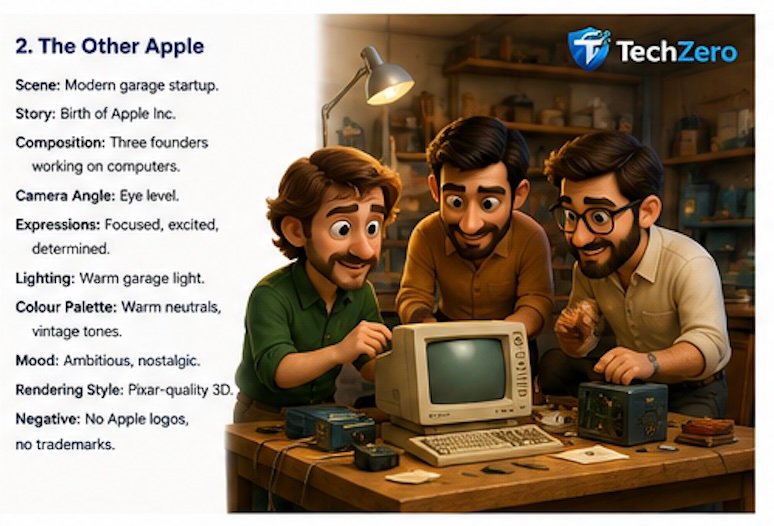
Founded in 1976 by Steve Jobs, Steve Wozniak, and Ronald Wayne, Apple started with a simple ambition: build computers that ordinary people could actually use.
The rest is technology history.
The Apple II brought personal computers into the mainstream.
The Macintosh introduced graphical computing to everyday users.
The iPod put a thousand songs in your pocket.
The iPhone put an entire computer there.
The iPad created a product category people didn’t know they wanted until they had one.
The MacBook became the laptop many competitors quietly benchmarked against.
Apple didn’t just build products.
It built expectations.
Today, when almost any flagship smartphone launches, one question inevitably follows:
“But how does it compare with the iPhone?”
Very few companies ever achieve that level of influence.
Apple earned it through years of relentless innovation, thoughtful design, and an ecosystem that works so well many users couldn’t tell you their Wi-Fi password—but can explain in great detail why every Apple product “just works.”
Influence, however, often comes with confidence.
And confidence occasionally sounds like this:
“That’ll be another ₹10,000.”
Then vs Now
| Newton’s Apple | Apple Inc. |
|---|---|
| Fell from a tree | Arrives in a beautifully designed box |
| Explained gravity | Explains why your bank balance feels lighter |
| Free | Premium |
| Inspired scientific discovery | Inspires upgrade decisions |
| Changed physics | Changed consumer technology |
| One apple changed the world | The other changes your monthly budget |
🍏 TeeZee’s Observation
“Newton spent years proving gravity exists.
Apple proves it every launch event.
Just watch everyone’s wallets drop.”
The remarkable thing is that neither Apple is ordinary.
One changed the way humanity understands the universe.
The other changed the way humanity shops for technology.
Only one of them, however, politely asks whether you’d also like to add AppleCare before checking out.
And that’s where our real investigation begins.
Before we examine the latest price hikes, let’s find out whether Apple products have started appreciating faster than some of the world’s most popular investments.
Chapter 2
The Best Performing Investment Wasn’t Supposed to Be a Gadget
When people want to protect their money from inflation, they usually buy one of four things.
Gold.
Real estate.
Stocks.
Or, if they’re feeling adventurous, a few US dollars.
Nobody has ever walked into a financial advisor’s office and confidently said,
“I’d like to diversify my portfolio with an iPhone, please.”
And yet, thanks to Apple’s latest round of price increases, that’s exactly what it feels like.
So, we decided to run an entirely unnecessary—but surprisingly interesting—experiment.
The TechZero Investment Challenge
Imagine you had ₹10,000 six months ago.
Where would it have grown the most?
| Investment | Typical Outcome |
|---|---|
| 🥇 Gold | Depends on the market |
| 🏠 Property | Usually appreciates slowly |
| 📈 Stock Market | Can go up or down |
| 💵 US Dollar | Depends on the exchange rate |
| 🍎 Apple Product | Depends on Apple’s next launch event |
Not exactly a comparison Warren Buffett would approve of…
…but let’s continue anyway.
Gold Has Inflation.
Apple Has Keynotes.
Gold becomes expensive because of global uncertainty.
Property appreciates because land is limited.
Stocks move because businesses perform well.
Currencies fluctuate because of economic conditions.
Apple products?
Sometimes they become more expensive simply because a keynote presentation ended.
It’s probably the only product launch where millions of people clap…
…while unknowingly volunteering to spend more money.
🍏 TeeZee’s Market Update
“Gold investors watch global markets.
Apple fans watch September.”
Let’s Compare the Numbers
Over the next few sections, we’ll compare the latest Apple price revisions with:
- 📱 iPhone
- 💻 MacBook
- 📟 iPad
- ⌚ Apple Watch
- 🎧 AirPods
Against:
- 🥇 Gold prices
- 💵 USD–INR exchange rate
- 🏠 Residential property trends
- 📈 Apple’s own stock performance
Not to prove that Apple products are better investments than gold.
That would be ridiculous.
We’re simply asking a much funnier question:
Has Apple increased its prices faster than some of the world’s most popular assets have appreciated?
The answer, as you’ll soon see…
…might surprise even long-time Apple fans.
Chapter 3
Apple’s Newest Feature Is… Higher Prices.
Every Apple launch follows a familiar script.
The CEO walks onto the stage.
The audience applauds.
A faster chip is announced.
A brighter display is unveiled.
Artificial Intelligence gets mentioned approximately every 37 seconds.
Then comes the moment everyone pretends not to worry about.
The price.
Sometimes it stays the same.
Sometimes it quietly climbs.
And sometimes it climbs so much that your existing Apple device suddenly starts whispering,
“You know… I’m still working perfectly fine.”
Meet the Price Hike Hall of Fame
Let’s look at how much extra buyers are now expected to pay.
(All figures below compare previous official launch prices with the latest announced prices. Regional taxes and exchange rates may cause slight differences.)
| Product | Previous Price (US) | Latest Price (US) | Increase (USD) | Approx. Increase (₹) | % Increase |
|---|---|---|---|---|---|
| iPhone | — | — | No Change | — | 0% |
| MacBook Air | $1,099 | $1,299 | $200 | ≈ ₹30,000 | 18.2% |
| MacBook Pro | $1,699 | $1,999 | $300 | ≈ ₹45,000 | 17.7% |
| iPad | $349 | $449 | $100 | ≈ ₹10,000 | 28.7% |
| iPad Air | $599 | $749 | $150 | ≈ ₹25,000 | 25.0% |
| iPad Pro | $999 | $1,199 | $200 | ≈ ₹40,000 | 20.0% |
| Apple Watch | — | — | No Change | — | 0% |
| AirPods | — | — | No Change | — | 0% |
At first glance, these numbers don’t look frightening.
Then you realise something.
You’re not paying ₹10,000 more for a better phone.
You’re paying ₹10,000 more just to reach the same starting point.
That’s a very expensive starting line.
🍏 TeeZee’s Price Check
“Apple didn’t add ₹10,000 worth of excitement.
It simply moved the entrance gate ₹10,000 further away.”
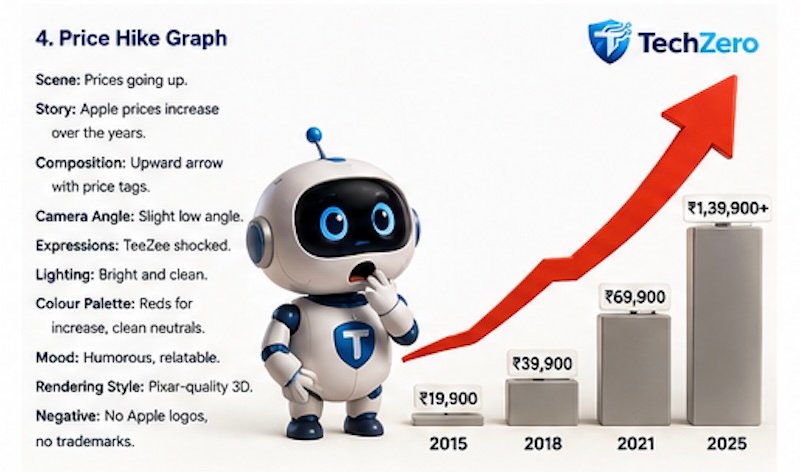
The Silent Upgrade
What’s fascinating isn’t that Apple increases prices.
Almost every company eventually does.
What’s fascinating is how quietly it happens.
No launch event says,
“Introducing…
the same storage…
but ₹8,000 more.”
Instead, the presentation focuses on:
✔ Better cameras
✔ Faster chips
✔ Longer battery life
✔ New colours
By the time the price appears on screen…
…everyone is still clapping.
It’s one of the greatest magic tricks in consumer technology.
Distract the audience with innovation.
Then casually update the price tag.
The ₹50,000 Question
Here’s the real question.
When Apple increases the price of a product by ₹10,000…
What exactly is that ₹10,000 buying you?
A better chip?
Better cameras?
Tariffs?
Higher manufacturing costs?
Inflation?
Or simply…
the privilege of buying the latest Apple product?
We’ll answer that in a later chapter.
But before we do…
let’s ask an even more painful question.
What Else Could You Buy With Just the Price Increase?
Not the phone.
Not the MacBook.
Not the iPad.
Just the amount Apple added to the bill.
The answers are equal parts hilarious…
…and financially concerning.
Chapter 4
The Price Increase Shopping Challenge
Let’s play a game.
Imagine you walked into an Apple Store planning to buy your dream device.
The salesperson smiles.
You smile back.
Everything is going perfectly.
Then comes the bill.
You suddenly discover that the latest version costs ₹10,000 (or more) than the previous one.
Now imagine Apple gave you a choice.
“Instead of paying the extra ₹10,000… would you like to buy something else?”
Now things become interesting.
If Your iPhone Became ₹10,000 More Expensive…
Instead of paying just the increase, you could buy things like:
📱 A complete budget Android smartphone
🎧 Premium wireless earbuds
⌚ A capable smartwatch
📖 A Kindle e-reader
🧹 A robot vacuum’s first EMI
🎮 A PS5 DualSense controller—with money left over for a game
✈️ A one-way flight between many Indian metro cities (if you book smartly)
🍕 Enough pizzas to keep your entire family happy for a weekend.
Suddenly…
that ₹10,000 doesn’t look so small anymore.
🍏 TeeZee’s Suggestion
“Congratulations!
Your iPhone now costs one Android phone more.”
If the MacBook Costs ₹50,000 More…
That’s not just a number.
That’s almost an entire home-office upgrade.
With that money, you could buy:
🖥️ A high-quality 27-inch monitor
⌨️ A premium mechanical keyboard
🖱️ A flagship wireless mouse
💺 A comfortable ergonomic office chair
🎧 Noise-cancelling headphones
Or…
buy all the accessories you’ve been postponing for months.
Ironically…
they’ll probably be used with your MacBook.
If the iPad Gets Pricier…by upto 70,000
Here’s what the increase alone could buy.
✔ A complete Android tablet
✔ A year’s worth of digital subscriptions
✔ A student study setup
✔ A decent office chair
✔ A family weekend getaway
It’s amazing how quickly “just a little increase” becomes a significant purchase.
AirPods and Apple Watch?
These usually receive smaller price adjustments.
But even ₹3,000–₹5,000 can pay for:
☕ Months of coffee
🍿 Several movie nights
📚 Books you’ve been meaning to read
🚌 Your daily commute for weeks
📱 A year’s worth of mobile recharge for many users
Amazing how “small amounts” stop feeling small when you spend them elsewhere.
The Psychology of Premium Pricing
Here’s the clever part.
Most of us don’t compare today’s price with last year’s price.
We compare today’s price with the total amount we’re already prepared to spend.
If you’ve mentally decided to spend ₹1,20,000 on a phone…
another ₹8,000 doesn’t feel like much.
Apple understands this better than almost any company.
The increase doesn’t look huge…
because it’s hidden inside an already expensive purchase.
That’s called price anchoring, and Apple has mastered it.
🍏 TeeZee Explains Marketing
“If I ask you for ₹10,000…
you’ll probably say no.
If I ask you for ₹1,39,900 instead of ₹1,29,900…
somehow it feels acceptable.
That’s marketing.
And maybe a little bit of magic.”
But Here’s the Bigger Question…
What if…
instead of paying Apple’s higher price…
you simply bought something else?
Would you actually lose much?
Or has the competition finally become good enough to challenge Apple?
Let’s put Apple’s biggest rivals on the stage and find out.
Chapter 5
The Apple Escape Plan – Meet the Gadgets Trying to Save Your Wallet
Congratulations.
You’ve reached the part of the article where Apple users become slightly uncomfortable.
Not because we’re about to insult Apple.
We’ve already done plenty of that.
But because we’re about to ask a question many Apple users avoid like software update notifications.
“Do you actually have alternatives?”
Short answer?
Absolutely.
Long answer?
Let’s invite them on stage.
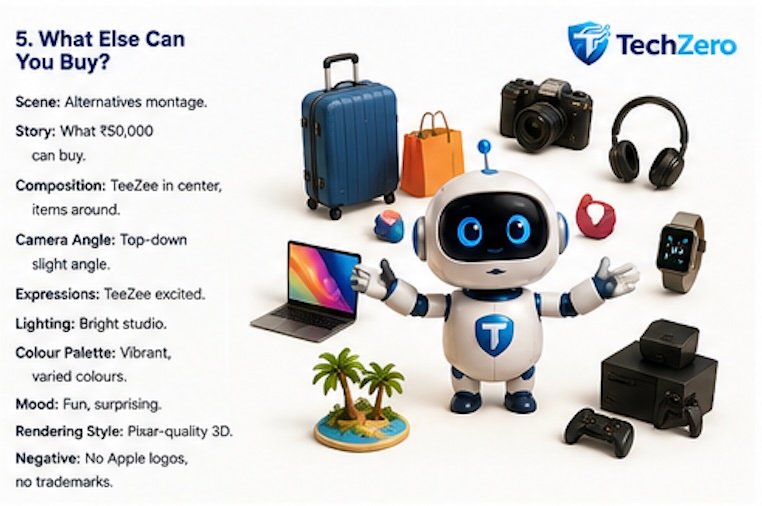
🎤 First Up: Samsung
Samsung walks onto the stage wearing a tailored suit.
Confident.
Experienced.
And carrying a presentation titled:
“I’ve been competing with Apple since before it was fashionable.”
Samsung clears its throat.
“I make flagship phones.”
“I make premium tablets.”
“I make smartwatches.”
“I even make displays…
…for Apple.”
The audience murmurs.
Apple quietly pretends not to hear that last line.
TeeZee’s Verdict
“Samsung is like that neighbour who keeps saying,
‘Nice house…
I built the windows.'”
🎤 Next Comes OnePlus
OnePlus doesn’t walk.
It sprints.
It plugs a phone into the charger.
Walks away.
Returns twenty minutes later.
Battery: 100%.
The Apple users in the audience collectively gasp.
OnePlus smiles.
“No offence…
I just had some time.”
TeeZee’s Verdict
“OnePlus charges batteries.
Apple charges customers.”
🎤 Honor Enters Quietly
Honor doesn’t make a dramatic entrance.
It simply places one of its tablets on the table.
Everyone looks.
Looks again.
Checks the price.
Looks again.
Then someone whispers,
“Wait…
That’s all it costs?”
Honor says nothing.
Sometimes silence is excellent marketing.
🎤 Microsoft Surface
Surface arrives carrying Excel.
PowerPoint.
Word.
Teams.
Three spreadsheets.
A company laptop.
And a corporate ID card.
It doesn’t even try to impress students.
It walks straight toward office workers.
“Let’s finish that presentation.”
Apple users suddenly remember Monday morning exists.
TeeZee’s Observation
“Buying a Surface for Excel makes as much sense as buying hiking shoes for trekking.
Buying a MacBook for Excel…
well…
depends how much you enjoy aluminium.”
🎤 ASUS, Lenovo and Dell
These three refuse individual introductions.
Together they announce,
“Whatever your budget is…
we probably already built something for it.”
Gaming?
Done.
Engineering?
Done.
Video editing?
Done.
Budget laptops?
Done.
Twenty-seven confusing model names?
Also done.
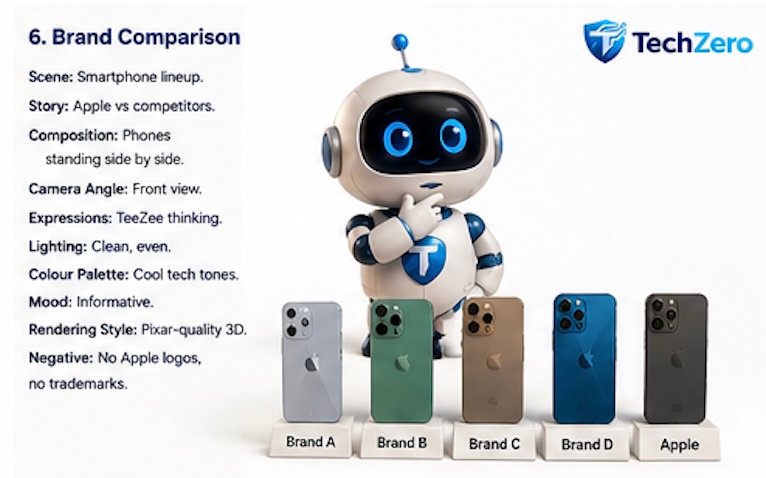
🎤 Nothing
Nothing walks onto the stage.
Literally glowing.
Transparent.
Minimalist.
Looking like it escaped from a science-fiction movie.
It doesn’t say much.
It simply stands there looking expensive…
while costing considerably less.
Marketing teams everywhere applaud.
The Plot Twist
Five years ago…
choosing Apple often meant getting a noticeably better experience.
Today?
The gap is still there.
But it isn’t the Grand Canyon anymore.
It’s more like stepping across a small stream.
Apple still wins in ecosystem integration.
MacBooks still have phenomenal battery life.
The Apple Watch remains the best companion for an iPhone.
The iPad continues to set the benchmark for premium tablets.
But Samsung has caught up.
OnePlus has matured.
Honor has become surprisingly competitive.
Windows laptops are better than they’ve ever been.
And Android…
well…
Android finally stopped trying to become iOS.
It became comfortable being Android.
🍏 TeeZee’s Reality Check
“The biggest reason people stay with Apple isn’t because they can’t leave.
It’s because leaving means explaining to friends why the blue bubbles disappeared.”
So…
Should You Switch?
Maybe.
Maybe not.
If you’re deeply invested in Apple’s ecosystem, switching isn’t just replacing one gadget.
It’s changing habits.
It’s learning new shortcuts.
It’s finding alternatives to AirDrop.
It’s saying goodbye to iMessage.
For many people, that’s simply not worth the effort.
And Apple knows it.
That’s the real power of the ecosystem.
Not that it’s impossible to leave.
Just that it’s wonderfully inconvenient.
Which brings us to an even bigger question.
If Apple is charging more…
and competitors are getting closer…
what did investors think about all this?
Because while customers debated whether to upgrade…
Wall Street was busy erasing hundreds of billions of dollars from Apple’s valuation.
Let’s do the maths.
Chapter 6 – Apple Charged Customers More…
Wall Street Responded With a 6% Discount.
Apple increased prices.
Customers frowned.
Wall Street frowned even harder.
On June 25, 2026, Apple announced price increases across several products—including MacBooks, iPads, HomePod, Apple TV, and Vision Pro—citing soaring memory and storage chip costs.
The market’s response was… less enthusiastic.
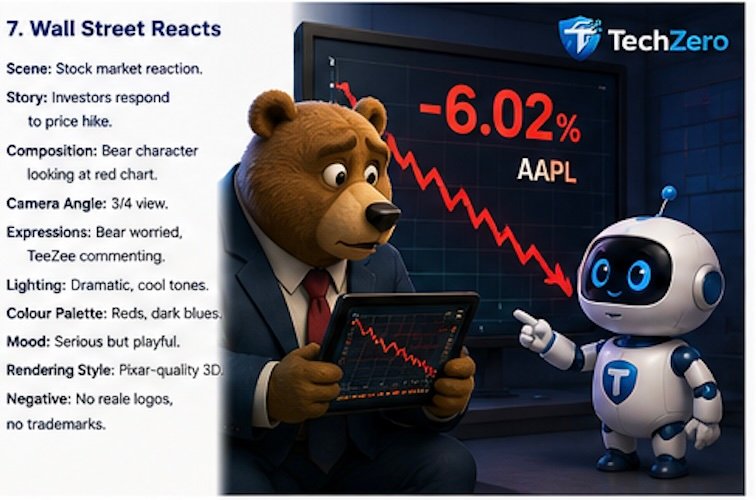
Apple’s stock closed 6.1% lower, its sharpest single-day decline in more than a year. While several factors weighed on technology stocks that day, Apple’s higher pricing added to investor concerns that customers might delay upgrades or simply decide to keep their existing devices a little longer.
Apparently, convincing customers to spend more is easier than convincing investors they’ll happily do it.
Wait…
Normally, companies raise prices because investors love higher profits.
Apple tried exactly that.
Wall Street’s response?
“We’re not convinced.”
Customers looked at the announcement and asked,
“Can I still afford this?”
Investors looked at the very same announcement and asked,
“Will everyone else still buy it?”
Same event.
Two completely different panic attacks.
🍏 TeeZee’s Wall Street Lesson
“Apple raised product prices by a few hundred dollars.
Wall Street replied,
‘Here’s a 6% discount on your company.'”
Six Percent Doesn’t Sound Scary…
…until you remember we’re talking about Apple.
When your mutual fund drops 6%, you complain.
When one of the world’s most valuable companies drops 6%, business news channels suddenly have enough material for the entire week.
A decline of around six percent translated into hundreds of billions of dollars being wiped from Apple’s market value in a single trading session.
That’s roughly:
- More than ₹20 lakh crore.
- Larger than the annual GDP of several countries.
- Enough money to buy millions of MacBooks.
- Or enough to make every finance journalist cancel their evening plans.
Thankfully for Apple, that money didn’t disappear from Tim Cook’s bank account.
Market value simply reflects what investors collectively believe a company is worth at a particular moment.
When confidence falls…
valuation follows.
Let’s Do Some Completely Unnecessary Maths
Now for the part every finance professor secretly hates.
Let’s assume, purely for illustration, that Apple earns around $500 in gross profit on a flagship iPhone.
To generate profits equivalent to hundreds of billions of dollars in lost market value, Apple would need the equivalent of selling:
Well over 500 million flagship iPhones.
That’s roughly:
📱 More iPhones than the combined population of the United States and Canada.
📱 More than the entire population of the European Union.
📱 Enough iPhones that charging them all at once would probably require a dedicated power grid.
Of course, that’s not how stock markets work.
Apple doesn’t recover market value by selling half a billion iPhones the next morning.
But it does show just how enormous Wall Street’s reactions can be when expectations change.
The Funny Part?
Customers complained because Apple wanted an extra ₹10,000.
Investors complained because Apple might not get that extra ₹10,000 from enough customers.
One group worried about spending money.
The other worried about Apple making enough money.
Different concerns.
Same headache.
🍏 TeeZee’s Final Observation
“One group refreshed Apple’s online store.
The other refreshed the stock market.
Somehow…
neither liked what they saw.”
So…
Who was right?
Were Apple’s higher prices an unavoidable consequence of soaring memory-chip costs?
Or did Apple simply use rising component costs as an opportunity to widen its already healthy margins?
Let’s separate the facts from the fan theories.
Chapter 7 – The Trial of Apple
Did Apple Really Need to Raise Prices?
Case Number: TZ-2026-001
The People vs. Apple Inc.
Charge:
Charging customers extra for products they were probably going to buy anyway.
The courtroom is packed.
Customers occupy the left side.
Shareholders sit on the right.
Tech YouTubers are livestreaming from outside.
Somewhere in the back row…
Android users are trying very hard not to smile.
Judge TeeZee enters.
Apple’s legal team arrives carrying a shiny MacBook.
The prosecution arrives carrying last year’s price list.
“Court is now in session.”
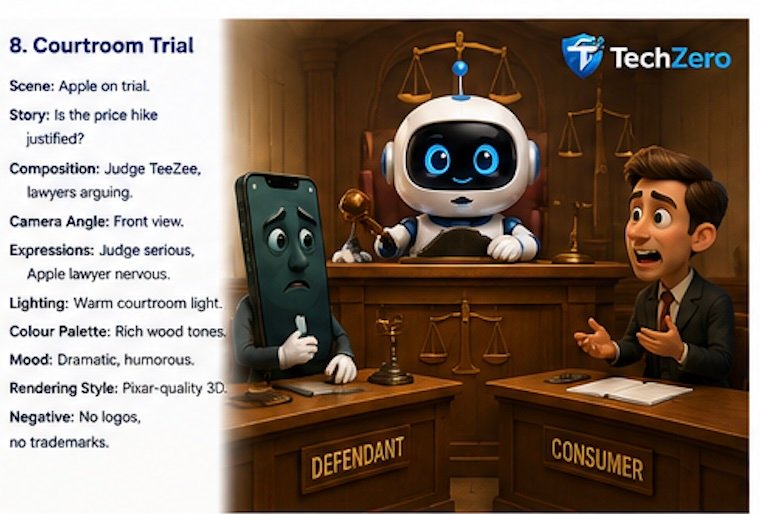
Exhibit A
The Memory Chip Defence
Apple’s lawyers stand up.
“Your Honour…
memory prices genuinely increased.”
They’re right.
During 2025 and 2026, the prices of NAND flash storage and DRAM memory rose sharply as AI servers, cloud providers and data centres competed for the same memory chips used in consumer electronics.
Apple wasn’t buying potatoes.
It was buying millions of cutting-edge memory chips.
Those chips genuinely became more expensive.
Judge TeeZee
“Accepted.
Memory prices went up.
Continue.”
Exhibit B
The AI Bill
Apple calls its second witness.
Artificial Intelligence.
Apple’s lawyers continue.
“We’ve committed billions of dollars to AI infrastructure, Apple Intelligence, silicon development, software and cloud computing.”
Fair point.
Artificial Intelligence isn’t just software.
Behind every AI feature sits an enormous amount of infrastructure.
It requires:
- Advanced silicon
- Massive cloud infrastructure
- Machine-learning engineers
- Data centres
- Years of research and development
None of that comes cheap.
Eventually, those investments have to pay for themselves.
Judge TeeZee
“Also accepted.
AI may be intelligent.
It certainly isn’t inexpensive.”
Exhibit C
Inflation Takes the Stand
Apple calls its third witness.
Inflation.
Inflation slowly walks to the witness stand…
looking slightly more expensive than last year.
Manufacturing costs have risen.
Shipping costs have risen.
Energy costs have risen.
Labour costs have risen.
Inflation affects almost every industry.
Apple isn’t immune.
Judge TeeZee
“Reasonable.
Proceed.”
Cross-Examination
The prosecution finally rises.
“Your Honour…
Samsung buys memory chips.
Lenovo buys memory chips.
ASUS buys memory chips.
Dell buys memory chips.
Almost everyone buys memory chips.
Yet somehow…
Apple’s products became the headline.”
The courtroom falls silent.
Apple’s lawyer smiles.
“Yes.
But none of them are Apple.”
The jury quietly nods.
Whether they like it or not…
that answer carries weight.
The Million-Dollar Answer
This is where economics enters the courtroom.
Not every company enjoys the same pricing power.
Pricing power is the ability to increase prices without losing a significant number of customers.
Apple has spent nearly five decades building exactly that.
Its ecosystem.
Its software.
Its retail stores.
Its customer support.
Its resale value.
Its long-term software updates.
Its brand.
Together, they create something that accountants call pricing power…
and customers simply call trust.
That trust allows Apple to charge more than many competitors while still selling millions of devices.
That’s not greed.
That’s pricing power.
🍏 TeeZee’s Business Lesson
“The Apple ecosystem doesn’t lock the door.
It just makes moving out feel like shifting an entire house.”
Closing Arguments
The prosecution says:
“Apple increased prices because it knew we’d pay.”
Apple replies:
“Our costs genuinely increased.”
Both statements contain some truth.
Memory became more expensive.
AI infrastructure became more expensive.
Manufacturing costs increased.
Global supply chains remain under pressure.
At the same time…
Apple also possesses something very few companies in the world have earned.
The confidence to ask for more.
And millions of customers willing to say,
“Fine.”
The Verdict
Judge TeeZee adjusts his glasses.
The courtroom falls silent.
After reviewing all the evidence, the court reaches the following verdict.
❌ Apple is not guilty of inventing higher memory prices.
❌ Apple is not guilty of causing inflation.
❌ Apple is not guilty of making AI infrastructure expensive.
✅ Apple is guilty…
…of knowing exactly how much its customers are willing to pay.
Sentence
- Continue making world-class products.
- Continue charging premium prices.
- Continue giving Android users something to debate every September.
- Continue reminding economists that branding can be just as powerful as technology.
Court adjourned.
Conclusion
From Gravity to Pricing Power
When a young Isaac Newton saw an apple fall from a tree, he asked a question that changed science forever.
“Why did it fall?”
Nearly three centuries later, another Apple made the world ask a very different question.
“Why does it cost so much?”
Between those two questions lies one of the greatest business stories ever told.
Over the last few chapters, we’ve followed Apple’s journey from a garage startup to one of the world’s most valuable companies. We’ve compared its price hikes with gold, property and Wall Street, calculated what else you could buy with the extra money, listened to both customers and investors, and even put Apple on trial.
So, what did we discover?
Apple didn’t raise prices for one single reason.
Memory chips genuinely became more expensive.
AI infrastructure requires billions of dollars in investment.
Manufacturing, logistics and global supply chains continue to add pressure.
Those are real costs.
But that’s only half the story.
The other half is something economists call pricing power.
Apple has spent nearly five decades building products that millions of people trust, an ecosystem that works remarkably well, and a brand that many customers willingly pay a premium for.
That’s not luck.
It’s not magic.
And it’s certainly not an accident.
The question isn’t whether Apple can charge more.
The real question is whether you believe the extra price is worth paying.
For some people, the answer will always be yes.
For others, today’s Samsung, OnePlus, Honor, ASUS, Lenovo, Dell and Microsoft devices offer excellent alternatives at more approachable prices.
Neither choice is wrong.
Technology is personal.
The best gadget isn’t necessarily the most expensive one.
It’s the one that fits your needs, your budget and the way you use it every day.
🍏 TeeZee’s Final Thought
“Buy the device that makes your life easier.
Not the one that makes your EMI longer.”
If Newton were alive today, he probably wouldn’t be studying falling apples anymore.
He’d be studying Apple’s pricing strategy.
After all, gravity explains why apples fall.
Pricing power explains why their prices don’t.
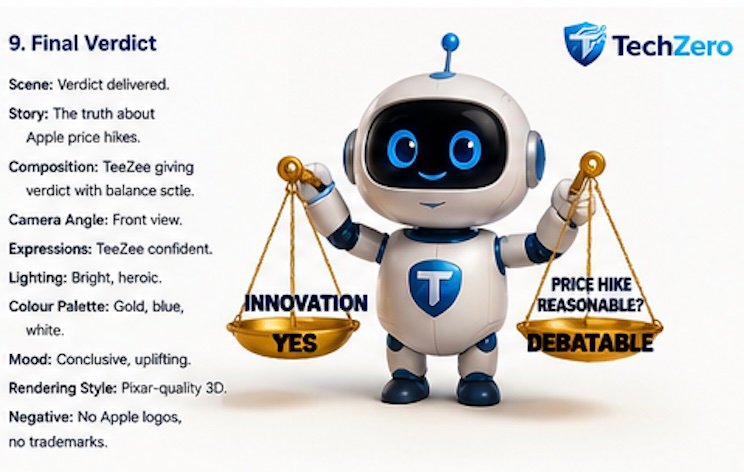
TechZero’s Verdict
Apple isn’t guilty of making great products.
Apple isn’t guilty of building one of the strongest technology ecosystems ever created.
Apple isn’t even guilty of charging premium prices.
Apple is guilty of one thing.
Understanding exactly how much people are willing to pay for an exceptional experience.
Whether that’s brilliant business…
or brilliantly expensive…
is a verdict only customers can deliver.
And every time someone clicks “Buy Now,”
the jury speaks.
Newton discovered gravity.
Apple perfected pricing power.
The rest is history.