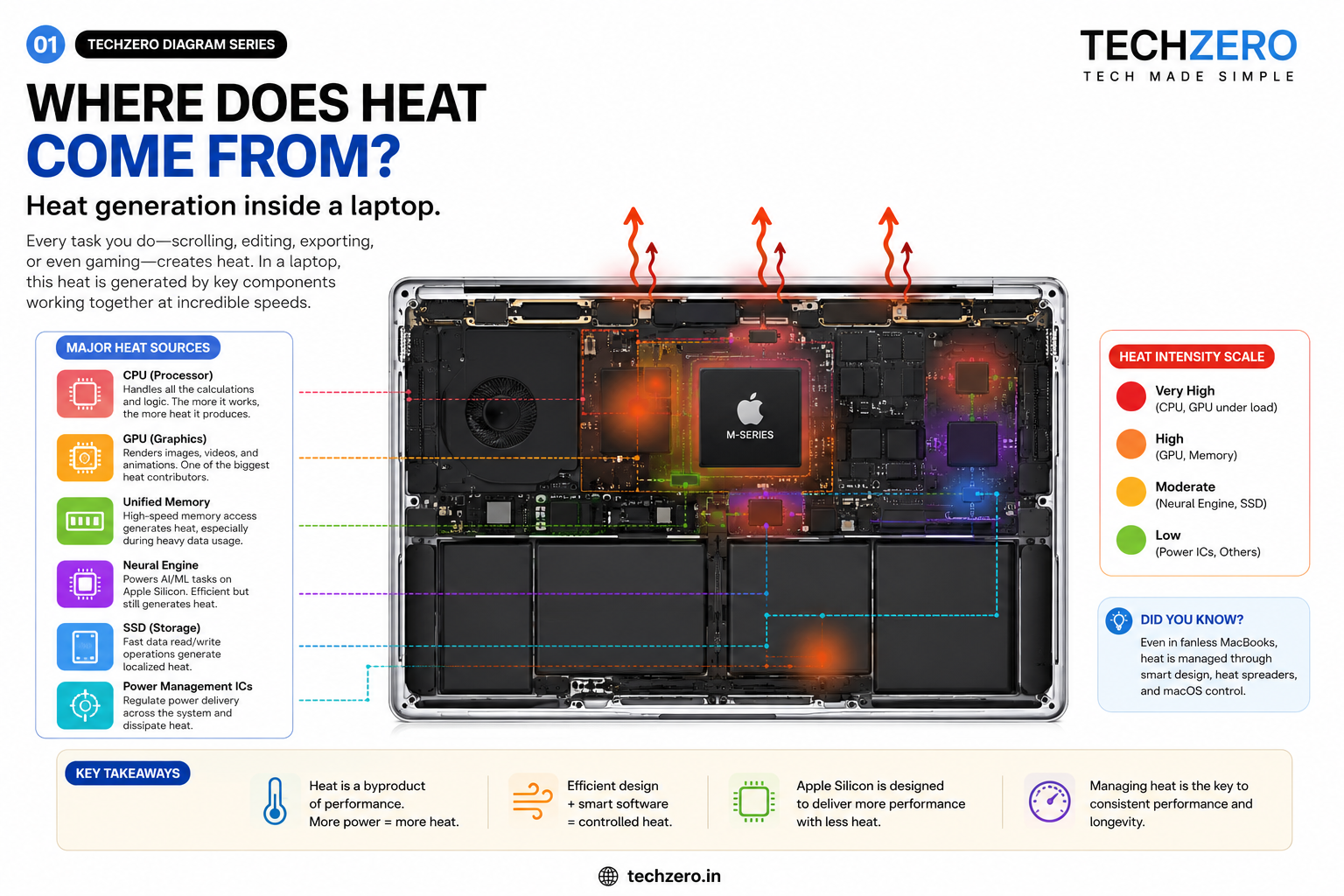
Apple’s fanless MacBooks don’t stay cool because they have a revolutionary cooling system—they stay cool because they generate far less heat in the first place. Instead of relying on noisy fans, Apple combines Apple Silicon’s exceptional performance per watt, Unified Memory, dedicated hardware engines, intelligent macOS power management, and a passive cooling system that uses copper heat spreaders, graphite sheets and the aluminum unibody to dissipate heat silently.
For everyday workloads such as web browsing, Microsoft Office, programming, photo editing and video conferencing, the MacBook Neo and MacBook Air remain cool, quiet and highly responsive without requiring active cooling. During prolonged processor-intensive tasks like 4K video rendering, Blender, AI inference or large software builds, the processor may gradually reduce its clock speed—a normal process known as thermal throttling—to remain within safe operating temperatures.
TechZero Takeaway: Apple’s engineering philosophy is fundamentally different from traditional PC manufacturers. Rather than removing large amounts of heat with bigger fans, Apple minimizes heat generation through efficient chip architecture and intelligent software, making fanless laptops practical for the vast majority of users.
Modern laptops have become thinner, lighter and more powerful, but one engineering challenge has remained constant: heat. Every processor converts electrical energy into heat, and as performance increases, managing that heat becomes increasingly difficult. For decades, laptop manufacturers addressed this challenge by adding larger heat pipes, faster cooling fans and more complex ventilation systems.
Apple chose a different path.
With Apple Silicon, the company proved that a modern laptop could deliver excellent performance while operating silently. Both the MacBook Neo and MacBook Air achieve this without a cooling fan, challenging decades of conventional laptop design.
At first glance, this seems impossible. A powerful processor, an ultra-thin chassis and no active cooling appear to be a recipe for overheating. Yet millions of users run office applications, development tools, creative software and even professional workflows on fanless MacBooks every day.
The explanation lies in engineering rather than marketing. Apple redesigned the processor architecture, operating system, memory subsystem and thermal design to work as a single integrated platform. Instead of relying primarily on fans to remove heat after it is generated, Apple focuses on reducing unnecessary heat generation from the beginning.
This guide explains that engineering in simple, practical terms. You’ll learn where laptop heat originates, how Apple Silicon minimizes it, how passive cooling works, when a fanless MacBook becomes warm, and why MacBook Pro models still require active cooling.
By the end of this article, you’ll understand why Apple’s fanless laptops remain among the most efficient notebooks available today.
Chapter 1 — A Laptop That Shouldn’t Exist
For decades, laptop engineering followed a straightforward principle:
Higher performance requires more cooling.
As processors became faster, manufacturers increased cooling capacity by adding larger heat sinks, multiple heat pipes and high-speed cooling fans. Modern gaming laptops often contain two or three fans because their processors and graphics chips can generate well over 100 watts of heat during sustained workloads.
A traditional laptop cooling system follows a familiar path:
Processor → Heat Pipe → Heat Sink → Cooling Fan → Hot Air Exhaust
Without continuous airflow, temperatures rise rapidly, forcing the processor to reduce its operating speed to protect itself. This behaviour is known as thermal throttling and is common in thin laptops performing demanding tasks.
Apple challenged this design philosophy.
Rather than building a larger cooling system, Apple redesigned the processor itself. The result was Apple Silicon—a family of chips engineered to deliver high performance while consuming significantly less power than traditional laptop processors.
Lower power consumption produces less heat.
Less heat reduces the need for active cooling.
Reduced cooling requirements make a fanless laptop practical.
This represents a fundamental shift in laptop engineering. Instead of focusing primarily on removing heat after it is created, Apple concentrates on preventing excessive heat from being generated in the first place.
Why This Is Engineering, Not Magic
The MacBook Neo and MacBook Air often appear almost effortless during everyday use. They wake instantly, remain silent and rarely become uncomfortably hot. This has led many users to believe that Apple somehow eliminated the heat problem entirely.
The reality is different.
Apple did not eliminate heat—it dramatically reduced how much heat the processor generates under typical workloads.
Every Processor Generates Heat
Every processor—regardless of manufacturer—produces heat.
Whenever billions of transistors switch billions of times every second, electrical resistance converts part of that energy into heat.
This applies equally to:
Apple Silicon
Intel processors
AMD processors
Qualcomm Snapdragon processors
Heat generation is governed by the laws of physics and cannot be eliminated completely.
Performance Per Watt Matters More Than Raw Speed
Many buyers compare processors using benchmark scores alone.
Engineers often use a different metric:
Performance per Watt
This measures how much useful computing work a processor performs for each watt of electrical power consumed.
Higher performance per watt delivers several advantages:
Lower heat generation
Longer battery life
Smaller cooling systems
Quieter operation
Better sustained performance
Apple Silicon has become widely recognized for its excellent performance-per-watt efficiency, allowing Apple to design powerful laptops that remain completely silent during most everyday workloads.
Fanless Does Not Mean Cold
One of the most common misconceptions is that a silent laptop never becomes warm.
This is incorrect.
A fanless MacBook still dissipates heat through:
Aluminum chassis
Internal graphite sheets
Copper thermal spreaders
Natural air convection
Thermal radiation
During demanding tasks such as software compilation, video rendering or AI workloads, the bottom surface may feel noticeably warm. This is expected behaviour and indicates that the cooling system is transferring heat away from the processor.
Warm does not automatically mean overheating.
Why Most Users Rarely Notice Heat
Most laptop owners spend the majority of their time performing relatively light workloads.
Examples include:
Web browsing
Microsoft Office
Google Workspace
Email
Video conferencing
Streaming
Programming
Document editing
These activities rarely push Apple Silicon anywhere near its thermal limits. As a result, the MacBook Neo and MacBook Air often remain cool, quiet and highly responsive without requiring a fan.
Only sustained professional workloads—such as long 4K video exports, Blender rendering, AI inference or large software builds—generate enough heat for thermal management to become a significant factor.
What You’ll Learn in This Guide
This article progresses from basic engineering principles to real-world behaviour, making it suitable for both everyday buyers and technology enthusiasts.
Topics Covered
Where laptop heat actually comes from.
Why processors become hot.
How traditional fan-based cooling works.
How Apple’s passive cooling system operates.
Why Apple Silicon generates less heat.
How macOS contributes to thermal management.
What thermal throttling is and when it occurs.
Why MacBook Pro models still require active cooling.
Practical tips for keeping your Mac cool and performing efficiently for years.
Understanding these concepts will help you separate marketing claims from engineering reality and make more informed purchasing decisions based on your actual workload.
Part 2 — Understanding Heat
Heat is not a flaw in modern processors—it’s an unavoidable by-product of computing. Every calculation performed by a processor requires billions of microscopic transistors to switch on and off at extremely high speeds. That switching consumes electrical energy, and a portion of that energy is always released as heat.
The faster a processor works, the more electrical activity occurs. Unless that heat is controlled efficiently, processor temperatures rise, reducing performance, shortening battery life and potentially affecting the lifespan of electronic components.
Understanding where heat originates is the first step toward understanding why Apple’s fanless MacBooks work so differently from conventional laptops.
Chapter 2 — Where Does Laptop Heat Come From?
Many people assume the processor is the only component that becomes hot. In reality, several components inside a laptop generate heat simultaneously. Some produce large amounts, while others contribute gradually over long periods.
Apple’s engineering approach focuses on minimizing heat generation across the entire system rather than cooling only the processor.
CPU — The Primary Heat Source
The CPU (Central Processing Unit) performs billions of calculations every second. Every instruction—opening a browser tab, compiling code or exporting a video—passes through the processor.
Why the CPU Gets Hot
Every transistor inside the processor acts like an electronic switch.
Modern processors contain tens of billions of transistors, each switching billions of times every second.
Every switch consumes energy.
Every energy transfer generates heat.
Even though each transistor produces only a tiny amount of heat, their combined effect creates the temperatures measured inside a laptop.
More Work Means More Heat
Processor temperature depends largely on workload.
Workload
Heat Generated
Idle
Very Low
Web Browsing
Low
Office Applications
Low
Programming
Moderate
Photo Editing
Moderate
Video Editing
High
3D Rendering
Very High
AI Processing
Very High
This explains why a laptop remains cool while reading emails but becomes noticeably warmer during video rendering.
GPU — Graphics Processing
The GPU (Graphics Processing Unit) handles graphics, video processing and parallel computation.
Unlike the CPU, which focuses on sequential tasks, the GPU performs thousands of operations simultaneously.
Activities That Increase GPU Temperature
Video playback
Photo editing
3D rendering
Gaming
Machine learning
Image generation
Motion graphics
Professional GPUs often consume more power than CPUs, which is why gaming laptops require large cooling systems.
Apple’s integrated GPU is engineered for high efficiency, reducing overall heat generation compared with many dedicated graphics solutions.
Unified Memory
Memory itself generates relatively little heat.
However, inefficient memory architectures force processors to move enormous amounts of data between separate components, increasing power consumption.
Apple’s Unified Memory Architecture minimizes unnecessary data movement, reducing both latency and energy consumption.
Why Unified Memory Generates Less Heat
Shared memory pool
Shorter communication paths
Fewer duplicated datasets
Reduced memory controllers
Lower power requirements
This architecture is discussed in greater detail later in the guide.
SSD Storage
Modern SSDs are significantly faster than traditional hard drives.
That speed comes from sophisticated storage controllers performing millions of operations every second.
SSD Activities That Generate Heat
Large file transfers
Installing applications
Video editing
Database operations
Software compilation
AI datasets
During normal office work, SSD temperatures remain relatively low.
Heavy sustained writes, however, can noticeably increase SSD temperature.
Battery
The battery also produces heat, particularly while charging.
This heat results from internal chemical reactions rather than computing activity.
Battery Conditions That Increase Temperature
Fast charging
High ambient temperature
Simultaneous charging and heavy workloads
Continuous maximum brightness
High processor utilization while plugged in
Apple continuously monitors battery temperature to protect both performance and battery lifespan.
Display
Modern displays consume a significant amount of power.
Higher brightness requires more electrical energy, increasing overall system heat.
Display Factors That Affect Temperature
Maximum brightness
HDR playback
Outdoor usage
Long display-on time
Although the display is not a major heat source, it contributes to the laptop’s overall thermal load.
Charging Circuit
Power management components regulate electricity flowing between the charger, battery and processor.
These circuits naturally generate heat during energy conversion.
Factors Affecting Charging Heat
Charger wattage
Battery level
System workload
Ambient temperature
This is why a laptop often feels warmer while charging than when operating on battery power alone.
Chapter 3 — Why Heat Is a Problem
Generating heat is normal.
Failing to manage it is not.
As processor temperatures increase, computers must balance three competing priorities:
Performance
Battery life
Component safety
If temperatures continue rising without control, permanent hardware damage could occur.
Modern laptops therefore include sophisticated thermal management systems designed to keep temperatures within safe operating limits.
Performance Reduction
Heat directly affects processor speed.
Thermal Throttling
When internal temperatures approach predefined safety limits, the processor automatically reduces its operating frequency.
Lower frequency means:
Lower power consumption
Reduced heat generation
Slower performance
This protective mechanism is known as thermal throttling.
Every modern processor—including Apple Silicon, Intel and AMD—uses thermal throttling when necessary.
Battery Degradation
Lithium-ion batteries dislike excessive heat.
High temperatures accelerate chemical aging inside battery cells.
Long-Term Effects
Reduced battery capacity
Shorter runtime
Faster battery wear
Earlier battery replacement
Managing heat therefore improves both performance and battery longevity.
Component Lifespan
Heat affects more than the processor.
Repeated exposure to high temperatures gradually stresses electronic components.
Components Affected
CPU
GPU
Battery
SSD
Voltage regulators
Motherboard components
Well-designed thermal management helps maximize the lifespan of the entire system.
User Comfort
A laptop is designed to rest on a desk—or sometimes on your lap.
Surface temperature therefore matters almost as much as internal temperature.
Why Surface Temperature Matters
Comfortable typing
Lap usage
Palm rest temperature
Overall user experience
Apple’s passive cooling system spreads heat across a larger aluminum surface rather than concentrating it in one location, helping maintain user comfort during everyday workloads.
Heat Is Wasted Energy
One of the most important engineering principles is often overlooked:
Every watt that becomes heat is a watt that is no longer available for computing.
Reducing unnecessary heat improves:
Battery life
Processor efficiency
Sustained performance
Cooling requirements
This principle forms the foundation of Apple Silicon’s design philosophy.
Key Takeaways
Heat Is Generated By
CPU
GPU
SSD
Battery
Display
Charging circuitry
Heat Affects
Performance
Battery life
Component lifespan
User comfort
Energy efficiency
The next part explains how traditional Windows laptops remove this heat using fans, heat pipes and vapor chambers—and why Apple decided to take a completely different approach.
Part 3 — How Traditional Laptops Stay Cool
Before understanding Apple’s fanless design, it’s important to understand how conventional laptops manage heat.
For decades, laptop cooling followed the same engineering principle:
Generate heat → Move heat away from the processor → Remove it using airflow.
This approach is known as active cooling because it depends on mechanical fans to continuously move air through the laptop.
The system works well and allows processors to deliver very high performance. However, it also introduces compromises such as fan noise, dust accumulation, higher power consumption and thicker chassis.
Chapter 4 — Active Cooling Explained
Most Windows laptops—from budget notebooks to high-end gaming machines—use a similar cooling architecture.
Although the size and complexity vary, the basic components remain the same.
Step 1 — Heat Is Generated
The processor begins producing heat as soon as it starts executing instructions.
Light workloads generate relatively little heat.
Heavy workloads such as gaming, software compilation or video rendering can increase processor temperatures rapidly.
Common High-Heat Workloads
AAA gaming
4K video editing
Blender rendering
AI inference
Machine learning
Large software builds
Virtual machines
Without cooling, processor temperatures would quickly exceed safe operating limits.
Step 2 — Thermal Paste Transfers Heat
The processor itself cannot directly cool down.
A thermal interface material (commonly called thermal paste) fills microscopic air gaps between the processor and the cooling system.
Why Thermal Paste Is Necessary
Improves heat transfer
Eliminates tiny air pockets
Reduces thermal resistance
Improves cooling efficiency
Even premium laptops rely heavily on this small but essential material.
Step 3 — Heat Pipes Move the Heat
Heat pipes are sealed copper tubes containing a tiny amount of working fluid.
They transport heat away from the processor far more efficiently than solid metal alone.
How Heat Pipes Work
Processor heats one end.
Internal liquid evaporates.
Vapor travels through the pipe.
Heat reaches the cooler end.
Vapor condenses.
Liquid returns to repeat the cycle.
This process occurs continuously while the laptop operates.
Step 4 — Heat Sink Dissipates Heat
The heat pipe transfers thermal energy into a metal heat sink.
A heat sink contains dozens of thin metal fins designed to maximize surface area.
Purpose of the Heat Sink
Increases cooling surface area
Releases heat into surrounding air
Prepares heat for fan removal
Without airflow, however, the heat sink eventually becomes saturated.
Step 5 — Cooling Fan Removes Heat
The cooling fan draws cool air into the laptop and forces hot air across the heat sink.
This continuous airflow prevents excessive heat buildup.
Fan Responsibilities
Draw cool air inside
Remove hot air
Maintain processor temperature
Support sustained performance
As processor temperatures increase, fan speed automatically increases.
Step 6 — Hot Air Leaves the Laptop
After absorbing heat, the air exits through exhaust vents.
Typical Exhaust Locations
Rear hinge
Side vents
Bottom vents
This completes one cooling cycle.
The entire process repeats thousands of times every second during heavy workloads.
Chapter 5 — Why Fans Become Loud
Many users associate fan noise with poor laptop quality.
In reality, louder fans usually indicate that the cooling system is working harder.
Why Fan Speed Changes
Modern laptops continuously monitor processor temperatures.
As temperatures rise, the system automatically increases fan speed.
Higher Fan Speed Occurs During
Gaming
Video exports
Large software builds
AI workloads
Stress testing
Hot environments
More heat requires more airflow.
More airflow requires higher fan speed.
Higher fan speed creates more noise.
Why Thin Laptops Struggle More
Thin laptops have less internal space for cooling components.
Smaller cooling systems reach their thermal limits more quickly.
Engineering Challenges
Smaller heat sinks
Shorter heat pipes
Smaller fans
Reduced airflow
Limited ventilation
This is one reason ultrabooks often become louder than larger laptops during demanding workloads.
Why Gaming Laptops Need Multiple Fans
Gaming laptops contain two major heat sources.
Components Producing Heat
CPU
Dedicated GPU
Both may generate significant heat simultaneously.
To manage this thermal load, manufacturers often include:
Multiple heat pipes
Large vapor chambers
Dual or triple cooling fans
Large exhaust vents
This explains why gaming laptops are thicker, heavier and noisier than ultraportable notebooks.
Chapter 6 — Limitations of Fan-Based Cooling
Active cooling is effective, but it is not perfect.
Every fan introduces mechanical, acoustic and maintenance-related compromises.
Fan Noise
The most obvious disadvantage is noise.
Noise Increases During
Gaming
Rendering
Software compilation
AI processing
Charging under heavy load
Premium laptops reduce noise, but no mechanical fan is completely silent.
Dust Accumulation
Fans constantly pull air into the laptop.
Along with that air comes dust.
Long-Term Effects
Blocked vents
Reduced airflow
Higher temperatures
Increased fan speed
More frequent thermal throttling
Dust is one of the leading causes of declining cooling performance over time.
Mechanical Wear
Unlike processors, fans contain moving parts.
Moving components eventually wear out.
Possible Failures
Bearing wear
Motor failure
Vibration
Increased noise
Complete fan failure
Although modern fans are reliable, they remain mechanical devices with finite lifespans.
Higher Power Consumption
Cooling itself consumes electricity.
Every spinning fan draws power from the battery.
Impact
Shorter battery life
Additional heat generation
Reduced efficiency
This is one reason Apple focuses on reducing heat generation rather than simply increasing cooling capacity.
Larger Internal Space
Fans require physical space.
That space cannot be used for:
Larger batteries
Additional speakers
Structural reinforcement
Smaller motherboard design
Removing the fan gives engineers greater flexibility when designing the laptop.
Chapter 7 — Why Apple Took a Different Approach
Apple did not eliminate fans because fans are ineffective.
It eliminated them because Apple Silicon produces significantly less heat under everyday workloads.
Instead of improving traditional cooling systems, Apple redesigned the processor itself.
Lower power consumption meant:
Less heat generation
Smaller cooling requirements
Silent operation
Better battery life
Simpler internal design
The cooling system became a consequence of the processor architecture rather than the primary engineering solution.
Key Takeaways
Traditional Laptop Cooling Uses
Thermal paste
Heat pipes
Heat sink
Cooling fan
Air intake
Air exhaust
Advantages
Excellent sustained performance
Handles very high power processors
Ideal for gaming and workstations
Disadvantages
Fan noise
Dust buildup
Mechanical wear
Higher battery consumption
Larger chassis
In the next part, we’ll examine how Apple eliminated the fan entirely by redesigning both the processor and the laptop around passive cooling Next
Part 4 — Apple’s Fanless Philosophy
Removing a cooling fan is not simply a design decision—it is the result of an entirely different engineering philosophy.
Most laptop manufacturers begin with a powerful processor and then design a cooling system capable of removing the resulting heat.
Apple reverses this process.
Instead of asking, “How do we cool a hot processor?”, Apple asks, “How do we build a processor that generates less heat without sacrificing performance?”
This philosophy influences every component inside a MacBook, from the processor architecture to the memory design, motherboard layout and even the aluminum enclosure.
The result is a laptop that remains silent during everyday use while still delivering performance that rivals many actively cooled notebooks.
Chapter 8 — Why Apple Silicon Changed Everything
The transition from Intel processors to Apple Silicon was more than a processor upgrade.
It fundamentally changed how Macs generate, distribute and manage heat.
Performance Per Watt Became the Primary Goal
For decades, processor manufacturers largely pursued higher clock speeds and increased performance.
Apple shifted its focus toward Performance per Watt.
What Is Performance per Watt?
Performance per Watt measures how much useful computing work a processor performs for every watt of electrical power it consumes.
Higher Performance per Watt provides several advantages:
Less heat generation
Lower electricity consumption
Longer battery life
Smaller cooling requirements
Better sustained performance
This single engineering goal forms the foundation of Apple’s fanless laptop strategy.
Apple Silicon Is a System-on-a-Chip (SoC)
Traditional laptops contain multiple large chips connected across the motherboard.
Apple combines many of these components into a single package called a System-on-a-Chip (SoC).
Components Inside Apple Silicon
CPU
GPU
Neural Engine
Media Engine
Memory Controller
Secure Enclave
Image Signal Processor
Display Engine
Instead of communicating across long motherboard traces, these components communicate internally at extremely high speed while consuming less power.
Shorter communication paths reduce electrical losses, which also reduces heat.
Smaller Motherboard, Shorter Signal Paths
Electrical signals lose energy while travelling across a circuit board.
Longer distances require more power.
More power produces more heat.
Benefits of Shorter Signal Paths
Lower latency
Lower energy consumption
Reduced electrical resistance
Improved efficiency
Less heat generation
Apple’s compact SoC architecture minimizes unnecessary electrical travel throughout the system.
Chapter 9 — Passive Cooling Explained
Without a fan, heat must still leave the processor.
Apple accomplishes this using passive cooling.
Passive cooling relies on materials and physics rather than moving mechanical parts.
Step 1 — Heat Leaves the Processor
The processor is the first component to become warm.
Rather than immediately blowing air across it, Apple first spreads the heat away from the chip.
Objective
Prevent localized hot spots
Spread thermal energy evenly
Reduce peak temperatures
Step 2 — Thermal Interface Material
Between the processor and the internal cooling components sits a highly conductive thermal interface material.
Purpose
Eliminate microscopic air gaps
Improve heat transfer
Reduce thermal resistance
Increase cooling efficiency
Even fanless laptops rely heavily on efficient thermal interfaces.
Step 3 — Copper Heat Spreaders
Copper conducts heat exceptionally well.
Apple uses carefully engineered copper components to move heat away from the processor before temperatures become excessive.
Why Copper?
Excellent thermal conductivity
Fast heat transfer
High reliability
Long lifespan
Copper spreads heat across a much larger area instead of allowing it to remain concentrated above the processor.
Step 4 — Graphite Sheets
Graphite is one of the most effective materials for distributing heat across thin surfaces.
Benefits of Graphite
Extremely lightweight
Excellent thermal conductivity
Uniform heat distribution
Minimal thickness
Graphite sheets help prevent individual areas of the laptop from becoming excessively hot.
Step 5 — Aluminum Unibody
Many people assume Apple’s aluminum enclosure exists primarily for appearance.
In reality, it is also an important part of the cooling system.
The Aluminum Chassis Functions As
Structural frame
Protective enclosure
Large passive heat spreader
Instead of trapping heat inside the laptop, the aluminum body distributes thermal energy over a much larger surface.
This lowers peak internal temperatures while keeping external temperatures more uniform.
Step 6 — Natural Air Convection
Warm air naturally rises.
As internal components warm the surrounding air, that air slowly moves away from the laptop without requiring a fan.
Passive Air Movement
Warm air rises
Cooler air replaces it
Continuous natural circulation
No moving parts
Although far slower than active cooling, natural convection is sufficient for low- to moderate-power processors like Apple Silicon.
Step 7 — Thermal Radiation
Every warm object continuously emits infrared energy.
This process is known as thermal radiation.
Characteristics
Requires no airflow
Requires no moving parts
Occurs continuously
Becomes more effective as temperature increases
While radiation removes less heat than convection, it still contributes to the MacBook’s overall cooling system.
Chapter 10 — Why the Aluminum Body Gets Warm
One of the most common questions asked by MacBook owners is:
“Why is the bottom of my MacBook warm if it doesn’t have a fan?”
The answer is simple.
The aluminum body is intentionally designed to absorb and spread heat.
Warm Exterior, Cooler Processor
When heat moves into the aluminum enclosure:
Processor temperature decreases.
Heat spreads over a larger surface.
Localized hot spots are reduced.
Internal cooling becomes more effective.
A warm chassis often indicates that the passive cooling system is working exactly as intended.
Warm Does Not Mean Overheating
Surface temperature and processor temperature are not the same.
The processor may remain within safe operating limits even when the aluminum enclosure feels warm.
Apple continuously monitors internal sensors rather than relying solely on external surface temperatures.
This distinction is important because many users mistake normal heat dissipation for overheating.
Chapter 11 — Why Fanless Doesn’t Mean Slow
A common misconception is that removing the fan automatically reduces performance.
The reality is more nuanced.
For short and moderate workloads, Apple Silicon often completes tasks before traditional laptops even need to increase fan speed.
Examples
Opening applications
Browsing
Office work
Programming
Photo editing
Video conferencing
Only prolonged heavy workloads eventually exceed the limits of passive cooling.
This is precisely why Apple offers actively cooled MacBook Pro models for professional users.
Key Takeaways
Apple’s Fanless Design Depends On
Apple Silicon efficiency
High Performance per Watt
System-on-a-Chip architecture
Copper heat spreaders
Graphite thermal layers
Aluminum unibody cooling
Natural convection
Thermal radiation
The Biggest Engineering Difference
Traditional laptops remove heat after it is generated.
Apple Silicon is engineered to generate significantly less heat in the first place, allowing passive cooling to handle workloads that previously required mechanical fans.
The next part explores the real hero behind this engineering achievement: Apple Silicon itself, including Performance Cores, Efficiency Cores, Unified Memory and dedicated hardware engines that dramatically reduce both power consumption and heat generation.
Part 5 — The Real Hero: Apple Silicon
Apple’s passive cooling system is only one half of the story.
The real breakthrough is Apple Silicon itself.
A fanless laptop would not be practical if the processor generated as much heat as traditional laptop CPUs. Apple therefore redesigned the processor architecture to maximize efficiency before focusing on cooling.
Instead of relying on brute-force performance, Apple Silicon intelligently decides where, when, and how power is used. Every unnecessary watt saved is one less watt converted into heat.
This philosophy allows the MacBook Neo and MacBook Air to remain silent during workloads that would often activate cooling fans on conventional laptops.
Chapter 12 — Performance Cores and Efficiency Cores
One of the biggest differences between Apple Silicon and older processor designs is the use of two different types of CPU cores.
Rather than making every core equally powerful, Apple assigns different jobs to different cores.
This approach is known as a Hybrid CPU Architecture.
Performance Cores (P-Cores)
Performance Cores are designed for demanding tasks that require maximum processing power.
Typical Workloads
Software compilation
RAW photo editing
Video rendering
AI inference
Large spreadsheets
Professional creative applications
Performance Cores deliver exceptional speed but consume more electrical power.
Higher power naturally generates more heat.
Apple therefore activates them only when necessary.
Efficiency Cores (E-Cores)
Efficiency Cores handle everyday computing tasks while consuming only a fraction of the power required by Performance Cores.
Typical Workloads
Web browsing
Email
Microsoft Office
Streaming
Music playback
Notes
Calendar
Messaging
Background synchronization
These cores allow the laptop to remain cool while significantly extending battery life.
Most users spend the majority of their day using Efficiency Cores rather than Performance Cores.
Why This Reduces Heat
Instead of running powerful cores continuously, macOS intelligently schedules work across both core types.
Result
Lower average power consumption
Lower average temperature
Longer battery life
Reduced fan requirement
Better sustained efficiency
This intelligent workload distribution is one of Apple’s most important thermal advantages.
Chapter 13 — Unified Memory Architecture
Traditional computers treat CPU memory and GPU memory as separate resources.
Whenever both processors need the same data, it often has to be copied between memory pools.
Copying data requires:
Time
Energy
Memory bandwidth
Every unnecessary data transfer also produces additional heat.
Apple eliminates much of this overhead using Unified Memory Architecture (UMA).
One Shared Memory Pool
Instead of separate memory systems, Apple Silicon allows multiple processors to access the same memory.
Components Sharing Memory
CPU
GPU
Neural Engine
Media Engine
No unnecessary copying.
No duplicated datasets.
No additional memory transfers.
Why Unified Memory Improves Efficiency
Data remains in one location.
Every processor accesses the same information directly.
Engineering Benefits
Lower latency
Lower power consumption
Less motherboard traffic
Higher efficiency
Reduced heat generation
This is one reason Apple’s relatively modest memory capacities often perform better than expected.
Chapter 14 — Dedicated Hardware Engines
General-purpose CPUs are extremely flexible.
They are not always the most efficient solution.
Apple therefore includes specialized hardware designed for specific workloads.
Dedicated hardware performs individual tasks much faster while consuming significantly less power.
Lower power means lower heat.
Neural Engine
Artificial Intelligence calculations normally place heavy demands on the CPU or GPU.
Apple instead uses a dedicated Neural Engine.
Typical Tasks
AI writing tools
Image recognition
Speech recognition
Language processing
Photo enhancements
Machine learning inference
By handling these workloads independently, the CPU remains cooler.
Media Engine
Video processing is traditionally one of the most power-hungry computing tasks.
Apple includes dedicated hardware specifically for video.
Supported Tasks
H.264 encoding
HEVC encoding
ProRes encoding
Video decoding
Hardware playback
Instead of forcing the CPU to process every video frame, specialized circuits perform the work far more efficiently.
The result is:
Faster exports
Lower power consumption
Reduced processor heat
Image Signal Processor (ISP)
Every webcam image passes through the Image Signal Processor before appearing on screen.
Responsibilities
Noise reduction
Exposure adjustment
White balance
Color correction
Face optimization
Because the ISP performs these calculations independently, the CPU remains available for other tasks.
Secure Enclave
Modern computers perform encryption continuously.
Passwords, Touch ID authentication and secure storage all require cryptographic processing.
Apple isolates these workloads inside the Secure Enclave.
Benefits
Improved security
Lower CPU utilization
Reduced background processing
Better energy efficiency
Chapter 15 — Dynamic Power Management
Perhaps the most impressive feature of Apple Silicon is that it rarely runs at maximum power unless absolutely necessary.
Instead, it continuously adjusts itself hundreds of times every second.
Dynamic Voltage Scaling
Higher voltage enables higher performance.
It also produces more heat.
Apple continuously lowers processor voltage whenever full performance is unnecessary.
Benefits
Reduced power consumption
Lower temperatures
Better battery life
Dynamic Frequency Scaling
Processor frequency determines how many operations the CPU performs every second.
Apple constantly adjusts clock speed based on workload.
Examples
Workload
Processor Behaviour
Idle
Very Low Frequency
Email
Low Frequency
Browsing
Moderate Frequency
Programming
High Frequency
Video Rendering
Maximum Frequency
Instead of remaining at maximum speed all day, the processor operates only as fast as necessary.
Clock Gating
Not every processor component is needed all the time.
Apple disables the clock signal to unused sections of the chip.
Result
Inactive circuits consume almost no power.
Lower power means less heat.
Power Gating
Clock Gating reduces activity.
Power Gating goes further.
It completely disconnects electrical power from unused parts of the processor.
Advantages
Nearly zero power consumption
Lower idle temperatures
Longer battery life
Improved efficiency
Power Gating is one reason Apple Silicon consumes remarkably little energy while idle.
Chapter 16 — Why Apple Silicon Feels Faster Without Getting Hot
Many users associate higher performance with higher temperatures.
Apple demonstrates that efficient engineering can often produce both higher responsiveness and lower heat.
Why Everyday Tasks Feel Instant
Most daily activities require short bursts of processing rather than sustained maximum performance.
Examples include:
Everyday Workloads
Opening Safari
Launching Mail
Searching Spotlight
Switching applications
Editing documents
Browsing websites
Apple Silicon completes these tasks quickly before returning to low-power operation.
The processor spends surprisingly little time operating at maximum power.
This “finish quickly, return to idle” strategy reduces both energy consumption and heat generation.
Efficiency Is the Real Advantage
Apple Silicon is not revolutionary because it ignores the laws of physics.
It succeeds because it wastes less energy.
Less wasted energy produces:
Benefits
Less heat
Longer battery life
Quieter operation
Better sustained performance
Smaller cooling requirements
This engineering philosophy makes fanless MacBooks possible.
Key Takeaways
Apple Silicon Reduces Heat Through
Performance and Efficiency Cores
Unified Memory Architecture
Dedicated Hardware Engines
Dynamic Voltage Scaling
Dynamic Frequency Scaling
Clock Gating
Power Gating
High Performance per Watt
Apple’s cooling system begins long before heat reaches the aluminum chassis. The processor itself is engineered to minimize unnecessary power consumption, making passive cooling practical for millions of everyday workloads.
In the next part, we’ll explore how macOS works alongside Apple Silicon, using intelligent software to manage workloads, control temperatures and maximize both performance and battery life.
Part 6 — How macOS Helps Control Heat
Hardware alone cannot keep a laptop cool.
Even the world’s most efficient processor can overheat if the operating system continuously keeps it busy, wastes CPU cycles or schedules tasks inefficiently.
This is where macOS plays a critical role.
Unlike most PC manufacturers, Apple designs both the operating system and the processor. This allows macOS to understand exactly how Apple Silicon behaves and make intelligent decisions about power consumption, processor scheduling and thermal management.
Rather than reacting after temperatures rise, macOS continuously predicts workloads, distributes tasks efficiently and minimizes unnecessary processor activity.
Chapter 17 — Intelligent Workload Scheduling
Every second, thousands of processes compete for processor time.
macOS decides which tasks should run first, which can wait and which processor cores should execute them.
This process is known as task scheduling.
Matching the Right Core to the Right Job
Apple Silicon contains both Performance Cores and Efficiency Cores.
macOS decides where each task should run.
Efficiency Cores Handle
Email synchronization
Calendar updates
Music playback
Notifications
Messaging
Cloud synchronization
Background indexing
These activities consume very little power.
Performance Cores Handle
Video rendering
Software compilation
Photo editing
AI processing
Large spreadsheets
Professional creative applications
Powerful cores activate only when necessary.
This reduces average processor temperature throughout the day.
Intelligent Core Migration
A task does not remain permanently assigned to one processor core.
As workloads change, macOS moves them dynamically.
Example
Open Safari.
Page loads on Performance Core.
Website finishes loading.
Background activity moves to Efficiency Core.
The processor immediately returns to a lower-power state.
This transition occurs automatically and is invisible to the user.
Chapter 18 — Background Activity Optimization
Many computers waste processing power on unnecessary background tasks.
Apple aggressively limits background activity whenever possible.
App Nap
Applications that are not actively being used consume significantly fewer resources.
App Nap Reduces
CPU usage
Memory activity
Background timers
Power consumption
Heat generation
For example, an inactive document editor does not continuously consume processor resources while you are browsing the web.
Background Refresh Management
Not every application needs constant updates.
macOS intelligently determines when background synchronization should occur.
Examples
Mail checks periodically.
Cloud files synchronize intelligently.
Photos update when resources are available.
Indexing pauses during demanding workloads.
This prevents unnecessary processor activity.
Chapter 19 — Memory Compression
Memory shortages often increase processor workload.
Instead of immediately writing inactive memory contents to storage, macOS first compresses memory.
Why Compression Helps
Compressed memory occupies less physical RAM.
This delays expensive storage operations.
Benefits
Faster multitasking
Reduced SSD activity
Lower power consumption
Better responsiveness
Less data movement also contributes to lower overall system temperatures.
Chapter 20 — Dynamic Thermal Management
Apple Silicon continuously reports temperature information to macOS.
Rather than waiting until the processor overheats, macOS makes gradual adjustments before temperatures become excessive.
Real-Time Temperature Monitoring
Modern Macs contain numerous thermal sensors.
Sensors Monitor
CPU temperature
GPU temperature
SSD temperature
Battery temperature
Power delivery components
Internal enclosure temperature
This information updates continuously.
Intelligent Performance Adjustment
If temperatures begin rising rapidly, macOS adjusts processor behaviour gradually.
Possible Adjustments
Lower processor frequency
Reduce voltage
Delay non-essential background tasks
Shift workloads to Efficiency Cores
Optimize power distribution
Most users never notice these adjustments because they occur incrementally.
Thermal Throttling Is the Last Resort
Many people believe thermal throttling occurs frequently.
In reality, macOS treats it as a final safety mechanism.
Thermal Management Priority
Schedule work intelligently.
Reduce unnecessary activity.
Lower voltage.
Lower clock speed.
Thermal throttle only if required.
This layered approach allows Apple Silicon to maintain performance for longer before reducing speed.
Chapter 21 — Low Power Mode
macOS includes an optional Low Power Mode.
Instead of simply reducing screen brightness, it optimizes the entire system.
What Low Power Mode Changes
Processor
Lower peak frequency
Reduced power consumption
Background Tasks
Less frequent synchronization
Delayed indexing
Reduced background processing
Graphics
Lower GPU activity
Better battery efficiency
Overall Benefits
Longer battery life
Lower operating temperatures
Quieter operation
Improved efficiency during travel
Low Power Mode is particularly useful when working away from a charger.
Chapter 22 — Why Macs Often Feel Fast Even at Lower Power
Many Windows laptops attempt to maintain maximum processor speed for extended periods.
Apple takes a different approach.
Instead of remaining fast continuously, Apple Silicon completes work quickly and immediately returns to an energy-efficient state.
Short Bursts of Performance
Most daily activities require only brief periods of maximum processing power.
Examples
Opening applications
Switching browser tabs
Searching Spotlight
Launching Photoshop
Saving documents
Exporting PDFs
Once these tasks finish, processor activity drops dramatically.
The result is:
Lower temperatures
Longer battery life
Reduced fan requirement
Less energy waste
This strategy explains why Apple Silicon often feels exceptionally responsive despite consuming relatively little power.
Chapter 23 — Hardware and Software Working Together
The biggest advantage of Apple’s thermal management strategy is integration.
Instead of treating hardware and software as separate systems, Apple designs them together.
Hardware Responsibilities
Apple Silicon
Efficient processing
Lower heat generation
Intelligent power management
Passive Cooling System
Heat spreading
Heat dissipation
Silent operation
Software Responsibilities
macOS
Intelligent scheduling
Background optimization
Memory compression
Temperature monitoring
Power management
Thermal protection
Neither system alone would produce the same results.
Together, they create one of the most efficient laptop platforms currently available.
Key Takeaways
macOS Reduces Heat By
Scheduling tasks intelligently
Using Efficiency Cores whenever possible
Limiting background activity
Compressing memory
Monitoring temperatures continuously
Dynamically adjusting processor behaviour
Delaying unnecessary workloads
Using thermal throttling only when absolutely necessary
Apple’s fanless design is therefore not solely a hardware achievement. It is the result of close integration between Apple Silicon and macOS, allowing the entire system to generate less heat while maintaining excellent responsiveness.
In the next part, we’ll examine how the MacBook Neo and MacBook Air behave during real-world workloads, including programming, video editing, AI processing, Blender rendering and other demanding tasks.
Part 7 — What Happens During Real-World Workloads?
Most laptops spend very little time running synthetic benchmarks. Their true performance is determined by how they handle everyday workloads such as web browsing, programming, video editing and content creation.
This is where Apple’s thermal philosophy becomes most apparent.
The MacBook Neo and MacBook Air are designed to deliver excellent performance during light and moderately demanding workloads while remaining completely silent. As workloads become heavier and more sustained, passive cooling eventually reaches its physical limits.
Understanding where those limits lie helps buyers choose the right Mac.
Chapter 24 — Office and Productivity Workloads
Office applications represent one of the easiest workloads for modern Apple Silicon.
Most productivity software relies more on responsiveness than sustained processor power.
Microsoft Office
Typical Workloads
Word
Excel
PowerPoint
Outlook
Expected Experience:
Instant application launch
Silent operation
Cool chassis
Minimal battery consumption
Even with multiple Office applications open simultaneously, processor utilization remains relatively low.
Google Workspace
Typical Workloads
Google Docs
Google Sheets
Google Slides
Gmail
Google Meet
Browser-based applications depend primarily on efficient CPU scheduling.
Apple Silicon handles these tasks comfortably while consuming very little power.
Video Conferencing
Modern video meetings combine multiple demanding tasks:
Camera processing
Audio processing
Video encoding
Network communication
Screen sharing
Common Applications
Zoom
Microsoft Teams
Google Meet
Webex
Despite these simultaneous workloads, MacBook Neo and MacBook Air generally remain quiet because dedicated hardware engines perform much of the video processing.
Chapter 25 — Programming Workloads
Programming workloads vary enormously.
Writing code requires little processing power.
Compiling that code can require substantially more.
Light Development
Examples
Visual Studio Code
Python
JavaScript
HTML
CSS
React
Node.js
Expected Behaviour
Silent operation
Low temperatures
Excellent battery life
Large Software Builds
Compiling thousands of source files places sustained load on multiple processor cores.
Examples
Xcode
Android Studio
Large C++
Enterprise Java
Rust projects
Expected Behaviour
Chassis becomes warm
Performance cores remain active
Higher battery usage
No fan noise
Compilation performance remains strong, although prolonged builds eventually approach the limits of passive cooling.
Chapter 26 — Photo Editing
Photo editing consists primarily of short bursts of processing rather than continuous heavy computation.
Typical Applications
Professional Software
Adobe Photoshop
Lightroom
Affinity Photo
Pixelmator Pro
Expected Behaviour
Smooth editing
Silent operation
Moderate temperatures
Even large RAW photo libraries remain well within the capabilities of Apple’s passive cooling system.
Chapter 27 — Video Editing
Video editing is one of the most demanding consumer workloads.
Whether the MacBook remains cool depends largely on the type of editing being performed.
Timeline Editing
Activities
Cutting clips
Trimming
Color adjustments
Titles
Audio editing
Expected Behaviour
Smooth playback
Moderate temperatures
Silent operation
Video Export
Exporting video requires continuous processor activity.
Activities
H.264 export
HEVC export
ProRes export
4K rendering
Expected Behaviour
Noticeably warmer chassis
Higher processor utilization
Excellent export efficiency due to Media Engine
Dedicated hardware video encoders dramatically reduce processor workload compared with traditional CPUs.
Chapter 28 — 3D Rendering
3D rendering stresses both CPU and GPU continuously.
Unlike office applications, rendering may continue for several minutes or even hours.
Applications
Examples
Blender
Cinema 4D
Maya
Expected Behaviour
High temperatures
Sustained processor load
Reduced performance over extended sessions
Professional rendering is better suited to actively cooled MacBook Pro models.
Chapter 29 — AI Workloads
Artificial Intelligence workloads vary from lightweight cloud services to computationally intensive local inference.
Cloud AI
Examples
ChatGPT
Gemini
Claude
Microsoft Copilot
These services perform most computation on remote servers.
Local processor demand remains relatively low.
Local AI
Examples
Large Language Models
Stable Diffusion
Local image generation
Machine learning inference
Expected Behaviour
High processor utilization
Increased memory usage
Higher temperatures
Faster battery drain
Passive cooling can handle occasional AI tasks, but prolonged AI workloads benefit from active cooling.
Chapter 30 — Gaming
Gaming produces one of the highest continuous thermal loads.
Unlike productivity applications, games simultaneously stress the CPU, GPU and memory subsystem.
Casual Gaming
Examples
Minecraft
Apple Arcade
Indie games
Expected Behaviour
Comfortable temperatures
Silent operation
Good battery efficiency
AAA Gaming
Examples
Modern AAA titles
Competitive esports
High-refresh gaming
Expected Behaviour
Continuous processor load
Higher temperatures
Possible thermal throttling during long sessions
Gaming remains one of the few workloads where Windows laptops with dedicated GPUs maintain a clear advantage.
Chapter 31 — When Does Thermal Throttling Occur?
Thermal throttling is often misunderstood.
It does not occur every time the laptop becomes warm.
Instead, it activates only when temperatures approach predefined safety limits.
Typical Situations
Likely to Trigger Thermal Throttling
Long Blender renders
Large software compilation
Extended 4K exports
AI model inference
Continuous stress testing
These workloads maintain maximum processor utilization for prolonged periods.
Unlikely to Trigger Thermal Throttling
Web browsing
Office applications
Programming
Email
Streaming
Photo editing
Everyday multitasking
Most users will rarely encounter thermal throttling during normal usage.
Chapter 32 — Workload Comparison
Typical Thermal Behaviour
Performance Summary
Workload
Heat Level
Fan Needed?
Web Browsing
⭐
No
Office Work
⭐
No
Streaming
⭐
No
Programming
⭐⭐
No
Photo Editing
⭐⭐⭐
No
Video Editing
⭐⭐⭐⭐
No
Video Export
⭐⭐⭐⭐
Occasionally Helpful
Blender Rendering
⭐⭐⭐⭐⭐
Yes
AI Processing
⭐⭐⭐⭐⭐
Yes
AAA Gaming
⭐⭐⭐⭐⭐
Yes
Chapter 33 — The Practical Reality
The internet often focuses on worst-case scenarios.
In reality, most MacBook owners spend over 90% of their time performing productivity tasks.
These workloads rarely stress Apple Silicon enough to require active cooling.
For these users, a fan would spend most of its life sitting idle while adding:
Weight
Noise
Dust
Mechanical complexity
Battery consumption
Apple therefore optimized the MacBook Neo and MacBook Air for the workloads that most people actually perform rather than the rare scenarios that require maximum sustained performance.
Key Takeaways
Passive Cooling Excels At
Productivity
Programming
Education
Business
Web browsing
Photo editing
Everyday multitasking
Active Cooling Becomes Beneficial For
Professional video production
Long software compilation
Blender rendering
AI development
Continuous heavy GPU workloads
AAA gaming
The next part compares the MacBook Neo, MacBook Air and MacBook Pro, explaining why Apple offers both fanless and actively cooled laptops and helping you determine which cooling design best matches your workload.
Part 8 — MacBook Neo vs MacBook Air vs MacBook Pro: Why Some Macs Need a Fan
Apple currently offers both fanless and actively cooled MacBooks. At first glance, this may appear inconsistent.
If fanless cooling is so effective, why does the MacBook Pro still include one or more cooling fans?
The answer lies in workload duration, not simply workload intensity.
A processor can safely operate at high temperatures for short periods. The challenge begins when that workload continues uninterrupted for several minutes or hours.
Apple therefore designs each MacBook for a different thermal envelope rather than a different level of intelligence.
Chapter 34 — Three Different Cooling Philosophies
Although all modern Macs use Apple Silicon, they are engineered for different types of users.
MacBook Neo
The MacBook Neo is designed for everyday productivity.
Best For
Students
Teachers
Writers
Bloggers
Office professionals
Business users
Everyday home users
Cooling System
Passive cooling
Aluminum heat spreader
Copper thermal components
Graphite sheets
Natural air convection
The focus is maximum efficiency with completely silent operation.
MacBook Air
The MacBook Air uses a similar fanless philosophy but is paired with more capable Apple Silicon.
Best For
Developers
Photographers
Designers
Frequent travellers
Content creators
Professional productivity
Its larger thermal capacity allows heavier workloads while remaining completely silent.
MacBook Pro
The MacBook Pro targets professionals whose workloads remain heavy for long periods.
Best For
Video editors
Software engineers
3D artists
Music producers
AI developers
Scientific computing
Instead of avoiding fans entirely, Apple uses active cooling to sustain maximum processor performance.
Chapter 35 — Passive Cooling vs Active Cooling
Both cooling methods obey the same laws of physics.
The difference is how quickly heat leaves the processor.
Passive Cooling
Advantages
Silent operation
No moving parts
No fan maintenance
Less dust accumulation
Lower power consumption
Greater reliability
Simpler internal design
Limitations
Lower sustained thermal capacity
Heat dissipates more slowly
Performance eventually decreases during prolonged heavy workloads
Passive cooling is ideal when processor utilization fluctuates throughout the day.
Active Cooling
Advantages
Removes heat continuously
Maintains peak performance longer
Better for rendering
Better for AI workloads
Better for software compilation
Better for long exports
Limitations
Fan noise
Dust buildup
Mechanical wear
Higher power consumption
More complex internal design
Active cooling becomes increasingly valuable as workload duration increases.
Chapter 36 — Why the MacBook Pro Includes Fans
Apple did not add fans because Apple Silicon runs hot.
Apple added fans because professional users demand maximum sustained performance.
Short Workloads
Examples include:
Tasks
Opening Photoshop
Compiling a small project
Exporting a PDF
Editing documents
The processor finishes these tasks before passive cooling reaches its limits.
A fan provides little benefit.
Long Workloads
Professional users often perform tasks lasting thirty minutes—or several hours.
Examples
8K video exports
Blender rendering
Large software builds
AI inference
Machine learning
Scientific simulations
These workloads continuously generate heat faster than passive cooling can remove it.
A fan allows the processor to maintain higher clock speeds for much longer.
Chapter 37 — What Happens Without a Fan?
Consider a simplified example.
Video Export
A long video export begins.
Stage 1
The processor operates at maximum performance.
Temperature rises steadily.
Stage 2
Heat spreads into the copper components and aluminum chassis.
Performance remains high.
Stage 3
The chassis approaches its maximum passive cooling capacity.
Processor temperature continues increasing.
Stage 4
macOS gradually reduces processor frequency.
Power consumption decreases.
Heat generation decreases.
Performance drops slightly.
This is thermal throttling.
A MacBook Pro reaches this stage much later because the fan continuously removes heat.
Chapter 38 — Which Cooling System Is Better?
Neither cooling system is universally superior.
Each is optimized for different workloads.
Choose Passive Cooling If
Your Work Includes
Office applications
Education
Programming
Browsing
Business
Blogging
Photography
General productivity
Benefits include:
Silence
Better battery life
No fan maintenance
Greater portability
Choose Active Cooling If
Your Work Includes
Professional video editing
Blender rendering
AI development
Scientific computing
Continuous software compilation
Long creative sessions
The fan enables the processor to sustain maximum performance for much longer.
Chapter 39 — Cooling Comparison
MacBook Cooling Systems
Comparison Table
Feature
MacBook Neo
MacBook Air
MacBook Pro
Cooling Method
Passive
Passive
Active
Fan
❌
❌
✅
Noise
Silent
Silent
Quiet under light load
Office Work
Excellent
Excellent
Excellent
Programming
Excellent
Excellent
Excellent
Photography
Very Good
Excellent
Excellent
Video Editing
Good
Very Good
Excellent
3D Rendering
Limited
Moderate
Excellent
AI Workloads
Limited
Moderate
Excellent
Sustained Performance
Good
Better
Best
Dust Maintenance
None
None
Periodic Cleaning
Chapter 40 — Choosing the Right Mac
Cooling should never be the primary purchasing factor.
Instead, choose the Mac whose cooling system matches your workload.
TechZero Recommendations
Buy the MacBook Neo If
You primarily perform productivity work.
You value silent operation.
You rarely push the processor continuously.
Budget is important.
Buy the MacBook Air If
You want additional performance headroom.
You occasionally edit videos.
You multitask heavily.
You expect your workload to grow.
Buy the MacBook Pro If
Your income depends on sustained performance.
You render professionally.
You build large software projects daily.
You train AI models.
You regularly push the processor for hours.
The cooling system should support your workflow—not define it.
Key Takeaways
Fanless Cooling Is Best For
Everyday productivity
Portability
Battery life
Silent operation
Low maintenance
Active Cooling Is Best For
Long professional workloads
Continuous processor-intensive tasks
Maximum sustained performance
Professional creative work
Scientific and engineering applications
Apple doesn’t build one cooling system for every Mac because every user has different performance requirements. The MacBook Neo and MacBook Air prioritize efficiency and silence, while the MacBook Pro prioritizes sustained performance. Each design is optimized for its intended audience rather than being universally “better.”
The next part separates engineering facts from common myths, addressing widespread misconceptions such as “warm means overheating,” “fanless laptops are slow,” and “cooling pads improve Mac performance.”
Part 9 — Myths and Misconceptions About Fanless MacBooks
Apple’s fanless MacBooks have challenged decades of conventional laptop engineering. As a result, they have also generated numerous myths—many based on outdated experiences with older laptops or misconceptions about how modern processors behave.
Understanding these myths helps buyers separate engineering facts from internet speculation.
Chapter 41 — Myth 1: “A Warm MacBook Is Overheating”
This is the most common misconception among new Mac owners.
A warm aluminum chassis is not evidence of overheating.
It is often evidence that the cooling system is functioning correctly.
Why the Chassis Feels Warm
Apple intentionally uses the aluminum enclosure as part of the passive cooling system.
Instead of trapping heat around the processor, thermal energy spreads across the metal body.
What Happens
Processor generates heat.
Heat moves into copper spreaders.
Graphite distributes the heat.
Aluminum absorbs and spreads it.
Heat dissipates into the surrounding air.
The warmth you feel is heat leaving the processor—not remaining inside it.
When Should You Be Concerned?
A warm MacBook is normal.
A problem exists only if symptoms appear alongside high temperatures.
Warning Signs
Unexpected shutdowns
Continuous freezing
Severe performance loss
Persistent overheating while idle
System temperature warnings
These situations are rare and usually indicate a software or hardware issue rather than normal operation.
Chapter 42 — Myth 2: “Fanless Means Slow”
Many people assume that removing the fan automatically reduces performance.
The opposite is often true.
For everyday computing, Apple Silicon frequently outperforms older fan-cooled laptops while consuming significantly less power.
Why It Feels Fast
Most daily tasks finish within seconds.
Examples include:
Everyday Tasks
Opening applications
Launching Safari
Switching browser tabs
Editing documents
Searching files
Sending emails
These activities complete long before passive cooling reaches its thermal limits.
For short workloads, a fan provides almost no advantage.
Where Fans Still Win
Fans become valuable during continuous heavy workloads.
Examples
Blender rendering
AI inference
Large software compilation
Multi-hour video exports
These tasks maintain maximum processor utilization for extended periods.
Chapter 43 — Myth 3: “Cooling Pads Improve Mac Performance”
Cooling pads are popular accessories for gaming laptops.
They provide far less benefit for fanless MacBooks.
Why Cooling Pads Help Gaming Laptops
Gaming laptops contain intake vents.
Cooling pads force additional air through those vents.
This increases airflow across the internal heat sink.
Why Fanless Macs Are Different
The MacBook Neo and MacBook Air have no internal fan pulling air through the chassis.
Chapter 45 — Myth 5: “Aluminum Makes the Laptop Hotter”
This misunderstanding comes from confusing heat generation with heat transfer.
Aluminum does not generate additional heat.
It simply transfers existing heat more effectively.
Why Apple Uses Aluminum
Aluminum has excellent thermal conductivity.
Advantages
Spreads heat rapidly
Prevents localized hot spots
Improves passive cooling
Increases structural strength
The chassis feels warmer because aluminum transfers heat to your hand more efficiently than plastic.
The processor itself may actually be running cooler.
Chapter 46 — Myth 6: “Charging Damages the Battery”
Modern lithium-ion batteries contain sophisticated charging electronics.
Leaving the charger connected during normal use does not continuously overcharge the battery.
How Apple Protects the Battery
macOS continuously monitors:
Battery Factors
Charge level
Temperature
Charging history
Usage habits
Battery health
Optimized Battery Charging delays full charging when appropriate to reduce long-term battery wear.
Chapter 47 — Myth 7: “The MacBook Should Always Feel Cold”
A processor performing useful work must consume energy.
Energy inevitably produces heat.
A completely cold processor under heavy workload would violate basic physics.
Normal Temperature Behaviour
During Light Work
Cool
Slightly warm
During Moderate Work
Warm keyboard area
Warm underside
During Heavy Work
Noticeably warm chassis
Stable performance
Intelligent thermal management
Warmth during demanding workloads is expected and usually indicates normal operation.
Chapter 48 — Myth 8: “Thermal Throttling Means the Laptop Is Bad”
Every modern processor thermal throttles.
Intel.
AMD.
Apple Silicon.
Qualcomm.
Even desktop processors.
Thermal throttling is not a defect.
It is a built-in safety mechanism.
Why It Exists
Processors operate within safe temperature limits.
When those limits approach, clock speed decreases slightly.
Benefits
Prevents overheating
Protects hardware
Maintains reliability
Extends component lifespan
Without thermal throttling, processors could permanently damage themselves.
Chapter 49 — Myth 9: “Fanless Laptops Cannot Be Used Professionally”
Many professionals successfully use fanless MacBooks every day.
The key is understanding workload duration.
Suitable Professional Work
Examples
Software development
UI/UX design
Photography
Writing
Teaching
Consulting
Business management
Financial analysis
These workloads rarely require continuous maximum processor output.
Professional Work Better Suited to MacBook Pro
Examples
Feature film editing
Hollywood post-production
Large AI models
Scientific computing
Enterprise rendering
These users benefit from sustained active cooling.
Chapter 50 — Engineering Facts
After separating myths from reality, several engineering principles become clear.
Facts
Apple’s Fanless Design
Generates less heat rather than simply removing more heat.
Uses the aluminum chassis as part of the cooling system.
Relies on processor efficiency instead of high airflow.
Benefits from tight integration between hardware and macOS.
Is optimized for the workloads most people perform every day.
Understanding these principles explains why the MacBook Neo and MacBook Air remain among the quietest and most efficient laptops available.
Key Takeaways
Myth vs Reality
Myth
Reality
Warm Mac = Overheating
Warm usually means heat is being dissipated correctly.
Fanless = Slow
Short workloads remain extremely fast.
Cooling Pad Improves Cooling
Minimal benefit for fanless Macs.
Closing Apps Always Helps
Processor activity matters more than open apps.
Aluminum Gets Hotter
Aluminum transfers heat more efficiently.
Charging Always Damages Battery
Battery management prevents overcharging.
Thermal Throttling Is Bad
Every modern processor uses it.
Fanless Macs Are Not Professional
Depends entirely on workload duration.
The final part of this guide focuses on practical maintenance, explaining how to keep a fanless MacBook running efficiently for years through proper charging habits, temperature management, cleaning and everyday usage practices.
Part 10 — Keeping Your Fanless Mac Cool for Years
One of the biggest advantages of a fanless MacBook is that there are no cooling fans to clean, replace or maintain. However, this does not mean the laptop requires no thermal care.
Heat remains the single biggest factor affecting battery health, sustained performance and long-term reliability.
Fortunately, keeping a MacBook Neo or MacBook Air running efficiently for six years or more requires only a few simple habits.
This final chapter explains the engineering-backed practices that actually matter—and separates them from internet myths.
Chapter 51 — Give the Laptop Room to Breathe
Even though the MacBook Neo and MacBook Air don’t have cooling fans, they still rely on natural airflow.
Heat leaves the aluminum chassis and transfers into the surrounding air.
If that air cannot circulate, cooling becomes less effective.
Use Hard, Flat Surfaces
A hard surface allows heat to dissipate evenly.
Recommended Surfaces
Wooden desk
Study table
Glass desk
Metal desk
Laptop stand
Avoid Soft Surfaces
Soft materials trap heat around the bottom chassis.
Avoid
Bed
Blanket
Pillow
Sofa cushion
Thick carpet
These surfaces act as insulation, slowing natural heat dissipation.
Chapter 52 — Ambient Temperature Matters
Your room temperature directly affects laptop cooling.
A laptop can never become cooler than the surrounding air.
Ideal Operating Environment
Best Temperature
18°C–28°C (64°F–82°F)
Within this range, passive cooling performs most efficiently.
High Ambient Temperature
During hot summers, the laptop starts from a higher temperature.
Effects
Faster heat buildup
Earlier thermal throttling
Higher chassis temperature
Faster battery aging
This is why a MacBook feels warmer in May than in December, even while running the same application.
Chapter 53 — Battery Care
Heat is the biggest long-term enemy of lithium-ion batteries.
Fortunately, Apple includes sophisticated battery management features.
Enable Optimized Battery Charging
macOS learns your charging habits.
Instead of immediately charging to 100%, it intelligently delays the final stage when appropriate.
Benefits
Reduced battery aging
Lower charging temperature
Longer battery lifespan
Leave this feature enabled unless you have a specific reason to disable it.
Avoid Continuous High Heat While Charging
Charging naturally generates heat.
Running demanding workloads while charging increases heat further.
Heavy Charging Workloads
Video rendering
Blender
AI inference
Gaming
Large software compilation
Whenever possible, allow demanding exports to finish before charging or vice versa.
Chapter 54 — Storage Also Affects Heat
Many users never associate storage with thermal performance.
However, a nearly full SSD must work harder to manage data efficiently.
Keep Free Space Available
Apple recommends maintaining sufficient free storage.
Practical Guideline
Keep at least 15–20% of the SSD free.
Benefits include:
Better SSD performance
Lower write amplification
Reduced controller workload
Improved system responsiveness
Chapter 55 — Software Maintenance
Keeping software updated is about more than security.
Apple frequently improves power management and thermal efficiency through macOS updates.
Install macOS Updates
Updates May Improve
Processor scheduling
Battery optimization
Graphics efficiency
Background task management
Thermal management
Small improvements accumulate over years of ownership.
Update Applications
Poorly optimized software can consume unnecessary processor resources.
Keeping applications current often improves both performance and efficiency.
Chapter 56 — Cleanliness Matters
Dust affects fan-cooled laptops far more than fanless Macs.
However, cleanliness still contributes to long-term reliability.
Keep the Exterior Clean
Recommended
Microfiber cloth
Soft brush for ports
Occasional display cleaning
Clean keyboard regularly
Avoid
Household cleaners
Excess liquid
Compressed air directly into ports
Abrasive cloths
Proper cleaning protects both appearance and functionality.
Chapter 57 — Travel Smart
Frequent travel exposes laptops to temperature extremes.
During Travel
Best Practices
Use a padded sleeve
Avoid direct sunlight
Do not leave inside parked vehicles
Keep chargers organized
Allow the laptop to return to room temperature before heavy use if exposed to extreme heat or cold
Extreme temperatures affect batteries far more than processors.
Chapter 58 — Monitor Battery Health
Battery degradation is normal.
Monitoring it helps identify unusual wear early.
Check Battery Health Periodically
Monitor
Maximum Capacity
Cycle Count
Service Recommendations
Most users only need to check a few times each year.
Obsessing over battery percentage daily provides little practical benefit.
Chapter 59 — Common Mistakes That Increase Heat
Most overheating complaints result from usage habits rather than hardware limitations.
Avoid These Habits
Common Mistakes
Using the laptop on a bed
Blocking the bottom surface with blankets
Running unnecessary background software
Ignoring software updates
Filling the SSD completely
Leaving the laptop inside a hot car
Using counterfeit chargers
Running heavy workloads in direct sunlight
These habits reduce thermal efficiency regardless of processor performance.
Chapter 60 — Final Engineering Verdict
Apple did not eliminate laptop fans through marketing or cosmetic design.
The company achieved it by reducing heat generation at nearly every level of the system.
The aluminum chassis spreads heat over a larger surface.
Passive cooling removes that heat silently.
Each improvement alone is incremental.
Together, they create one of the most thermally efficient laptop platforms available today.
TechZero Final Verdict
Apple’s Fanless Engineering Succeeds Because It Focuses On
Generating less heat rather than removing more heat.
Maximizing performance per watt.
Tight hardware and software integration.
Intelligent workload scheduling.
Efficient passive cooling.
Long-term reliability.
Silent everyday computing.
For students, professionals, developers, writers and most content creators, the MacBook Neo and MacBook Air demonstrate that excellent performance does not always require loud fans or bulky cooling systems.
Professional users with sustained workloads will still benefit from the active cooling of the MacBook Pro. But for the vast majority of users, Apple’s fanless engineering proves that smarter design can often outperform larger cooling systems.
TechZero Takeaway: The secret behind Apple’s fanless MacBooks isn’t a revolutionary cooling system—it’s that they generate remarkably little unnecessary heat in the first place. Cooling is the final step in Apple’s thermal strategy, not the first.
Appendix A — Frequently Asked Questions (FAQ)
Does the MacBook Neo have a cooling fan?
No. The MacBook Neo uses a passive cooling system consisting of thermal interface materials, copper heat spreaders, graphite sheets and the aluminum unibody chassis. Heat dissipates naturally without a mechanical fan.
Can a fanless MacBook overheat?
Under normal workloads, no.
During prolonged processor-intensive tasks like Blender rendering, AI inference or large 4K exports, the processor may reduce its clock speed through thermal throttling to remain within safe operating temperatures.
Does the MacBook Air also use passive cooling?
Yes.
Like the MacBook Neo, the MacBook Air operates without a cooling fan and relies on Apple’s highly efficient Apple Silicon architecture and passive cooling design.
Why does the bottom of my MacBook feel warm?
The aluminum chassis is part of the cooling system.
Heat is intentionally transferred from the processor into the aluminum body where it spreads over a larger surface before dissipating into the surrounding air.
Should I use a cooling pad?
Generally, no.
Unlike gaming laptops, fanless MacBooks do not pull air through internal vents, so cooling pads provide minimal improvement.
A hard desk surface is usually more effective.
Can I use my MacBook on my lap?
Yes.
However, during heavy workloads, a hard surface provides better heat dissipation than blankets, pillows or soft cushions.
Running demanding applications while charging increases overall system temperature further.
Does thermal throttling damage the processor?
No.
Thermal throttling is a built-in safety feature that protects the processor by reducing clock speed before temperatures become unsafe.
Why doesn’t Apple simply install a fan?
Because most users rarely perform workloads that require one.
Adding a fan would increase noise, dust accumulation, power consumption and internal complexity for relatively little benefit during everyday computing.
Which Mac should professionals buy?
Professionals performing sustained workloads such as large software builds, AI processing, 3D rendering or professional video editing should consider the actively cooled MacBook Pro.
Appendix B — Engineering Glossary
Term
Meaning
Apple Silicon
Apple’s custom ARM-based processors.
SoC
System-on-a-Chip integrating CPU, GPU and other components.
Performance per Watt
Amount of computing performance produced for each watt of electrical power.
Passive Cooling
Cooling without mechanical fans.
Active Cooling
Cooling using one or more fans.
Thermal Interface Material
Material improving heat transfer between processor and cooling system.
Heat Spreader
Component distributing heat across a larger surface.
Graphite Sheet
Lightweight material used to spread heat.
Unified Memory
Shared memory accessible by CPU, GPU and Neural Engine.
Thermal Throttling
Automatic reduction in processor speed to prevent overheating.
Dynamic Voltage Scaling
Automatic adjustment of processor voltage.
Dynamic Frequency Scaling
Automatic adjustment of processor clock speed.
Clock Gating
Disabling unused processor sections without removing power.
Power Gating
Completely disconnecting power from inactive processor blocks.
Neural Engine
Dedicated AI accelerator inside Apple Silicon.
Media Engine
Dedicated hardware for video encoding and decoding.
Thermal Envelope
Maximum sustained heat a cooling system can safely dissipate.