
📌 Quick Summary
Smart glasses are rapidly emerging as the next major evolution in personal computing. Backed by advances in artificial intelligence, computer vision, voice recognition, and wearable technology, companies like Apple, Meta, Google, Samsung, Qualcomm, and Xiaomi are investing heavily in AI-powered eyewear that could transform how we interact with digital information.
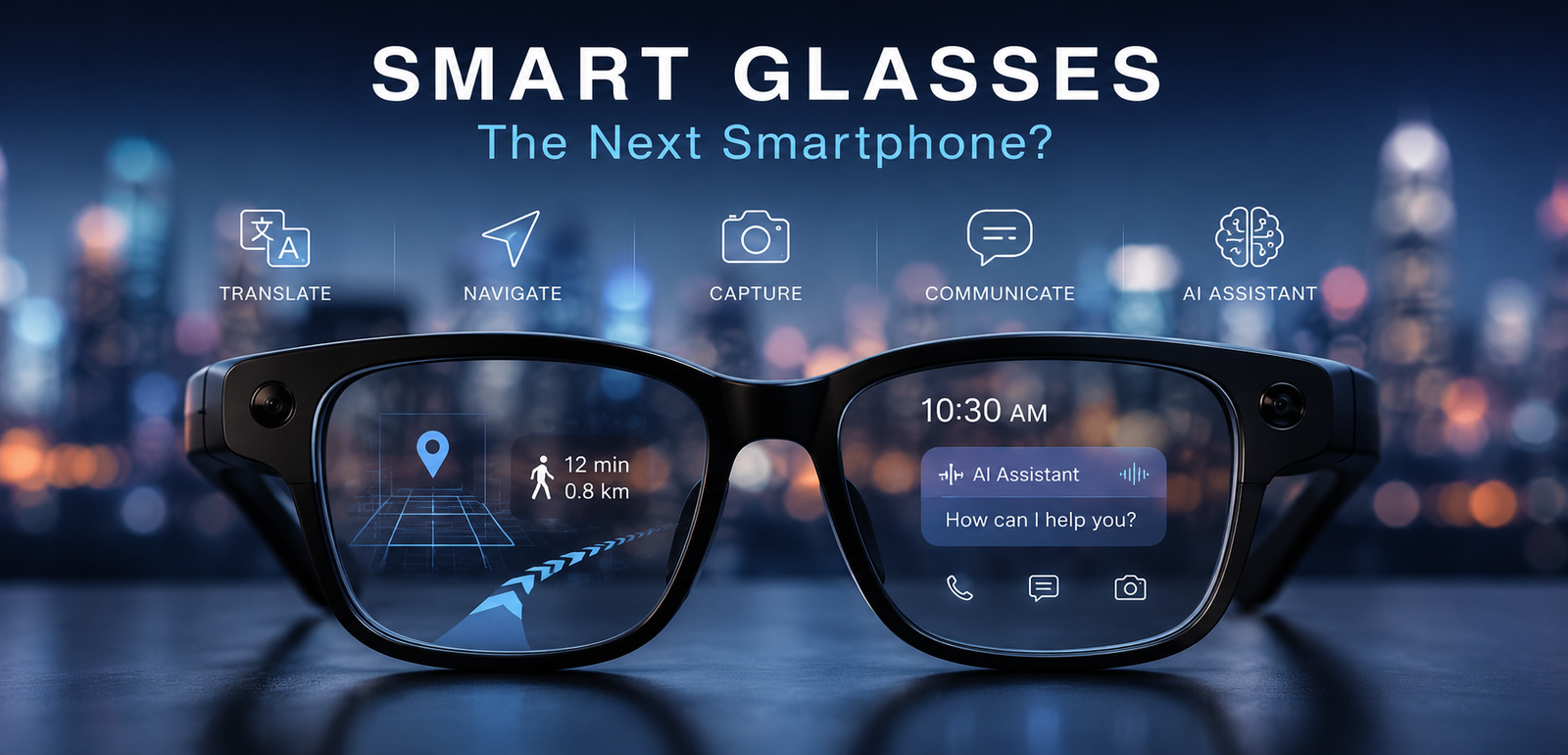
Unlike smartphones, which require users to constantly look down at a screen, smart glasses enable hands-free access to navigation, messaging, photography, translation, voice assistants, and real-time AI assistance while allowing users to stay focused on the world around them. Instead of replacing smartphones completely, smart glasses are expected to become a companion device, handling quick everyday interactions while smartphones continue serving as powerful computing hubs.
Although current smart glasses still face challenges such as battery life, privacy concerns, processing limitations, and cost, rapid improvements in AI chips, displays, and wearable hardware suggest they could become as common as smartwatches over the next decade. Whether you’re a traveler, professional, content creator, or technology enthusiast, smart glasses offer a glimpse into a future where AI is always available, making technology more natural, intuitive, and seamlessly integrated into everyday life.
Introduction
For nearly two decades, the smartphone has been the center of our digital lives. It replaced cameras, GPS devices, MP3 players, calculators, flashlights, gaming consoles, notebooks, wallets, and even desktop computers for millions of people. Today, almost everything we do—communicating, shopping, banking, learning, working, and entertaining ourselves—happens through a smartphone.
But something interesting is happening in the technology industry.
The companies that created the smartphone revolution are now investing billions of dollars into something entirely different: AI-powered smart glasses.
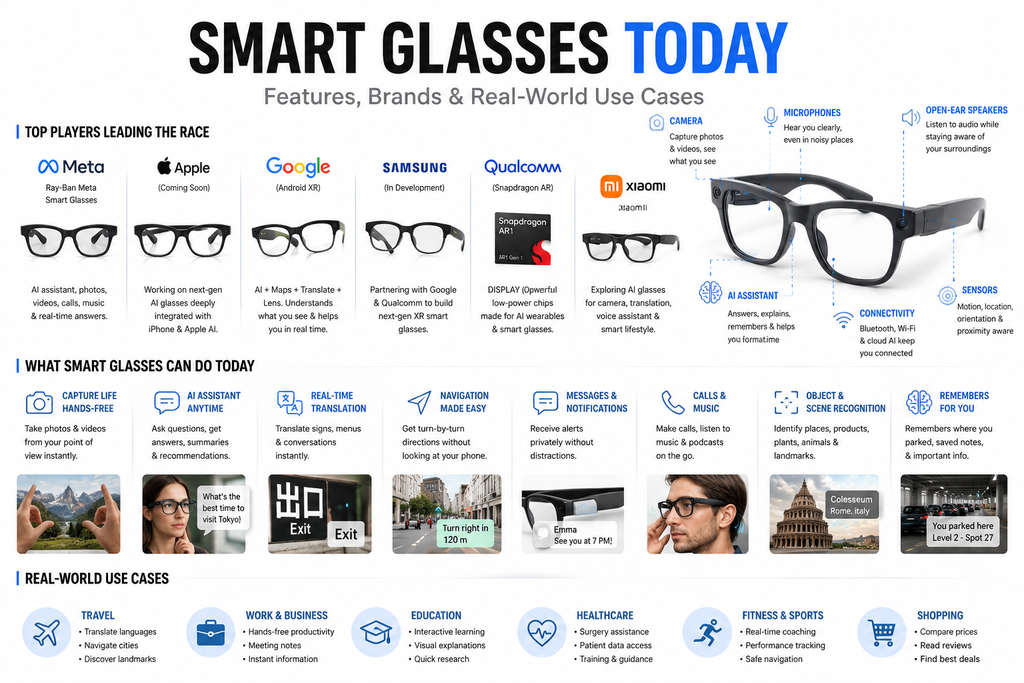
Apple is working on next-generation wearable computing. Meta is rapidly expanding its AI glasses ecosystem. Google has revived its smart glasses ambitions with Android XR. Samsung is partnering with Google and Qualcomm to build future wearable devices. Qualcomm is designing processors specifically for AI wearables, while companies like Xiaomi, Huawei, Oppo, Honor, and Vivo are racing to develop their own intelligent glasses.
This isn’t a coincidence.
When the world’s biggest technology companies all begin moving in the same direction, it usually signals the beginning of the next major computing revolution.
The question is no longer whether smart glasses will become mainstream.
The real question is whether they could eventually become as important as today’s smartphones.
The answer may surprise you.
The Evolution of Personal Computing
Technology evolves in waves. Every decade introduces a new device that fundamentally changes how humans interact with computers.
In the 1980s, desktop computers brought digital technology into homes and offices. They allowed people to write documents, play games, and access software in ways that had never been possible before.
The 1990s made computing portable through laptops. People could finally carry their work anywhere without being tied to a desk.
The 2000s belonged to smartphones. Apple, Google, Samsung, Nokia, BlackBerry, and others transformed mobile phones into pocket-sized computers capable of running powerful applications, accessing the internet, capturing high-quality photos, and connecting billions of people.
Today, smartphones dominate modern life.
However, history has repeatedly shown that no technology remains the primary computing platform forever.
Desktop computers still exist, but most people spend far more time on smartphones.
Laptops remain essential for work, yet they no longer represent the center of personal computing.
Similarly, smartphones are unlikely to disappear overnight, but they may no longer remain the primary way people interact with digital information.
Instead, they could become powerful companion devices while wearable technology takes over everyday interactions.
That transition has already begun.
Why Smartphones Are Beginning to Mature
Modern smartphones are remarkable engineering achievements.
Flagship devices now feature processors capable of performing trillions of operations every second. Cameras rival professional photography equipment in many situations. OLED displays offer stunning brightness, color accuracy, and refresh rates exceeding 120Hz. Batteries last an entire day despite increasingly demanding workloads.
Yet something feels different compared to a decade ago.
Consumers no longer rush to upgrade every year.
The excitement surrounding new smartphone launches has gradually declined.
The reason isn’t that smartphones have become worse.
It’s because they’ve become incredibly good.
When every flagship phone already offers excellent cameras, fast performance, beautiful displays, and reliable battery life, yearly improvements become increasingly difficult to notice.
Adding another camera sensor, slightly increasing processor speed, or introducing marginally brighter screens no longer creates the dramatic leap that consumers experienced during the early smartphone era.
Many users now keep their phones for three, four, or even five years before upgrading.
This slowing replacement cycle has become one of the biggest challenges facing smartphone manufacturers.
If consumers aren’t buying new phones as frequently, technology companies must find the next category capable of driving innovation and long-term growth.
Smart glasses have emerged as one of the strongest candidates.
Artificial Intelligence Has Changed Everything
If smartphones represented the biggest technological revolution of the last fifteen years, artificial intelligence is becoming the defining technology of the next fifteen.
Unlike previous software upgrades, AI fundamentally changes how humans interact with computers.
For decades, computers waited for instructions.
Users opened applications.
Pressed buttons.
Typed commands.
Clicked menus.
Browsed websites.
Artificial intelligence reverses that relationship.
Instead of navigating software manually, people simply ask questions.
Instead of searching dozens of websites, AI generates answers.
Instead of writing documents from scratch, AI helps create them.
Instead of editing images manually, AI performs complex edits within seconds.
Instead of translating sentences word by word, AI understands context and meaning.
Technology is becoming conversational.
That shift may sound subtle, but it changes everything.
Rather than learning how software works, software increasingly learns how humans think.
The challenge is that smartphones weren’t originally designed for this kind of interaction.
Typing long prompts onto a touchscreen isn’t always convenient.
Stopping to unlock a phone every few minutes interrupts conversations, walking, driving, shopping, travelling, and countless daily activities.
Artificial intelligence works best when it’s always available.
Smart glasses make that possible.
Imagine an AI That Never Leaves Your Side
Consider a typical day.
You wake up and ask about today’s weather.
You check your calendar.
You navigate through traffic.
You answer messages.
You translate a sign while travelling.
You identify a plant during your morning walk.
You search for product reviews while shopping.
You ask questions during a meeting.
You capture memorable moments with family.
Almost every one of these activities requires taking your smartphone out of your pocket.
Unlocking it.
Opening an app.
Typing.
Reading.
Closing it again.
Repeating the process dozens or even hundreds of times every day.
Smart glasses aim to eliminate those interruptions.
Imagine walking through an unfamiliar city.
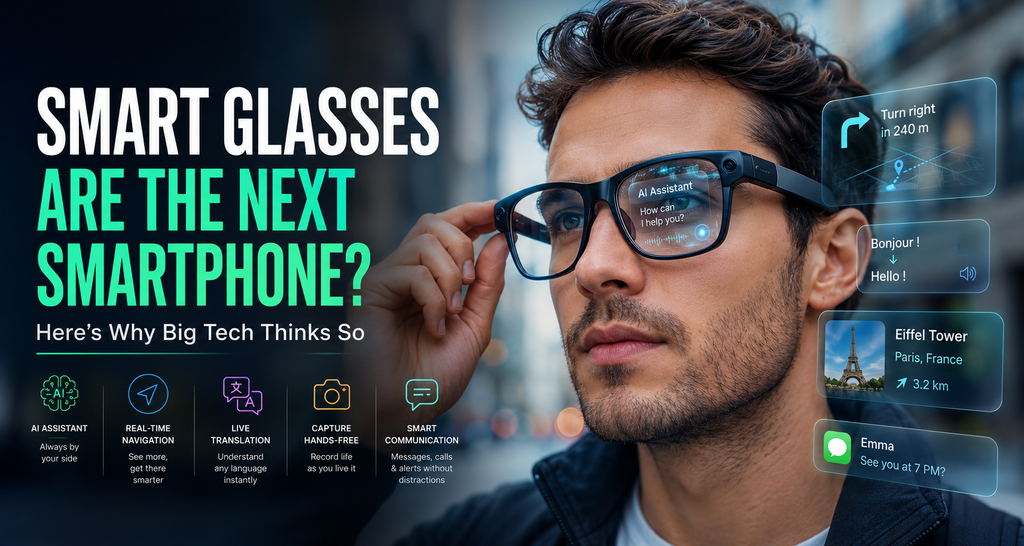
Instead of staring at Google Maps on your phone, navigation arrows quietly appear in front of your eyes while you continue looking at the road ahead.
Imagine entering a restaurant where the menu is written in a language you don’t understand.
Your glasses instantly translate every item into your preferred language.
Imagine receiving an important message.
Instead of stopping what you’re doing, you hear it through tiny speakers built into your glasses and respond naturally using your voice.
Imagine standing in front of a famous monument.
Instead of opening a browser and searching its history, you simply ask:
“What building is this?”
Your AI assistant immediately explains its history, architecture, visiting hours, and cultural significance.
This is the future that companies are trying to build.
Smart Glasses Are Not Just Another Gadget
Many people think smart glasses are simply smartphones attached to a pair of spectacles.
That couldn’t be further from the truth.
The goal isn’t to replace your smartphone by shrinking it.
The goal is to make interacting with technology feel invisible.
Instead of constantly demanding your attention through notifications, screens, and applications, smart glasses aim to blend digital information naturally into your everyday life.
Think about how much effort goes into even the simplest smartphone interaction.
A notification arrives.
You hear a sound.
Reach into your pocket.
Unlock your phone.
Read the message.
Reply.
Lock the screen.
Put the phone away.
Repeat this process countless times every day.
Each interruption may last only a few seconds, but together they consume a surprising amount of attention.
Smart glasses remove many of these small interruptions.
Technology begins adapting to humans rather than forcing humans to adapt to technology.
That simple difference has enormous implications.
Why Every Major Technology Company Is Betting on Smart Glasses
Competition in the smartphone industry has never been more intense.
Apple.
Samsung.
Google.
Xiaomi.
OnePlus.
Oppo.
Vivo.
Honor.
Huawei.
Each company spends billions of dollars developing faster processors, better cameras, improved batteries, and brighter displays.
Yet despite competing aggressively in smartphones, these same companies increasingly agree on one thing:
Wearable AI represents the future.
Whenever the entire technology industry moves together, consumers should pay attention.
The same pattern occurred before smartphones became mainstream.
The same pattern happened before cloud computing.
The same pattern happened before artificial intelligence exploded into public awareness.
History often repeats itself.
Apple’s Vision: Computing That Disappears
Apple has spent decades simplifying technology.
The Macintosh made graphical computing accessible.
The iPod transformed portable music.
The iPhone reinvented the mobile phone.
The Apple Watch reduced dependence on smartphones.
Apple’s long-term vision appears to focus on something even more ambitious.
Technology that fades into the background.
Instead of staring at screens, users simply interact naturally with intelligent devices.
Rather than pulling out a phone every few minutes, information quietly appears only when needed.
Apple believes the future isn’t about adding more screens.
It’s about making screens less necessary.
Smart glasses fit perfectly into that philosophy.
Meta Wants AI to Become Your Everyday Companion
Meta has arguably done more than any other company to bring AI smart glasses into public conversation.
Rather than waiting for perfect augmented reality technology, Meta chose a more practical approach.
It started with glasses capable of taking photos, recording videos, playing music, answering phone calls, and communicating with AI assistants.
That approach may seem simple.
In reality, it’s incredibly strategic.
Most people don’t need holograms floating in front of their eyes.
They simply want technology that makes everyday life easier.
If AI can answer questions, recognize landmarks, remember conversations, identify objects, summarize information, and assist naturally while you’re walking, cooking, travelling, or shopping, then smart glasses immediately become useful.
Practicality often wins over futuristic concepts.
Google Is Trying Again
Google introduced one of the earliest smart glasses more than a decade ago.
The idea was ahead of its time.
Battery technology was limited.
Artificial intelligence wasn’t advanced enough.
Displays were expensive.
Voice recognition struggled.
Consumers weren’t ready.
Today’s world is completely different.
Large language models understand natural conversations.
Computer vision recognizes objects almost instantly.
Cloud computing delivers enormous processing power.
Translation happens in real time.
Google Maps provides incredibly accurate navigation.
Android powers billions of devices worldwide.
All these technologies now exist simultaneously.
Google’s second attempt arrives at exactly the right moment.
Samsung Is Preparing for the Next Computing Platform
Samsung dominates the Android smartphone market alongside Apple at the premium end.
But Samsung also understands that every major technology platform eventually reaches maturity.
The company invests heavily in displays, semiconductors, AI chips, batteries, image sensors, memory, and wearable devices because it wants to remain relevant regardless of which product category dominates the future.
Whether consumers eventually adopt augmented reality glasses, mixed reality headsets, or AI-powered eyewear, Samsung intends to be ready.
Few companies control as much of the electronics supply chain as Samsung, giving it a significant advantage.
Qualcomm Is Building the Intelligence Inside Future Glasses
Most consumers recognize smartphone brands.
Far fewer recognize the companies designing the processors inside those devices.
Qualcomm has quietly become one of the most influential technology companies in mobile computing.
Future smart glasses require processors capable of running sophisticated AI models while consuming extremely little power.
Unlike smartphones, glasses cannot accommodate large batteries or cooling systems.
Every milliwatt matters.
Qualcomm is designing chips specifically for these challenges.
Future wearable processors must simultaneously handle computer vision, voice recognition, AI inference, wireless communication, audio processing, image capture, and sensor fusion—all within frames weighing only a few dozen grams.
That’s one of the biggest engineering challenges of modern consumer electronics.
Chinese Brands Are Moving Faster Than Ever
Chinese manufacturers rarely ignore emerging technology trends.
Companies like Xiaomi, Huawei, Honor, Oppo, Vivo, TCL, and Lenovo have become increasingly aggressive in wearable AI.
These companies already manufacture smartphones, earbuds, smartwatches, tablets, laptops, televisions, and AI-powered home devices.
Adding smart glasses to that ecosystem is a natural next step.
Competition among these manufacturers will likely accelerate innovation while making smart glasses more affordable over the next several years.
Just as Android smartphones eventually became available across every price segment, smart glasses are expected to follow a similar path.
What Exactly Are Smart Glasses?
Despite their futuristic reputation, smart glasses often look surprisingly ordinary.
Most resemble regular spectacles or sunglasses.
The technology is hidden inside the frame.
Modern AI-powered smart glasses combine multiple advanced components into an incredibly compact device.
Cameras
Tiny high-resolution cameras capture photos and videos while also helping artificial intelligence understand the surrounding environment. They recognize landmarks, identify objects, scan QR codes, read text, and assist with visual search.
Microphones
Multiple microphones capture voice commands while filtering background noise. Advanced beamforming technology ensures the AI assistant hears your voice clearly, even in noisy environments such as airports, restaurants, or busy streets.
Open-Ear Speakers
Instead of covering your ears like headphones, directional speakers project sound toward your ears while allowing surrounding sounds to remain audible. This design keeps users aware of traffic, conversations, and environmental hazards.
Artificial Intelligence
AI acts as the brain of the entire system. It understands spoken language, answers questions, translates conversations, identifies objects, summarizes information, provides navigation, and performs countless intelligent tasks using both on-device processing and cloud computing.
Sensors
Accelerometers, gyroscopes, GPS, ambient light sensors, proximity sensors, and future eye-tracking systems help the glasses understand movement, orientation, location, and user interactions.
Connectivity
Bluetooth connects the glasses to smartphones. Wi-Fi and cloud services provide access to powerful AI models, software updates, real-time translations, internet searches, and online assistants.
Displays
Some smart glasses include tiny transparent displays capable of projecting navigation arrows, notifications, translations, or contextual information directly into the wearer’s field of view. Others deliberately avoid displays altogether, relying entirely on voice interaction to create a simpler, lighter experience.
The Biggest Difference Isn’t the Hardware
The cameras are impressive.
The microphones are excellent.
The speakers are surprisingly capable.
The processors are incredibly efficient.
But none of these components represent the true breakthrough.
The real innovation is context.
Your smartphone only knows what you tell it.
Smart glasses understand much more.
They know where you’re looking.
They know where you’re walking.
They recognize objects around you.
They understand conversations.
They remember previous interactions.
They combine this contextual awareness with artificial intelligence to deliver information exactly when it’s needed.
That transforms computing from reactive to proactive.
Instead of waiting for commands, technology begins understanding situations.
And that’s precisely why so many experts believe smart glasses aren’t just another gadget—they could become the next major computing platform after the smartphone.
What Can Smart Glasses Actually Do Today?
One of the biggest misconceptions surrounding smart glasses is that they are still science fiction. While fully immersive augmented reality glasses are still a few years away from becoming mainstream, today’s AI-powered smart glasses are already surprisingly capable.
Modern smart glasses can take photos, record videos, answer questions using artificial intelligence, translate languages, provide navigation, play music, make phone calls, read notifications, identify objects, and even remember information for you.
However, they are not all built the same.
Some focus on artificial intelligence.
Some prioritize cameras.
Others emphasize augmented reality.
Understanding the different approaches taken by major technology companies helps explain where the industry is heading.
Meta’s AI Glasses: The Current Market Leader
If one company deserves credit for making smart glasses exciting again, it is Meta.
Instead of trying to build an expensive futuristic computer for your face, Meta asked a much simpler question:
“What if glasses could simply become your AI companion?”
That philosophy changed everything.
Rather than projecting complicated holograms everywhere, Meta focused on solving everyday problems.
Imagine walking through a market and asking,
“What fruit is this?”
The AI identifies it instantly.
You’re cooking dinner and forget an ingredient.
Instead of touching your phone with messy hands, you simply ask your glasses.
Need directions while cycling?
Ask the glasses.
Want to take a quick photo without reaching into your pocket?
Tap the frame.
Need to translate a sign in another country?
Ask AI.
These are small conveniences individually.
Together, they dramatically reduce how often people need to look at their smartphones.
Meta’s strategy is clear.
The glasses don’t replace the phone.
They replace hundreds of tiny interactions with the phone.
Why AI Makes Meta’s Glasses Different
Traditional smart glasses mostly acted like Bluetooth accessories.
They played music.
Handled phone calls.
Displayed notifications.
Meta added artificial intelligence.
Now the glasses don’t simply connect you to your phone.
They understand your surroundings.
Imagine standing inside a supermarket.
You look at two different coffee brands.
You ask,
“Which one has better reviews?”
The AI can analyze what you’re looking at and answer naturally.
Walking through a museum?
Ask about a painting.
Looking at a flower?
Ask its name.
Confused about a machine?
Ask how it works.
The camera becomes AI’s eyes.
The microphone becomes AI’s ears.
The speakers become AI’s voice.
For the first time, wearable computing begins feeling genuinely intelligent.
Apple Is Playing the Long Game
Apple has never been first.
It rarely tries to be.
Instead, Apple usually waits until technologies mature before refining them into polished consumer products.
The iPhone wasn’t the first smartphone.
The Apple Watch wasn’t the first smartwatch.
AirPods weren’t the first wireless earbuds.
Yet Apple transformed every category.
Industry analysts expect Apple to follow the same strategy with smart glasses.
Rather than launching an unfinished product, Apple appears focused on creating something lightweight, stylish, private, and deeply integrated into its ecosystem.
Imagine wearing ordinary-looking glasses that quietly work with your iPhone.
Walking directions appear only when needed.
Messages arrive discreetly.
Siri understands everything happening around you.
Photos are captured instantly.
Translation happens automatically.
Calendar reminders appear naturally.
Apple’s strength has always been ecosystem integration.
Your Mac.
Your iPhone.
Your iPad.
Your Apple Watch.
Your AirPods.
Future smart glasses could become another seamless part of that ecosystem.
Google’s Android XR Vision
Google helped invent many technologies that make modern smart glasses possible.
Google Maps.
Google Lens.
Google Assistant.
Gemini AI.
Android.
Cloud AI.
Real-time translation.
Now Google is bringing these technologies together through Android XR.
Unlike traditional Android designed for smartphones, Android XR is built specifically for wearable computing.
Instead of thinking in terms of applications, Android XR thinks in terms of experiences.
Imagine asking,
“Translate everything I see.”
The system continuously translates signs, menus, and documents.
Imagine saying,
“Remember where I parked.”
Hours later, your glasses guide you directly back to your car.
Imagine looking at a complicated machine.
Google AI explains every visible component.
This represents contextual computing.
The computer understands what you’re seeing.
Samsung’s Hardware Advantage
Samsung may have one of the strongest positions in the wearable industry.
Why?
Because Samsung builds many of the components that other companies depend on.
Displays.
Memory chips.
Camera sensors.
Processors.
Batteries.
OLED technology.
Manufacturing expertise.
This gives Samsung enormous flexibility when designing future smart glasses.
The company also has years of experience producing smartwatches, wireless earbuds, foldable phones, and premium mobile devices.
Everything learned from those products contributes toward wearable AI.
Samsung’s challenge isn’t hardware.
It’s creating software experiences compelling enough to convince users that glasses deserve a place alongside smartphones.
Qualcomm: The Company Behind the Curtain
Consumers rarely think about processors.
Yet every intelligent wearable depends on extremely efficient silicon.
Unlike smartphones, smart glasses cannot contain massive batteries.
Weight matters.
Heat matters.
Comfort matters.
Future AI glasses must run sophisticated machine learning models while consuming minimal power.
That’s where Qualcomm plays a crucial role.
Its wearable processors are designed to perform continuous camera analysis, speech recognition, AI inference, image processing, wireless communication, and sensor fusion simultaneously.
Without specialized chips, modern AI glasses simply wouldn’t exist.
Xiaomi and Chinese Manufacturers Are Moving Fast
Chinese technology companies have become remarkably effective at turning emerging technologies into affordable consumer products.
Xiaomi, Honor, Huawei, Oppo, Vivo, TCL, Lenovo, and several startups are all investing heavily in wearable AI.
Historically, Chinese manufacturers have accelerated adoption by offering capable products at significantly lower prices.
The same pattern may repeat here.
Premium AI glasses will likely launch first.
More affordable alternatives will follow rapidly.
Competition benefits consumers.
It encourages faster innovation, lower prices, and broader software ecosystems.
How AI Sees the World Through Smart Glasses
One of the biggest technological breakthroughs isn’t the glasses themselves.
It’s computer vision.
Computer vision allows artificial intelligence to understand images almost like humans do.
When you look at a dog, your brain instantly recognizes it.
Modern AI models can now do something remarkably similar.
Point your glasses toward:
A building.
A flower.
A landmark.
A painting.
A product.
A menu.
A QR code.
A receipt.
A mathematical equation.
A business card.
The AI identifies what you’re seeing and provides useful information within seconds.
This transforms cameras from passive recording devices into intelligent assistants.
Instead of merely capturing the world, they begin understanding it.
Real-Time Translation Feels Like Science Fiction
Language has always been one of humanity’s biggest barriers.
Imagine landing in Tokyo.
Street signs are unfamiliar.
Restaurant menus are unreadable.
Train announcements make little sense.
Traditional translation apps require stopping repeatedly.
Taking out your phone.
Opening an application.
Capturing a photo.
Waiting for translation.
Repeating the process.
Smart glasses eliminate these interruptions.
Future systems continuously translate text while you continue walking naturally.
Hold conversations.
Read instructions.
Navigate airports.
Understand menus.
Communicate confidently.
The technology becomes nearly invisible.
Navigation Without Looking Down
Nearly everyone has experienced the same problem.
You’re walking through an unfamiliar city while staring down at your smartphone.
You miss scenery.
You bump into people.
You lose awareness of traffic.
Smart glasses solve this elegantly.
Instead of displaying an entire map, they simply show subtle navigation cues.
Turn left.
Continue straight.
Destination ahead.
That’s all most people actually need.
Navigation becomes less distracting and significantly safer.
Cyclists, hikers, runners, and travelers stand to benefit enormously.
Photography Without Missing the Moment
Smartphone cameras are excellent.
But they require taking the phone out first.
By the time you’re ready, the moment may already be gone.
Smart glasses change that.
Imagine watching your child score a goal.
A beautiful sunset appears.
Your pet does something hilarious.
Instead of reaching into your pocket, you simply press a button or use a voice command.
The moment is captured instantly.
Because the camera sits at eye level, photos and videos naturally reflect what you actually experienced.
Content creators are particularly excited about this capability.
First-person perspectives feel immersive and authentic.
AI That Remembers Things for You
Human memory isn’t perfect.
We forget names.
Parking locations.
Shopping lists.
Conversations.
Appointments.
Imagine telling your glasses,
“Remember where I left my backpack.”
Later, simply ask,
“Where is my backpack?”
AI searches previous visual information and reminds you.
Imagine meeting someone briefly.
A week later you ask,
“Who was the person I met at yesterday’s conference?”
Future AI systems may help reconstruct those memories using contextual information.
This isn’t about replacing human memory.
It’s about extending it.
Health and Accessibility Applications
Smart glasses could become life-changing for millions of people.
People with visual impairments may receive descriptions of their surroundings.
Street crossings.
Obstacle warnings.
Text reading.
Object identification.
Face recognition for familiar contacts.
Color identification.
Indoor navigation.
For elderly users, AI reminders could help with medication schedules, appointments, and emergency notifications.
Workers may receive safety alerts.
Students could receive educational assistance.
Accessibility may become one of the most meaningful applications of wearable AI.
Productivity Without Interruptions
Imagine working in an office.
A message arrives.
Instead of stopping your conversation, you receive a discreet notification.
Calendar reminder.
Meeting starts in five minutes.
Your next appointment location appears.
Need information during a meeting?
Quietly ask AI.
Need to summarize notes?
AI handles it.
Need quick calculations?
Ask naturally.
Instead of constantly switching between conversations and smartphones, productivity becomes more fluid.
Professionals could save countless small interruptions every day.
Shopping Becomes Smarter
Imagine standing inside an electronics store.
You look at a laptop.
Ask,
“Is this a good deal?”
AI compares prices.
Reviews.
Specifications.
Alternatives.
Warranty information.
Environmental ratings.
Similarly, grocery shopping becomes easier.
Identify healthier products.
Understand ingredients.
Check allergens.
Compare nutrition.
Estimate costs.
Shopping becomes informed instead of impulsive.
Travel Without Language Barriers
Travelers may become some of the earliest mainstream adopters.
Imagine visiting Europe.
Your glasses:
Translate signs.
Read train schedules.
Identify landmarks.
Convert currencies.
Provide walking directions.
Recommend nearby restaurants.
Explain historical monuments.
Help pronounce local phrases.
Instead of constantly opening multiple travel applications, AI becomes your personal guide.
Education Becomes Interactive
Students could benefit enormously.
Imagine reading a biology textbook.
Look at a diagram.
Ask AI for a simpler explanation.
Reading history?
Point toward a historical monument.
Receive contextual information instantly.
Studying engineering?
Identify machine components visually.
Learning becomes conversational rather than passive.
Instead of searching separately, information appears exactly when curiosity arises.
The Biggest Challenge: Battery Life
Despite incredible progress, smart glasses still face serious limitations.
Battery life remains one of the biggest obstacles.
Running cameras continuously.
Listening for voice commands.
Processing AI.
Maintaining wireless connectivity.
Displaying information.
All consume significant energy.
Unlike smartphones, glasses cannot contain large batteries.
Engineers must balance performance, comfort, weight, and operating time.
Battery technology will play a major role in determining how quickly smart glasses become mainstream.
Privacy Remains a Major Concern
Whenever cameras become smaller, privacy questions become bigger.
How do people know when recording is happening?
How is visual data processed?
What information remains on-device?
What gets uploaded to cloud servers?
Can strangers identify when AI is analyzing them?
Manufacturers are introducing recording indicators, privacy lights, on-device AI processing, and transparent policies.
Still, earning public trust may become just as important as advancing technology itself.
Today’s Smart Glasses Are Only the Beginning
Current smart glasses are impressive.
Future generations will likely be dramatically more capable.
Better batteries.
Lighter frames.
More powerful AI.
Brighter displays.
Improved privacy.
Longer operating time.
Lower prices.
Today’s devices resemble smartphones from the late 2000s—already useful, but still far from their ultimate potential.
The pace of innovation suggests that what seems extraordinary today could become completely ordinary within the next decade.
Smart Glasses vs Smartphones: Will They Really Replace Your Phone?
Every time a revolutionary technology appears, the same question follows.
Will it replace what we already use?
When laptops became popular, many believed desktop computers would disappear.
They didn’t.
When tablets arrived, experts predicted the end of laptops.
That never happened.
When smartphones exploded in popularity, people expected them to replace PCs completely.
Instead, each device found its own role.
The same pattern is likely to repeat with smart glasses.
Rather than replacing smartphones overnight, they will gradually change how we use them.
In the future, your smartphone may become something you rarely touch but always carry.
The phone will remain the computing powerhouse inside your pocket, while your glasses become the primary interface for interacting with that computing power.
Think of it this way.
Today, you look at your phone.
Tomorrow, information may simply appear around you.
Smart Glasses vs Smartphones
| Feature | Smartphones | Smart Glasses |
|---|---|---|
| Screen | Large touchscreen | Tiny display or no display |
| Input | Touch, keyboard, voice | Voice, gestures, AI, eye tracking (future) |
| Portability | Always worn | |
| Camera | High-quality rear cameras | First-person perspective |
| Navigation | Requires looking down | Hands-free directions |
| AI Interaction | Open app or assistant | Always available |
| Translation | Manual | Real-time and continuous |
| Notifications | Screen-based | Discreet audio or visual alerts |
| Photography | Take phone out | Instant capture |
| Battery | Large | Limited |
| Gaming | Excellent | Limited |
| Productivity | Excellent | Companion device |
| Comfort | Carry separately | Wear all day |
| Privacy | Better controlled | Greater concerns |
| Best For | Everything | Everyday AI assistance |
The comparison makes one thing clear.
Smart glasses are not trying to beat smartphones in every category.
They’re trying to eliminate the small, repetitive interactions that happen hundreds of times every day.
What Smart Glasses Still Can’t Do
Despite the excitement, today’s smart glasses are far from perfect.
Understanding their limitations is just as important as understanding their strengths.
Limited Battery Life
The biggest challenge is battery technology.
Running cameras, microphones, speakers, wireless radios, sensors, and AI simultaneously consumes significant power.
Most current smart glasses last only a few hours of heavy usage.
Until battery technology improves dramatically, smartphones will continue serving as the primary computing device.
Processing Power
Modern smartphones contain incredibly powerful processors.
Many AI tasks require enormous computational resources.
Although wearable processors are improving rapidly, smart glasses still rely heavily on smartphones or cloud servers for demanding workloads.
Future chips will reduce this dependence, but that transition will take time.
Display Limitations
Even the best smart glasses cannot match the viewing experience of a large smartphone screen.
Watching movies.
Editing photographs.
Playing competitive games.
Writing lengthy documents.
Video conferencing.
Reading books.
These tasks remain much more comfortable on smartphones, tablets, or computers.
Fashion Matters
Unlike smartphones, glasses become part of your appearance.
People happily carry identical phones.
They don’t necessarily want identical eyewear.
Manufacturers must convince consumers that smart glasses are both fashionable and technologically advanced.
If people don’t enjoy wearing them, even the smartest technology won’t succeed.
Prescription Lens Compatibility
Millions of people already wear prescription glasses.
Future smart glasses must easily support prescription lenses without making products significantly heavier or more expensive.
Companies are actively working on this challenge.
Privacy Concerns
Perhaps the biggest obstacle isn’t technical.
It’s social.
People generally know when someone is recording with a smartphone.
Smart glasses are different.
Tiny cameras can make bystanders uncomfortable.
Questions naturally arise.
Is recording happening?
Where is data stored?
Who owns the information?
Can facial recognition identify strangers?
Technology companies will need strong privacy protections and transparent policies before widespread public acceptance occurs.
Industries That Could Change Forever
Smart glasses won’t impact everyone equally.
Some professions may experience dramatic transformation.
Healthcare
Doctors could review patient information while keeping both hands free.
Surgeons may receive real-time guidance during procedures.
Nurses could verify medications instantly.
Medical students may receive interactive learning experiences.
Manufacturing
Engineers working on complex machinery could receive repair instructions directly in their field of view.
Technicians might identify faulty components instantly.
Maintenance becomes faster and more accurate.
Education
Students could transform learning into an interactive experience.
Imagine looking at the solar system in a textbook and seeing planets appear in three dimensions.
Historical landmarks could provide contextual information during field trips.
Chemistry experiments could display safety instructions automatically.
Education becomes immersive rather than passive.
Retail
Sales staff may instantly access inventory information.
Customers could compare products without searching online.
AI might recommend alternatives based on price, reviews, or specifications.
Shopping becomes far more personalized.
Logistics
Warehouse workers could receive picking instructions without carrying handheld scanners.
Delivery personnel might navigate more efficiently.
Inventory management becomes faster and less error-prone.
Tourism
Imagine visiting Rome.
Instead of hiring a guide, your glasses explain every monument automatically.
Walking through museums becomes interactive.
Foreign languages become less intimidating.
Travel becomes more immersive.
Accessibility
Perhaps the greatest impact will be for people with disabilities.
Future smart glasses may:
- Describe surroundings for visually impaired users.
- Read printed text aloud.
- Recognize familiar faces.
- Detect obstacles.
- Identify products.
- Guide indoor navigation.
- Translate conversations.
- Assist elderly users with reminders.
This could significantly improve independence for millions of people.
Who Should Consider Buying Smart Glasses Today?
Although smart glasses aren’t replacing smartphones yet, certain users can already benefit greatly.
Content Creators
First-person videos feel more natural than handheld recordings.
Cooking tutorials.
Travel vlogs.
Cycling adventures.
Family memories.
Everything becomes easier to capture.
Travelers
Real-time navigation.
Language translation.
Currency conversion.
Landmark identification.
Restaurant recommendations.
Travel becomes significantly more convenient.
Professionals
Business users can receive notifications discreetly, join calls hands-free, capture ideas instantly, and interact with AI without constantly checking their phones.
Cyclists and Runners
Hands-free navigation improves safety.
Music playback remains accessible.
Calls become easier.
Fitness tracking integrates naturally.
Early Technology Enthusiasts
People who enjoy experiencing emerging technologies will find today’s smart glasses surprisingly capable, even if they’re still evolving.
Who Should Wait?
Not everyone needs smart glasses today.
If your primary smartphone usage involves:
- Gaming
- Watching movies
- Mobile photography
- Video editing
- Reading books
- Social media scrolling
- Long work sessions
Then current smart glasses probably won’t replace much of your daily routine.
Waiting another few product generations may be the smarter decision.
The Biggest Technological Challenges Ahead
Several major breakthroughs must occur before smart glasses become truly mainstream.
Better Batteries
Consumers expect all-day usage.
Current products still struggle with continuous AI processing.
Battery chemistry remains one of the industry’s biggest research priorities.
More Powerful AI Chips
Future processors must deliver desktop-class intelligence while consuming only tiny amounts of power.
Companies like Qualcomm, Apple, Google, Samsung, and MediaTek are investing heavily in this area.
Smaller Displays
MicroLED technology, waveguide optics, and advanced projection systems continue improving.
Future displays will become brighter, smaller, lighter, and more energy-efficient.
Improved Artificial Intelligence
Today’s AI already feels impressive.
Tomorrow’s systems will understand context much better.
Instead of waiting for commands, AI may proactively provide useful information before you even ask.
Lower Prices
Like every new technology, smart glasses currently command premium prices.
Mass production, increased competition, and component improvements will gradually make them more affordable.
The same happened with smartphones, smartwatches, wireless earbuds, and OLED televisions.
Will Smart Glasses Replace Smartphones?
The short answer is:
Not completely.
At least not anytime soon.
Instead, smartphones and smart glasses will likely evolve into complementary devices.
Think about smartwatches.
They didn’t replace smartphones.
They reduced dependence on them.
Smart glasses will probably follow the same path—but on a much larger scale.
Your smartphone becomes:
- The processor.
- The storage.
- The battery.
- The internet connection.
- The application hub.
Your glasses become:
- The display.
- The microphone.
- The camera.
- The speakers.
- The AI interface.
Eventually, you may only reach for your smartphone when performing tasks that genuinely require a large screen.
Everything else could happen naturally through your glasses.
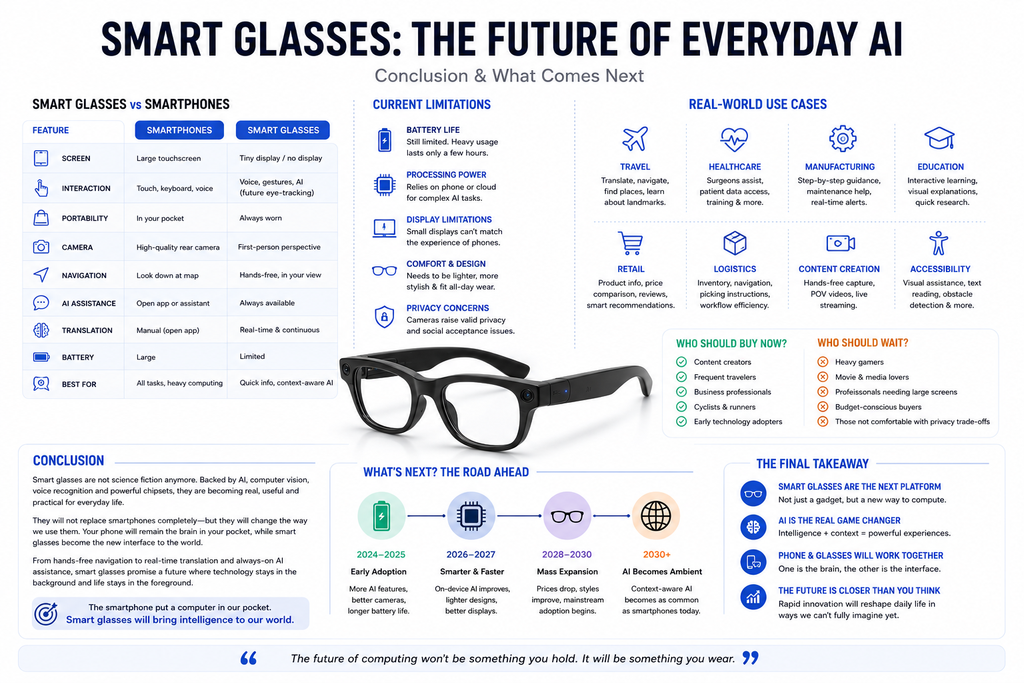
Looking Ahead: The Next Decade
The next ten years may redefine personal computing.
Artificial intelligence is advancing faster than almost anyone predicted.
Processors continue becoming more efficient.
Displays are shrinking.
Batteries are improving.
Computer vision is becoming remarkably accurate.
Voice recognition feels increasingly natural.
What seems futuristic today may become ordinary sooner than we expect.
Remember how unusual wireless earbuds once seemed?
Today, they’re everywhere.
The same was true for smartphones.
History suggests wearable AI could follow a similar path.
Final Verdict
Smart glasses are no longer a futuristic concept reserved for science fiction movies.
They have become one of the most exciting frontiers in consumer technology.
While today’s products still have limitations—including battery life, privacy concerns, cost, and software maturity—they already demonstrate a glimpse of how humans may interact with technology in the coming decade.
The biggest change isn’t that smart glasses place a screen in front of your eyes.
The biggest change is that they allow artificial intelligence to become continuously available without demanding your attention.
Instead of opening apps, you simply ask.
Instead of searching manually, AI understands what you’re looking at.
Instead of interrupting your day to interact with technology, technology quietly supports your day in the background.
That shift may prove even more significant than the arrival of the smartphone itself.
Will smart glasses replace smartphones?
Probably not.
But they may redefine our relationship with them.
The smartphone transformed the world by putting a computer in our pocket.
Smart glasses could transform it again by bringing intelligence directly into our everyday lives.
One thing is becoming increasingly clear.
The future of computing may no longer be something you hold in your hand.
It may be something you simply wear.
Frequently Asked Questions (FAQ)
Are smart glasses better than smartphones?
Not yet. Smartphones remain more powerful for gaming, productivity, photography, and entertainment. Smart glasses excel at hands-free AI assistance, navigation, communication, and contextual information.
Can smart glasses work without a smartphone?
Some models can perform basic functions independently, but most currently rely on a smartphone or cloud connection for advanced AI features.
Do smart glasses have cameras?
Many modern smart glasses include built-in cameras for photos, videos, object recognition, and AI-powered visual understanding. However, not every model includes a camera.
Can smart glasses translate languages in real time?
Yes. Several modern smart glasses already support real-time translation of spoken conversations and written text, with accuracy improving rapidly thanks to advances in AI.
Are smart glasses safe to wear all day?
Most current models are designed for extended use and resemble ordinary eyewear. Comfort depends on weight, battery size, and frame design.
Will smart glasses replace laptops too?
Unlikely. Laptops will continue to dominate content creation, programming, professional editing, and other complex tasks. Smart glasses are expected to complement existing devices rather than replace them.
Should you buy smart glasses in 2026?
If you’re an early adopter, frequent traveler, content creator, or someone excited about AI-powered wearable technology, smart glasses are worth exploring. For most users, waiting another generation or two will likely provide better battery life, improved software, and more affordable prices.