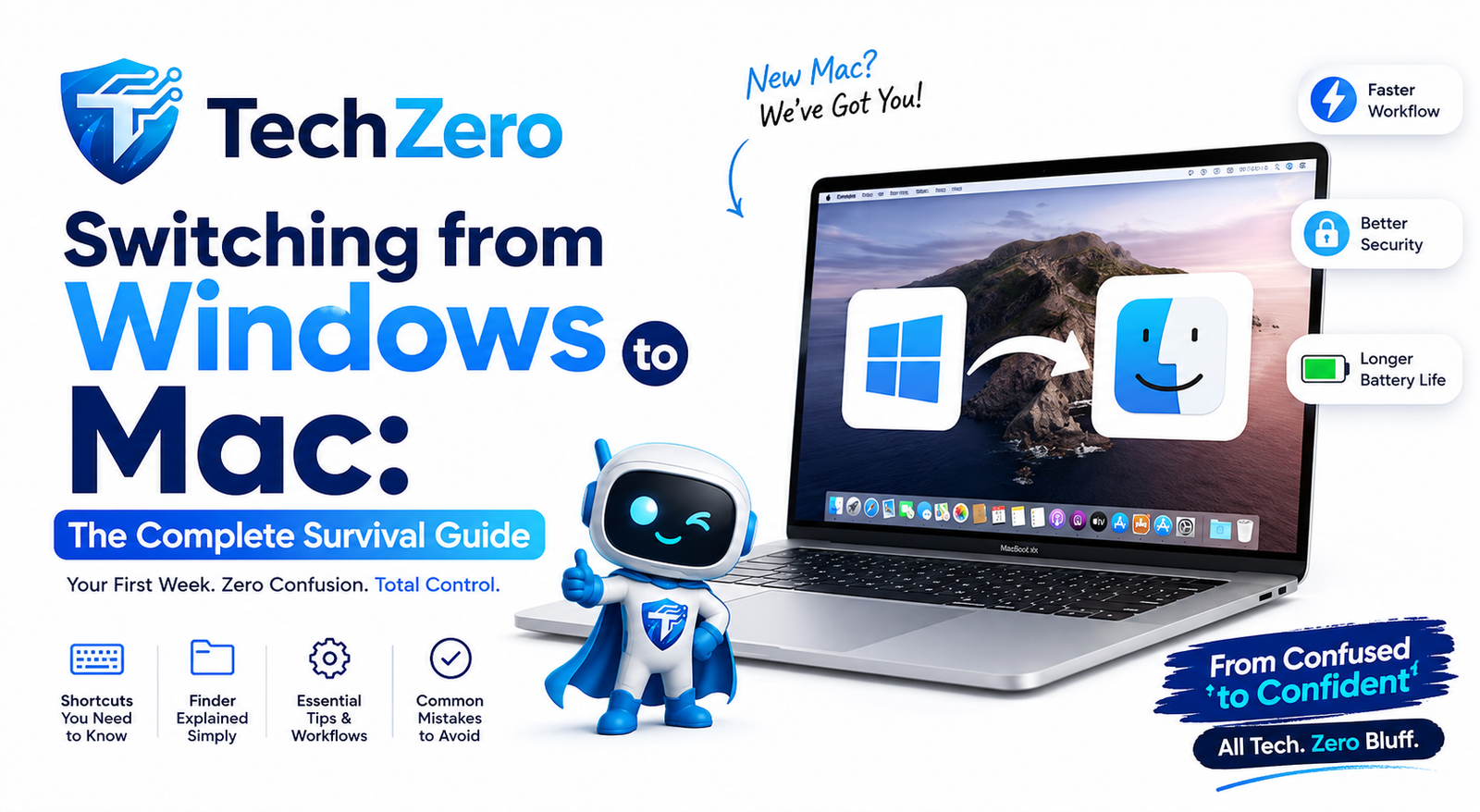

Welcome to the Apple Ecosystem
If you are staring at your new Mac, desperately pressing Ctrl+C and wondering why nothing is happening, take a deep breath.
Switching from Windows to Mac is like moving to a new country: the roads look similar, but you are suddenly driving on the other side. This guide is your ultimate translation manual—walking you through every single “Wait… why doesn’t this work?” moment.
📌 Day 1 Survival Kit
Don’t scroll through a massive guide just to figure out how to copy a file. Here are the absolute essentials to survive your first hour:
| If you want to… | Press This |
|---|---|
| Copy | ⌘ C |
| Paste | ⌘ V |
| Cut (Move file) | ⌘ C → ⌘ ⌥ V |
| Undo | ⌘ Z |
| Switch Apps | ⌘ Tab |
| Force Quit (Frozen app) | ⌘ ⌥ Esc |
| Search Everything | ⌘ Space |
| Screenshot | ⌘ ⇧ 4 |
| Lock Screen | ⌃ ⌘ Q |
| Emoji Picker | Fn or 🌐 / ⌃ ⌘ Space |
Part 1: Keyboard & Typing (The Muscle Memory Reset)
Your fingers are programmed for Windows shortcuts. Here is the reality check:
- The Control Key is Dead to You: On Mac, most standard shortcuts abandon the Control key. Your new best friend is the Command (⌘) key.
- Alt becomes Option (⌥): This isn’t just an Alt key. It enables special characters, fast word navigation, and unlocks hidden menus.
- Delete vs. Backspace: The Mac
Deletekey behaves exactly like the WindowsBackspacekey. To get a true Windows “Forward Delete,” press Fn + Delete. - Navigation: Forget Home and End keys. To go to the start/end of a line, use ⌘ + Left/Right Arrow. To jump to the top/bottom of a document, use ⌘ + Up/Down Arrow.
Part 2: Mouse & Trackpad
Apple’s trackpads are legendary, but they require a slight adjustment from a standard PC mouse.
- Right-Click (Secondary Click): It is often disabled out of the box! Go to System Settings and enable “Secondary Click,” or simply tap with two fingers on the trackpad.
- Natural Scrolling: Mac scrolls like a smartphone—pushing two fingers up moves the content up. If you hate it, turn off “Natural Scrolling” in Trackpad settings.
- Touch ID: It’s not just for logging in. Use your fingerprint to autofill passwords, authenticate Apple Pay purchases, approve app installations, and unlock deep System Settings.
- Force Click: Modern Mac trackpads are pressure-sensitive. Press down deeper (until you feel a second click) on a word to get an instant dictionary definition, or Force Click a file to instantly preview it.
Part 3: Menu Bar & Dock (Understanding the Desktop)
If you are a Windows user on Mac, the desktop layout is usually the first major point of confusion.
The Menu Bar at the Top
Unlike Windows—where every app window carries its own File/Edit/View menu inside the window—macOS locks a single, global Menu Bar to the very top of your screen. This bar dynamically changes to match whichever application is currently active.
The “Option-Click” Secret
Hold down the ⌥ Option key while clicking the , , , or icons in the top right menu bar.
The Dock (Not a Taskbar)
The Dock holds your apps, but it behaves differently than the Windows Taskbar. Apps stay pinned there whether they are open or closed.
- How to tell what is running: Look closely at the bottom of the app icons in the Dock. If there is a tiny black dot beneath the icon, the app is actively running in memory. No dot? The app is completely closed.
Part 4: Finder (Where Are My Files?)
Finder is your new File Explorer, but it plays by completely different rules.
- There is no C: Drive: Everything starts from your user folder (
/Users/Name). You won’t see an address bar by default; press ⌘ + Shift + G (Go to Folder) to type a direct path. - Hidden Files: Want to see them? Press ⌘ + Shift + . (period).
- The Cut & Paste Confusion: macOS doesn’t let you “Cut” a file in the traditional sense. Copy the file normally (
⌘ C). When you go to paste it, press ⌘ + Option + V. This pastes the file and deletes the original, effectively moving it. - Renaming: Do not press
F2. Just click the file once and press Return.
Quick Look
Select any file (PDF, image, video, spreadsheet) and press the Spacebar. It instantly pops open a lightning-fast preview without launching heavy applications. Press the spacebar again to close it. You will use this 50 times a day.
Part 5: The App Lifecycle Mystery
Closing a window and quitting an app are two completely different things on macOS.
- The Red X: Closes the current window. It does not quit the application. (Remember to look for the tiny dot in the Dock).
- To actually quit: You must press ⌘ + Q.
- Installing: Say goodbye to
.exeinstallers. Most Mac apps download as.dmg(disk image) files. Open it, and literally drag the app icon into the Applications folder. - Uninstalling: Drag the app from the Applications folder to the Trash. (For a cleaner uninstall that removes hidden cache files, use a free tool like AppCleaner).
- Task Manager Replacement: When an app freezes, press ⌘ + Option + Esc to bring up the Force Quit menu. For deeper CPU/RAM system stats, search for Activity Monitor.
Part 6: Window Management
macOS does not have native, drag-to-the-edge window snapping like Windows.
- Split View: Hover your mouse over the Green Button in the top left of any window to tile it neatly to the left or right of the screen.
- Mission Control: Swipe up on the trackpad with three fingers. Every open window instantly zooms out so you can see them all spread across your screen at once.
- The Fix for Windows Snapping: Download a free app called Rectangle. It brings exact Windows-style keyboard shortcuts and drag-to-edge snapping back to your MacBook.
Part 7: Screenshots, Quick Actions & Clipboard
- Screenshots: There is no Print Screen button.
⌘ + ⇧ + 3: Captures the whole screen.⌘ + ⇧ + 4: Captures a selected portion.⌘ + ⇧ + 5: Opens the advanced screen recording and capture menu.
- Universal Clipboard: This will blow your mind. Copy text on your iPhone. Press
⌘ Von your Mac. It pastes instantly. They share the same invisible clipboard securely over iCloud.
Quick Actions
Right-click any image on your Desktop or in Finder, and look for at the bottom of the menu. You can instantly perform complex tasks without ever opening a single application.
Part 8: Spotlight (The Ultimate Search Engine)
Do not click through folders to find an app. Press ⌘ + Space to open Spotlight.
Spotlight is a true productivity engine, not just a file search tool. Type these examples directly into the search bar:
25*64(Instant calculator)100 usd to inr(Instant currency conversion)weather(Local forecast)timer 15 min(Sets a system timer)
Part 9: External Drives (The NTFS Problem)
If you plug a Windows-formatted (NTFS) external hard drive into your Mac, you will notice a frustrating problem: your Mac can read the files perfectly, but cannot write, edit, or save to it.
- Solution 1: If the drive is empty, format it to ExFAT (which both Windows and Mac can natively read and write).
- Solution 2: If you have data you can’t format, buy a third-party utility like Paragon NTFS for Mac to seamlessly enable write access system-wide.
Part 10: Networks & File Sharing
Connecting to a company server or NAS requires a slight syntax change.
- From Finder, press ⌘ + K (Connect to Server).
- On Windows, a network path looks like
\\ServerName\SharedFolder. On Mac, you must use the SMB protocol format:smb://ServerName/SharedFolder.
Part 11: Productivity (Preview & Markup)
Most Windows users never realize that the default macOS image viewer (Preview) is an absolute powerhouse. You don’t need Adobe Acrobat or Photoshop for daily admin tasks.
- Open a PDF or image in Preview and click the marker icon (Markup).
- You can instantly sign documents using your trackpad, highlight text, draw arrows, crop images, resize them, and even combine multiple PDFs simply by dragging and dropping pages in the left sidebar.
Part 12: The Apple Ecosystem Magic
If you own an iPhone or iPad, this is where Apple justifies the hardware price tag.
- AirDrop: No USB cables. No Bluetooth pairing. No emailing files to yourself. Right-click any file → Share → AirDrop. It transfers instantly and wirelessly to your phone.
- Handoff: Reading a Safari webpage or writing an email on your phone? A little icon will appear on your Mac’s Dock. Click it, and pick up exactly where you left off on the larger screen.
Part 13: System Maintenance & Backups
- Stop Shutting Down: Windows users shut down daily. Mac users just close the lid. Let it sleep; macOS handles power management beautifully. Only reboot if something is acting buggy or an update requires it.
- Things NOT to Install: Do not install driver updaters, registry cleaners, or PC speed boosters. They are unnecessary bloatware on macOS and often do more harm than good.
- Backups: Ditch manual copying. Plug in an external drive and turn on Time Machine. It takes incremental snapshots of your system, allowing you to literally “go back in time” into a 3D interface to retrieve a deleted file from three weeks ago.
Part 14: Software & Hardware Compatibility
The biggest anxiety of switching from Windows to Mac is wondering if your daily tools will break. Here is the current landscape:
- Microsoft Office: Works perfectly. Word, Excel, and PowerPoint have native, fully featured Mac versions. (Note: Highly complex Windows-specific Excel macros using ActiveX controls will not work, but standard VBA is fine).
- Adobe Creative Cloud: Flawless. Macs are heavily optimized for Premiere, Photoshop, and Illustrator.
- Android Phones: Androids do not plug-and-play as easily as iPhones. You will need a free app like OpenMTP or Android File Transfer to move files via USB, or use Google’s Nearby Share alternatives for wireless transfers.
- Cloud Storage: Google Drive, OneDrive, and Dropbox all have native macOS clients that integrate directly into the Finder sidebar.
- Printers & VPNs: Generally easier on Mac. Most modern printers use AirPrint and configure instantly without downloading drivers. Major VPN clients all have native macOS apps.
- Running Windows Apps: If you must run a specific Windows
.exeprogram, you have options. You can use Parallels Desktop or VMware Fusion (now free for personal use) to run a full virtual machine. For lighter apps, translation layers like CrossOver or Wine can run Windows software without installing the full Windows OS.
Frequently Asked Questions (FAQ)
Can I use my Windows keyboard on a Mac?
Yes. It will plug and play perfectly. However, the Windows key will act as the Command key, and the Alt key will act as the Option key. You can remap these in System Settings if you want to flip the layout to match an Apple keyboard perfectly.
Is Mac good for gaming?
Apple Silicon has incredible graphical power, and Steam works natively. Games like Baldur’s Gate 3 and Resident Evil run beautifully. However, many competitive multiplayer games requiring Windows kernel-level anti-cheat (like Valorant) will not work. Cloud gaming via GeForce NOW or Xbox Cloud Gaming is a great alternative.
Do I need to buy an antivirus?
For most users, no. macOS has robust built-in protection (XProtect and Gatekeeper) that prevents malicious software from running in the background. Unless your company mandates it or you frequently download pirated software, third-party antivirus is unnecessary bloat.
Can I use a Mac without an iPhone?
Absolutely. While the ecosystem features (AirDrop, Handoff) are great bonuses, macOS is a standalone, incredibly powerful operating system. You can easily use it alongside an Android phone.
Can I connect multiple external monitors?
It depends on your Mac’s chip. Base M1, M2, and M3 MacBooks only support one external monitor natively. Pro and Max chips support multiple simultaneous displays.
The Final Word
The biggest mistake new Mac users make is trying to turn macOS into Windows. The biggest breakthrough comes when you stop fighting the differences and start using the features Apple explicitly designed into the system.
Give yourself two weeks. Your fingers will stop reaching for Ctrl, Spotlight will replace the Start Menu, and the trackpad will become second nature. That’s when macOS starts to feel less like a completely different computer—and more like a fundamentally faster way to get work done.
The 2026 MacBook Buying Guide
Air, Pro, or Neo? Find the exact Mac model for your workflow and budget.
Mac RAM & SSD Guide
Don’t overpay for upgrades. Learn exactly how much Unified Memory and storage you need.
Mac vs. Windows: Which to Buy?
Still on the fence? A zero-bluff comparison of hardware, software, and long-term value.
macOS 27 ‘Golden Gate’
See what features are coming to your new Mac in this year’s massive software update.


[…] 📍 This cheat sheet is part of TechZero’s comprehensive Switching from Windows to macOS Master Guide. Be sure to check out the main hub for a complete transition roadmap. 50 Windows Habits Every […]