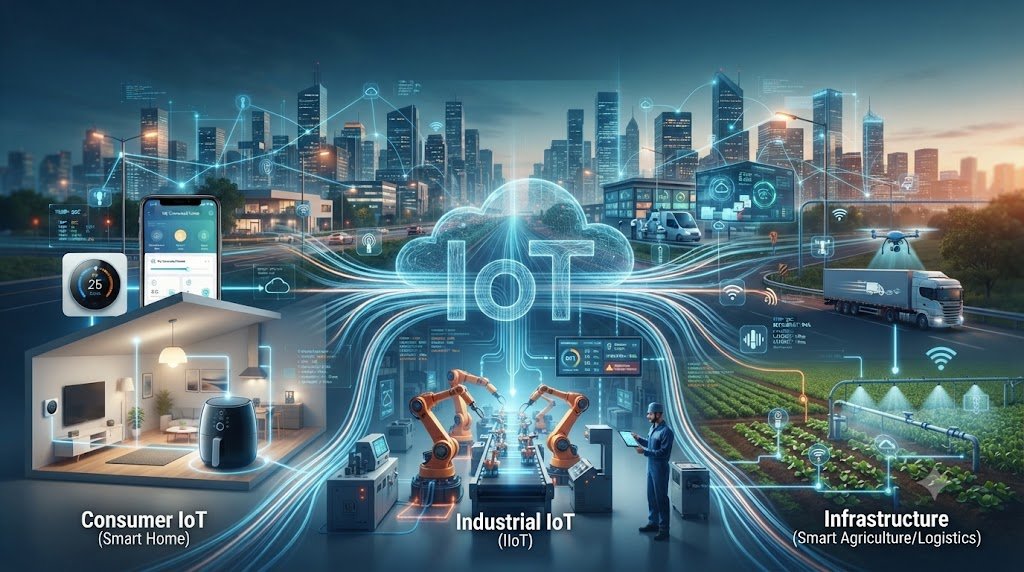

Every time your smartwatch counts your steps, your car warns about low tyre pressure, or your home’s security camera sends an alert to your phone, you are interacting with the Internet of Things (IoT). Today, tens of billions of connected devices are in active use worldwide, quietly powering the infrastructure of modern life.
By bridging the physical and digital worlds, IoT enables a level of automation, efficiency, and insight that was previously unimaginable. This comprehensive guide explores what IoT is, why it was created, how it works in practice, where it is used, and the challenges that will shape its future.
📌 Quick Summary
- IoT connects physical devices to the internet, turning ordinary objects into intelligent nodes.
- Sensors collect data, networks transmit it, and software turns it into actions.
- Tens of billions of devices power sectors ranging from smart homes and factories to healthcare and smart cities.
- AI makes IoT devices intelligent, while Edge Computing makes them faster and more secure.
- Interoperability and security remain critical hurdles for the ecosystem.
1. Why Was IoT Created? The Problem It Solved
Imagine checking every traffic signal in a city manually, reading electricity meters door-to-door every month, or asking a factory worker to inspect thousands of industrial machines every hour. That simply does not scale.
IoT emerged because the physical world was generating information faster than humans could collect or act on it. Before IoT, machines generated vast amounts of operational data, but that data remained trapped in local silos:
- A factory machine tracked its own operating temperature, but a human technician had to walk over with a clipboard to inspect it.
- Homeowners had to manually adjust thermostats based on guesswork rather than automated schedules.
- Doctors relied on periodic, isolated check-ups instead of continuous vital tracking.
Instead of waiting for people to notice problems, devices themselves began sensing, communicating, and responding automatically.
💡 Did You Know?
A single modern connected car can generate gigabytes of operational data in a single day, monitoring everything from tyre friction to engine combustion efficiency.
2. A Day in Your Life Powered by IoT
To see how deeply IoT is woven into daily life, consider a standard 24-hour cycle:
- 7:00 AM — Your smartwatch tracks your sleep phases and gently vibrates to wake you up at the optimal point in your sleep cycle.
- 7:30 AM — Your smart geyser activates automatically based on your morning routine, ensuring hot water is ready without wasting energy.
- 8:15 AM — Your connected car navigation reroutes you around an accident by aggregating real-time traffic sensor data from thousands of other vehicles.
- 9:30 AM — Your office door unlocks instantly via NFC access control, logging your attendance without physical keycards.
- 1:00 PM — A local restaurant’s smart inventory system automatically reorders fresh produce as stock levels dip below a predefined threshold.
- 5:00 PM — An e-commerce delivery van is tracked live via GPS, giving you an exact arrival window down to the minute.
- 8:00 PM — Your smart lights switch on automatically as motion sensors detect you entering your living room.
- 11:00 PM — Your home security camera arms itself, shifting into night-vision mode and ready to alert your phone if anomalous motion occurs.
3. The Human Body Analogy: Understanding IoT Architecture
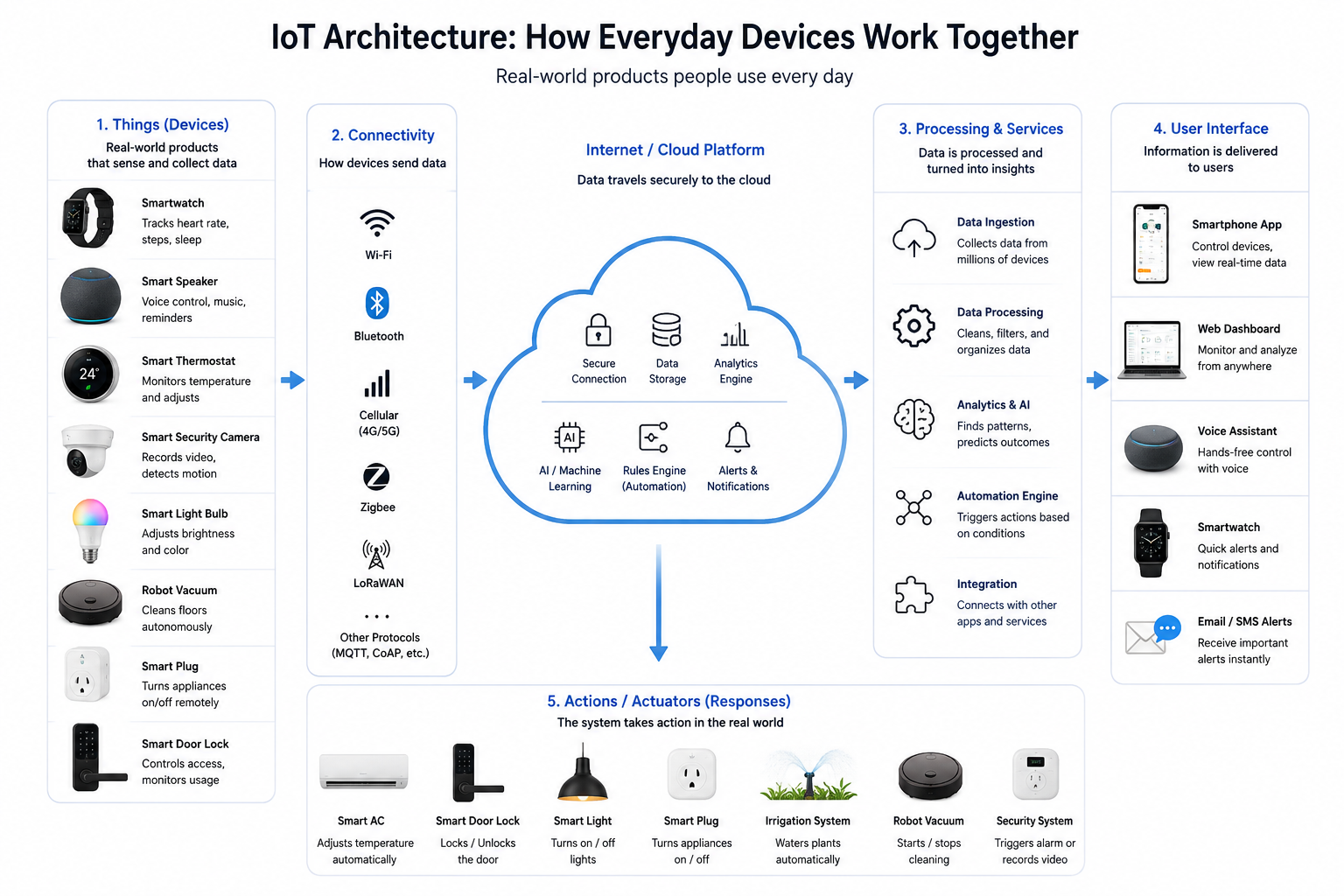
To understand how an IoT system operates under the hood, compare its architecture to the human body:
| Human Body Part | IoT Counterpart | Function |
| Eyes & Ears | Sensors | Collect environmental data (temperature, motion, light). |
| Brain | Cloud / Edge Computing | Process, analyze, and make decisions based on incoming data. |
| Nerves | Internet & Protocols | Transmit data signals securely from devices to servers. |
| Hands | Actuators | Execute physical actions (turning valves, locking doors). |
| Memory | Database | Store historical patterns and user preferences. |
💡 Did You Know?
Some smart agricultural farms water crops only where soil moisture sensors detect dryness, reducing total water consumption by up to 40%.
4. IoT vs. M2M: The Evolution of Machine Communication
Many people confuse the Internet of Things with Machine-to-Machine (M2M) communication. While IoT evolved from M2M, they serve different architectural scales:
| Feature | M2M (Machine-to-Machine) | IoT (Internet of Things) |
| Core Connection | Machine $\leftrightarrow$ Machine (Point-to-Point) | Device $\leftrightarrow$ Internet Cloud Ecosystem |
| Network Type | Closed, proprietary, or cellular local loops | Open, IP-based internet infrastructure |
| Scale | Limited scale within a single facility | Massive, global scale across millions of nodes |
| Primary Domain | Mostly industrial automation and telemetry | Consumer smart homes, healthcare, cities, and IIoT |
5. IoT vs. Smart Devices: What’s the Difference?
Many readers assume that any electronic gadget with a chip is part of the Internet of Things. However, true IoT requires continuous network connectivity and data exchange capabilities.
| Device | Is it IoT? | Why? |
| Bluetooth Speaker | Sometimes | Typically local-only unless paired with an internet-connected smartphone or smart hub. |
| Smart TV | Yes | Actively streams content over the internet and runs connected apps. |
| USB Printer | No | Relies strictly on a direct physical cable connection. |
| Wi-Fi Printer | Yes | Network-connected, enabling remote job submission and ink status monitoring. |
| Digital Camera | Usually No | Captures data locally on an SD card without continuous network communication. |
6. How IoT Works: Architecture & Data Flow
The System Architecture Flow
Billions of Devices
Sensors and actuators deployed across physical environments worldwide.
Collect Data
Continuous capture of physical signals like temperature, motion, and stress.
Generate Information
Data transmission via secure protocols and aggregation in cloud servers.
AI Learns Patterns
Machine learning models analyze trends and identify anomalies in real time.
Automation Happens
Instantaneous triggers execute physical actions without human intervention.
Humans Save Time
Efficiencies multiply, resources conserve, and proactive decisions take over.
A Smart Air Conditioner in Action
- A temperature sensor detects that a room has reached 31°C.
- The reading travels over Wi-Fi to a cloud platform.
- Software compares the reading against your preferred temperature profile.
- Since you normally keep the room at 24°C, the cloud sends a command back.
- An actuator turns the AC compressor on.
- Seconds later, your phone displays: “Cooling started automatically.”
The Life of a Data Packet
Tracing a single data packet reveals the intricate mechanics under the hood:
- Trigger: Motion is detected by a Passive Infrared (PIR) sensor.
- Signal Generation: The sensor creates an analog electrical voltage.
- Conversion: An onboard microcontroller converts the analog signal into digital packets.
- Transmission: A Wi-Fi or cellular module transmits the packet over the local network and internet.
- Ingestion: A cloud database receives, authenticates, and stores the packet.
- Analysis: An AI analytics engine evaluates the packet against behavioral patterns.
- Action: A push notification is dispatched to the user’s mobile application.
7. A Brief History of IoT
IoT did not appear overnight. It is the culmination of decades of evolution in networking, computing, and miniaturization:
- 1999: The term “Internet of Things” is formally coined by British technology pioneer Kevin Ashton during a presentation at Procter & Gamble.
- 1990s:Machine-to-Machine (M2M) communication lays the groundwork, allowing wired industrial machines to send basic data to remote computers.
- 2000s:RFID (Radio Frequency Identification) tags revolutionize supply chain tracking and asset management.
- 2010:Smartphones explode into the market, providing mobile processing power, touch interfaces, and ubiquitous internet connections that fuel consumer applications.
- 2015:Smart Homes enter the mainstream, bringing connected thermostats, smart bulbs, and voice assistants into everyday households.
- 2020:Industry 4.0 takes hold, integrating Industrial IoT (IIoT) into automated factories and global supply chains.
- Today: The convergence of AI, Edge Computing, and IoT creates intelligent, self-learning networks capable of split-second automation.
8. IoT Communication Protocols
Data transmission in IoT is not one-size-fits-all. Different environments require specialized ranges, bandwidths, and power profiles:
Home Automation & Local Networks
- Wi-Fi: High bandwidth, higher power consumption, ideal for smart home hubs and streaming cameras.
- Zigbee & Thread: Low power, mesh networking capability, perfect for reliable smart lighting and sensor grids.
- Z-Wave: Sub-GHz frequency home automation protocol that avoids crowded Wi-Fi interference.
Wearables & Personal Area Networks
- Bluetooth LE (BLE): Ultra-low power consumption, optimized for fitness trackers, smartwatches, and local beacons.
Industrial, Utility & Long-Range Networks
- LoRaWAN: Long range and extremely low power, built for precision agriculture and remote utility monitoring.
- NB-IoT (Narrowband IoT): Cellular-based protocol offering deep indoor penetration for smart meters and asset trackers.
- MQTT: Lightweight publish-subscribe messaging architecture designed specifically for constrained devices.
- CoAP: Constrained Application Protocol, providing a lightweight RESTful alternative to HTTP for microcontrollers.
💡 Did You Know?
A modern wind turbine can generate thousands of individual sensor readings every second, tracking blade stress, wind velocity, and gearbox vibration.
9. Myth vs. Reality
| Myth | Reality |
| IoT only means smart homes. | IoT powers heavy manufacturing, healthcare monitoring, precision agriculture, and logistics on a massive scale. |
| IoT always needs Wi-Fi. | Many devices rely on Bluetooth, Zigbee, LoRaWAN, Z-Wave, or cellular networks depending on power and distance needs. |
| IoT and AI are the same thing. | IoT gathers and transports data; AI interprets that data, recognizes patterns, and automates decisions. |
| Every IoT device sends data to the cloud. | Modern devices increasingly process data locally at the “edge” to eliminate latency and preserve bandwidth. |
⚠️ Reality Check
Many IoT products marketed as “smart” offer little value beyond remote control through a mobile app.
The real power of IoT lies in automation, data-driven insights, and autonomous decision-making—not simply adding Wi-Fi to a kitchen appliance.
10. The Pillars of IoT in Action (Granular Examples)
- Consumer IoT (Smart Homes & Wearables): Smart refrigerators tracking expiration dates, smart microwaves, connected air fryers, and health-monitoring smartwatches tracking ECG metrics.
- Industrial IoT (IIoT): Connected vibration and thermal sensors enabling predictive maintenance on manufacturing assembly lines before critical machinery fails.
- Transportation & Automotive: Connected vehicles, real-time fleet tracking, smart dashcams, and automated toll collection systems.
- Agriculture: Soil moisture sensors and smart irrigation valves that optimize crop yields while conserving water.
- Retail: Smart shelves tracking inventory levels in real time and checkout-free cashierless stores.
- Infrastructure & Smart Cities: Connected traffic lights optimizing traffic flow based on vehicle density, alongside smart waste bins that notify sanitation crews only when full.
11. The Interoperability Challenge
One of the biggest practical hurdles in IoT is interoperability. Because manufacturers historically built closed, proprietary ecosystems, devices from Brand A often refused to communicate with devices from Brand B.
Today, the industry is unifying around cross-platform standards:
- Ecosystem Aggregators: Apple Home, Google Home, and Amazon Alexa serve as major software control layers.
- Matter: An open-source connectivity standard backed by Apple, Google, Amazon, and Samsung that ensures smart home devices work seamlessly together out of the box.
- Thread: A low-power, secure mesh networking protocol that underpins Matter devices, ensuring robust local connectivity without relying entirely on the cloud.
12. Why IoT Matters: The Value Proposition
- Enhanced Efficiency: Automating repetitive tasks allows industrial processes and home routines to run faster with fewer errors.
- Data-Driven Decision Making: IoT aggregates millions of data points every second, enabling decisions based on concrete evidence rather than intuition.
- Predictive Intelligence: By analyzing historical patterns, IoT systems predict equipment failures, supply chain bottlenecks, and service requirements before they occur.
13. IoT Security: Vulnerabilities and Defense
Because every connected device represents a potential entry point for malicious actors, security is paramount.
Common Vulnerabilities
- Default Credentials: Devices shipped with factory-default usernames and passwords that are rarely changed.
- Unencrypted Communication: Data packets intercepted in transit over unsecured wireless networks.
- Firmware Vulnerabilities: Outdated software code that leaves open backdoors for hackers.
- Botnets and DDoS Attacks: Vulnerable IoT devices (like IP cameras) hijacked en masse to launch devastating Distributed Denial of Service attacks.
- Supply Chain Attacks: Compromised third-party components integrated into hardware manufacturing.
Defense Strategies
- Implementing strict zero-trust architectures and device authentication.
- Enforcing end-to-end encryption for all data in transit and at rest.
- Automating over-the-air (OTA) firmware patching to close security loopholes quickly.
14. The Future: AIoT and Edge Computing
The future of IoT is inextricably linked to Artificial Intelligence (AI) and Edge Computing.
While IoT serves as the nervous system collecting data, AI acts as the brain that makes sense of it. As AI advances, devices are evolving from simple tools that follow explicit instructions into intelligent agents (AIoT) that learn and adapt to user behavior autonomously.
Simultaneously, the industry is shifting toward Edge Computing. Rather than sending every data byte to a distant cloud server—which introduces latency—processing is handled locally on the device or a local gateway. This localized computing is crucial for mission-critical applications like autonomous vehicles, where a fraction of a second makes the difference between safety and collision.
💡 TechZero Perspective
People often think the Internet changed the world because computers became connected. That is only half the story.
IoT represents the next phase of the internet—not connecting people, but connecting the physical world itself. Once every machine becomes capable of sensing, communicating, and making decisions, the internet evolves from an information network into an intelligence network.
15. TechZero Recommendation: Where to Start Building
If you are a beginner looking to understand or build within the IoT space, do not start by writing complex code for microcontrollers or buying expensive hardware kits.
- Understand sensors first: Learn how physical phenomena (temperature, light, vibration) are converted into analog or digital electrical signals.
- Study data flows: Trace how packets travel from local networks to servers before touching hardware frameworks like Arduino or Raspberry Pi.
- Master networking basics: A solid grasp of IP addressing, MQTT message brokers, and Wi-Fi/BLE constraints will save you countless hours of debugging later.
16. Authoritative Standards & References (EEAT)
For engineers, researchers, and professionals seeking deeper formal standardization, reference these foundational frameworks:
- IEEE Standards: IEEE P2413 (Standard for an Architectural Framework for the Internet of Things).
- NIST: National Institute of Standards and Technology (NIST SP 800-183 – Cybersecurity for IoT).
- IETF: Internet Engineering Task Force RFCs governing lightweight protocols like CoAP and MQTT.
- ISO/IEC 30141: Reference architecture framework defining trustworthy IoT systems globally.
17. Conclusion
The Internet transformed how people communicate. IoT is transforming how machines communicate.
Over the next decade, billions of connected devices will quietly automate homes, factories, hospitals, farms, and entire cities. Most of this technology will remain invisible—but its impact will be everywhere.
Understanding IoT today is no longer optional for technology professionals. It is becoming as fundamental as understanding the internet itself. As security protocols mature and interoperability challenges dissolve, the boundary between the physical and digital worlds will blur further, creating a truly interconnected society.
📚 TechZero Learning Path
Internet
The foundational global web network connecting computers and systems.
Networking
Protocols, IP routing, and how data packets travel across networks.
Cloud Computing
Centralized servers storing, managing, and processing massive datasets.
IoT (Internet of Things)
Connecting physical sensors and devices to the digital ecosystem.
Edge Computing
Processing data locally on devices to eliminate latency and save bandwidth.
Artificial Intelligence (AI)
Machine learning models that recognize patterns and automate decisions.
Digital Twins
Virtual software replicas of physical systems for real-time simulation.
Robotics
Autonomous physical machines driven by integrated AI and IoT networks.
IEEE Standards IEEE P2413
Architectural framework and standardizations for the Internet of Things.
NIST Framework SP 800-183
Cybersecurity guidelines and foundational principles for IoT risk management.
IETF RFCs Protocols
Internet Engineering Task Force specifications for MQTT and CoAP messaging.
ISO/IEC 30141 Architecture
Global reference architecture framework defining trustworthy IoT systems.
Network Architecture Internal Guide
Explore underlying network architectures and protocols powering connected systems.
Internet Fundamentals Core Concepts
Understand how data packets and core web infrastructure actually function.
Smart Home Automation Consumer Tech
See practical smart home automation and connected appliances in action.
Semiconductor Supply Hardware
Dive into global semiconductor demand and manufacturing hardware trends.
AI Capabilities Intelligence
Distinguish practical AI features from marketing hype in modern devices.

[…] CPU vs GPU vs TPU vs NPU Explained […]
[…] AI processing. 🔗 Related TechZero Hardware Explainer: Read our comprehensive breakdown on CPU vs GPU vs TPU vs NPU Architectures to understand how modern mobile chips handle processing […]
[…] Buying a Windows laptop in 2026 is no longer a simple choice between two chip makers. The market is split into three entirely different computing architectures: Intel Core Ultra (x86), AMD Ryzen AI (x86), and Snapdragon X (ARM64). To understand how these co-processors interact, read our breakdown on CPU vs GPU vs TPU vs NPU explained. […]
[…] Windows 12, Copilot+, AI PCs, and future Windows developments. 🧠 TechZero Deep Dives ⚡ CPU vs GPU vs NPU Understand the exact hardware powering Microsoft’s Copilot+ local proc… 💻 2026 Processor Buying Guide Don’t overpay for the wrong chip. Read this before buying […]