
Introduction
Buying a television has become far more complicated than it was a decade ago.
Earlier, consumers only needed to choose between screen size and brand. Today, buyers encounter dozens of marketing terms:
- LED
- QLED
- Mini LED
- OLED
- Neo QLED
- QNED
- IPS
- VA
- Full Array Local Dimming
- Quantum Dot
Most consumers understandably become confused.
A ₹40,000 television and a ₹4,00,000 television may both advertise themselves as 4K Smart TVs. Yet the viewing experience can be dramatically different.
This guide explains everything you need to know about modern television technologies, panel types, picture quality, gaming performance, longevity, burn-in concerns, and value for money.
By the end, you’ll know exactly which technology deserves your money.
The Most Important Thing to Understand
Many buyers assume:
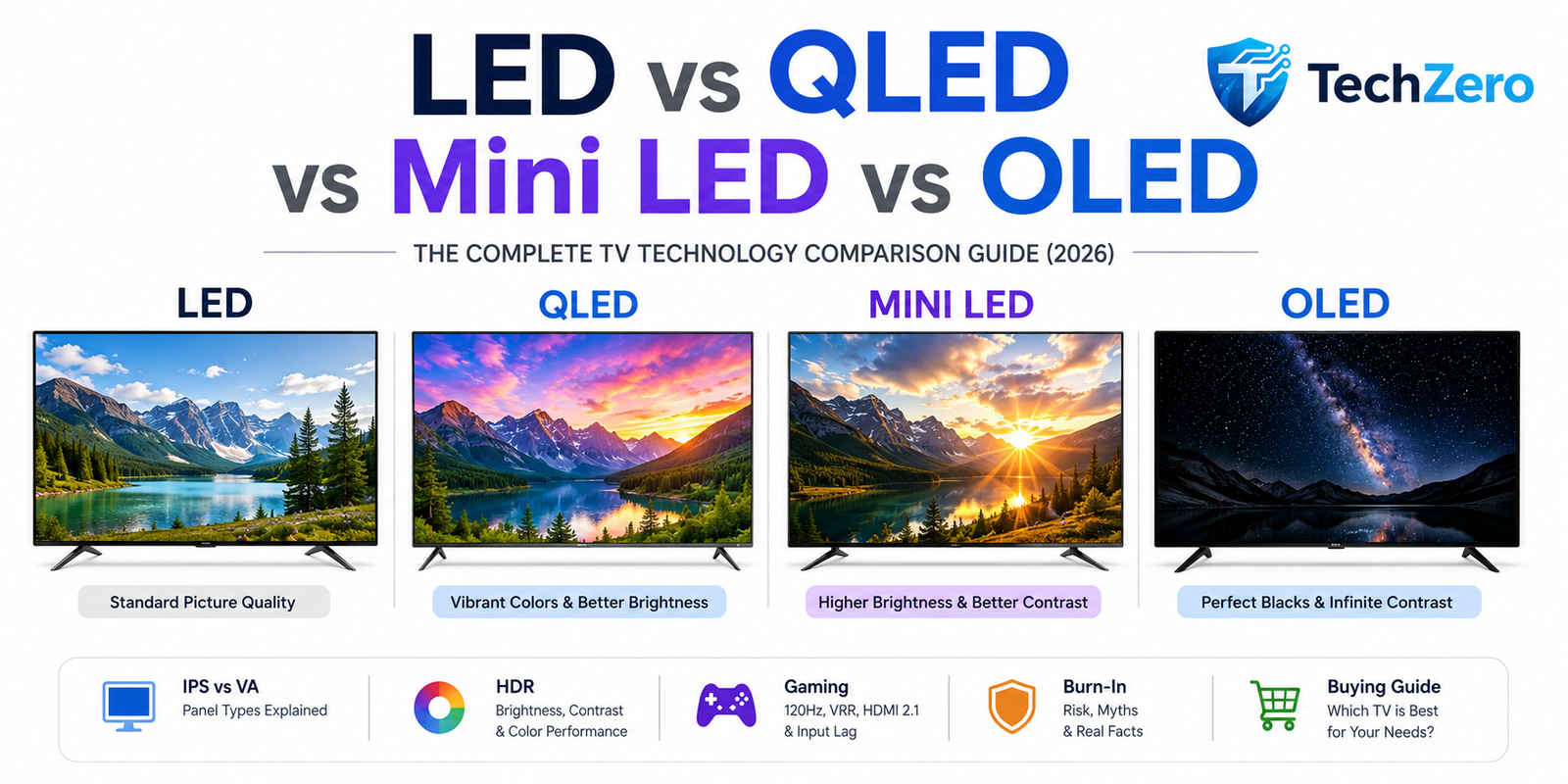
LED, QLED, Mini LED, and OLED are completely different display technologies.
This is only partially true.
In reality:
LED
Uses LEDs as backlighting behind an LCD panel.
QLED
Still an LCD TV.
Uses LED backlighting plus Quantum Dot technology.
Mini LED
Still an LCD TV.
Uses thousands of tiny LEDs for superior backlight control.
OLED
A completely different technology.
Each pixel creates its own light.
This distinction explains nearly every difference in picture quality.
LED TV Explained
LED TVs are currently the most common televisions sold worldwide.
Despite the name, they are actually:
LCD TVs + LED Backlight
The LEDs sit behind the display and illuminate the LCD layer.
Advantages
- Affordable
- Bright
- Long lifespan
- No burn-in risk
- Excellent value
Disadvantages
- Limited black levels
- Lower contrast
- Blooming around bright objects
- Inferior HDR performance
Best For
- Budget buyers
- Casual viewing
- Bedrooms
- Guest rooms
QLED TV Explained
QLED stands for:
Quantum Dot Light Emitting Diode
Despite the marketing, QLED is still LCD technology.
The difference is the addition of Quantum Dots.
These microscopic particles dramatically improve color reproduction.
Advantages
- Higher brightness
- Better color volume
- Excellent HDR
- Great daytime viewing
Disadvantages
- Blacks still not perfect
- Depends heavily on local dimming quality
- Blooming still exists
Best For
- Bright living rooms
- Sports
- Family usage
- Mixed content
Mini LED Explained
Mini LED represents the biggest improvement in LCD technology.
Traditional TVs use hundreds of LEDs.
Mini LED TVs use thousands.
This allows significantly more dimming zones.
Benefits
- Better contrast
- Deeper blacks
- Less blooming
- Higher HDR brightness
- Improved uniformity
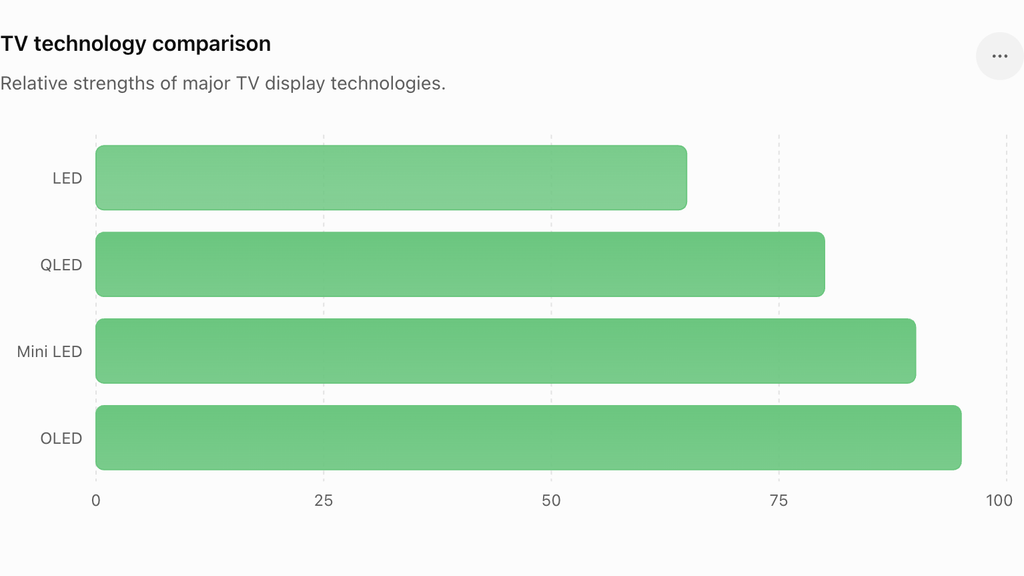
Mini LED is currently the strongest competitor to OLED.
OLED Explained
OLED stands for:
Organic Light Emitting Diode
Every individual pixel produces its own light.
No backlight exists.
When a pixel needs to display black:
It simply turns off.
Completely.
This produces perfect black levels.
Advantages
- Infinite contrast
- Perfect blacks
- Exceptional viewing angles
- Fastest response times
- Outstanding HDR
Disadvantages
- Expensive
- Lower peak brightness than top Mini LED TVs
- Potential burn-in
- Costly repairs
Quick Comparison Table
| Feature | LED | QLED | Mini LED | OLED |
|---|---|---|---|---|
| Brightness | Good | Very Good | Excellent | Excellent |
| Black Levels | Average | Good | Excellent | Perfect |
| Contrast | Average | Good | Excellent | Perfect |
| Gaming | Good | Excellent | Excellent | Best |
| Burn-In Risk | None | None | None | Possible |
| Viewing Angles | Average | Average | Good | Excellent |
| HDR | Basic | Very Good | Excellent | Excellent |
| Price | Lowest | Moderate | Premium | Premium |
Understanding IPS vs VA Panels
Most buyers completely ignore panel technology.
This is a mistake.
The panel type often impacts image quality more than marketing labels.
IPS Panel
IPS stands for:
In-Plane Switching
Strengths
- Excellent viewing angles
- Consistent colors
- Better family-room performance
Weaknesses
- Poor contrast
- Grayish blacks
- Less cinematic
Ideal For
- Wide seating arrangements
- Family viewing
VA Panel
VA stands for:
Vertical Alignment
Strengths
- Superior contrast
- Better blacks
- More immersive movies
Weaknesses
- Narrower viewing angles
Ideal For
- Home theaters
- Movie lovers
- Dark-room viewing
IPS vs VA Comparison
| Feature | IPS | VA |
|---|---|---|
| Viewing Angles | Excellent | Average |
| Black Levels | Average | Excellent |
| Contrast | Average | Excellent |
| Movies | Good | Excellent |
| Gaming | Good | Excellent |
| Family Viewing | Excellent | Good |
Why Local Dimming Matters
Local dimming allows sections of the screen to dim independently.
Without local dimming:
Entire screen brightness remains elevated.
Result:
Poor black levels.
Full Array Local Dimming
Best implementation.
Edge Lit
Least desirable.
Gaming Performance
Modern gamers should focus on:
- HDMI 2.1
- 120Hz
- VRR
- ALLM
- Low Input Lag
Gaming Ranking
- OLED
- Mini LED
- QLED
- LED
HDR Performance
HDR is where expensive TVs separate themselves.
A great HDR TV requires:
- High brightness
- Deep blacks
- Wide color gamut
HDR Ranking
- OLED
- Mini LED
- QLED
- LED
Sports Viewing
Sports require:
- Brightness
- Motion handling
- Viewing angles
Best Technologies
- Mini LED
- QLED
- OLED
Longevity and Reliability
This is an area many reviewers ignore.
LED
8–10 years+
QLED
8–10 years+
Mini LED
8–10 years+
OLED
Typically 6–10 years
Modern OLEDs are much more durable than earlier generations.
Burn-In: Should You Worry?
For most users:
No.
Modern OLED protection mechanisms are highly effective.
However, if you display:
- News channels all day
- CCTV feeds
- Static menus
Mini LED may be safer.
Which Technology Should You Buy?
Budget Under ₹40,000
Buy:
LED
₹40,000–₹80,000
Buy:
QLED
₹80,000–₹2,00,000
Buy:
Mini LED
Above ₹1,00,000
For movie lovers:
OLED
Editor’s Take
Having used traditional LED TVs, Mini LED displays, and Apple’s latest Tandem OLED display on the iPad Pro M5, I believe most buyers underestimate how good modern Mini LED technology has become.
OLED remains the reference standard for contrast and black levels. However, Mini LED offers a compelling combination of:
- Higher brightness
- No burn-in concerns
- Excellent HDR
- Better value
For long productivity sessions and mixed household usage, Mini LED often feels like the more practical technology.
For dedicated movie enthusiasts, OLED still delivers the most cinematic experience available today.
Final Verdict
Buy LED If
You want the lowest price.
Buy QLED If
You want better colors without spending a fortune.
Buy Mini LED If
You want the best balance of performance, brightness, longevity, and value.
Buy OLED If
You want the absolute best picture quality and are willing to pay for it.
For most Indian households in 2026, Mini LED represents the sweet spot between affordability and flagship performance, while OLED remains the dream display for cinema enthusiasts.