
📌 30-Second Summary
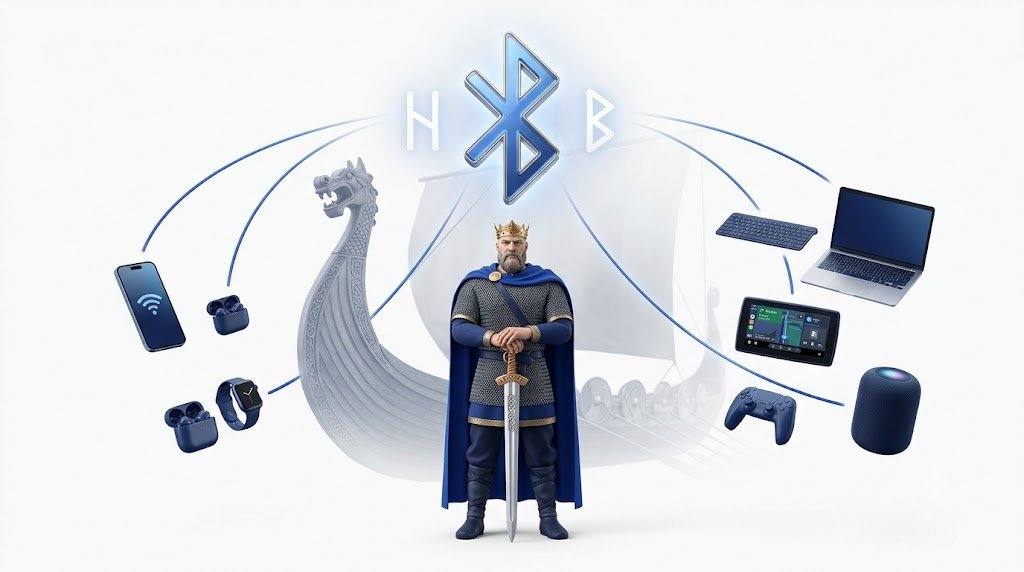
Bluetooth is named after King Harald “Bluetooth” Gormsson of Denmark, who became famous for uniting Denmark and Norway during the 10th century. Engineers developing a new wireless communication standard chose his name because their technology was designed to unite devices from different manufacturers. The Bluetooth logo itself is a bind rune, created by combining the ancient Viking runes representing the letters H and B.
Why Is Bluetooth Called Bluetooth? The Fascinating Story Behind Its Name & Logo
The Viking King in Your Pocket
Every day, billions of people tap the Bluetooth icon without giving it a second thought. Whether you’re connecting your wireless earbuds, pairing a smartwatch, streaming music to your car, or using a wireless keyboard, Bluetooth quietly powers modern life. Yet very few people know that Bluetooth isn’t named after a technology, radio waves, or even the color blue. Instead, it is named after a Viking king who lived more than 1,000 years ago. Even more fascinating, the famous Bluetooth logo secretly contains his initials.
👑 Meet Harald Bluetooth
Harald Gormsson, better known as Harald Bluetooth, ruled Denmark during the late 10th century. He is remembered as one of Scandinavia’s most influential rulers because he united much of Denmark and Norway under a single kingdom. During an era when neighboring tribes frequently fought one another, Harald brought rival groups together through diplomacy, conquest, and political alliances.
His nickname, Blåtand (“Bluetooth”), has several possible origins. The most popular explanation suggests that he had a dark or discolored tooth, while other historians believe the nickname referred to his complexion or represented an Old Norse expression rather than a literal blue tooth. Whatever its true origin, Harald’s greatest legacy was his ability to bring divided people together—a concept that would unexpectedly inspire one of the world’s most important wireless technologies nearly a thousand years later.
🤔 Why Is Bluetooth Called Bluetooth?
Fast forward to the mid-1990s. Several technology companies, including Intel, Ericsson, Nokia, IBM, and Toshiba, were collaborating to create a universal short-range wireless communication standard. Their goal was ambitious: enable devices from different manufacturers to communicate seamlessly without cables.
During one of the development meetings, Intel engineer Jim Kardach suggested the temporary codename Bluetooth after reading a historical novel about King Harald Bluetooth. The comparison was remarkably fitting. Just as Harald had united different kingdoms, this new technology would unite devices from different companies into a single wireless ecosystem.
The name was never intended to become permanent. Alternatives such as RadioWire and PAN (Personal Area Networking) were seriously considered. However, none of them generated the same enthusiasm or captured the project’s vision as effectively. Eventually, the temporary codename remained, becoming one of the most recognizable technology brands in history.
💡 TechZero Insight
One of the most surprising facts about Bluetooth is that it was never supposed to be its official name. It survived largely because the companies involved couldn’t agree on a better alternative before the technology launched. Sometimes the world’s biggest brands aren’t born through years of marketing—they’re simply the temporary names that nobody ever replaced.
⚔️ Harald Bluetooth vs. Bluetooth Technology
The connection between the king and the technology is more than symbolic. Harald Bluetooth united kingdoms, removed political barriers, and brought rival tribes together under one rule. Bluetooth technology does something remarkably similar in the digital world by connecting electronic devices, removing compatibility barriers, enabling products from competing manufacturers to communicate, and creating a universal wireless ecosystem used across the globe.
🔷 The Secret Behind the Bluetooth Logo
The Bluetooth logo is much more than a modern graphic design. It is inspired by a bind rune, an ancient Scandinavian tradition of combining multiple runic letters into a single symbol. The logo merges two characters from the Younger Futhark alphabet: ᚼ (Hagall), representing the letter H, and ᛒ (Bjarkan), representing the letter B. Together, these two runes form the initials of Harald Bluetooth.
Although the logo itself was designed in the late 1990s, its inspiration comes from a writing system that is more than a thousand years old. Most people see the Bluetooth symbol every day without realizing they are looking at a modern interpretation of an ancient Viking monogram.
📜 A Thousand-Year Timeline
The story of Bluetooth spans more than a millennium. In 958 AD, Harald Bluetooth became King of Denmark. During the 960s, he united Denmark and much of Norway, establishing himself as one of Scandinavia’s most influential rulers. More than a thousand years later, in 1997, Intel engineer Jim Kardach proposed “Bluetooth” as the project’s temporary codename. In 1998, the Bluetooth Special Interest Group (SIG) was officially formed, and by 1999, the first Bluetooth specification was released. Today, Bluetooth is one of the world’s most widely used wireless communication standards, embedded in billions of devices.
🌍 Why Bluetooth Matters Today
Bluetooth has quietly become one of the foundations of modern technology. Without it, many of the conveniences we take for granted would simply disappear. It powers wireless earbuds, smartwatches, keyboards, mice, gaming controllers, fitness trackers, smart home products, medical equipment, automotive infotainment systems, industrial sensors, and countless Internet of Things (IoT) devices.
Today, more than five billion Bluetooth-enabled products are shipped every year, making it one of the most widely deployed wireless technologies on Earth. Few innovations have become so deeply woven into everyday life while remaining almost invisible to the people who use them.
❌ Myth vs. ✅ Fact
A common misconception is that Bluetooth is named because it uses blue light or blue-colored radio waves. In reality, the technology has nothing to do with the color blue. It is named after King Harald Bluetooth, whose greatest achievement was bringing divided kingdoms together.
Another popular myth is that the Bluetooth logo is simply an abstract geometric design. In fact, it is a carefully crafted bind rune that combines the Viking runes for H and B, representing Harald Bluetooth’s initials.
People also assume Bluetooth was always intended to be the official name of the technology. The truth is that it began as a temporary codename before becoming the permanent global brand.
🤯 Did You Know?
Bluetooth has a fascinating history filled with little-known facts. Before Bluetooth became the dominant wireless standard, infrared communication was widely used, but it required devices to face each other directly. The Bluetooth Special Interest Group (SIG) has since grown to include tens of thousands of member companies worldwide. Today, Bluetooth technology can be found not only in smartphones and laptops but also in televisions, automobiles, medical equipment, industrial machinery, aircraft systems, and even smart toothbrushes. It is also one of the very few modern technology brands whose logo is directly inspired by an ancient writing system.
Key Takeaways
Bluetooth is named after Harald “Bluetooth” Gormsson, a Viking king from the 10th century who became famous for uniting Denmark and Norway. Engineers borrowed his name because Bluetooth technology was designed to unite devices made by different manufacturers. The famous Bluetooth logo combines the ancient Viking runes for H and B, Harald’s initials, preserving his legacy in one of the world’s most recognizable symbols. What began as a temporary project codename eventually evolved into one of the most successful and widely recognized technology brands in history.
Final Thought
Every time your earbuds connect to your phone, your smartwatch syncs with your laptop, or your car automatically starts playing your favorite playlist, you’re using a technology named after a king who lived more than a thousand years ago.
Harald Bluetooth united kingdoms. Bluetooth technology united devices. The world changed, but the underlying idea remained the same: bringing separate things together to create something stronger.
Great technology connects machines. Great ideas connect history with the future.