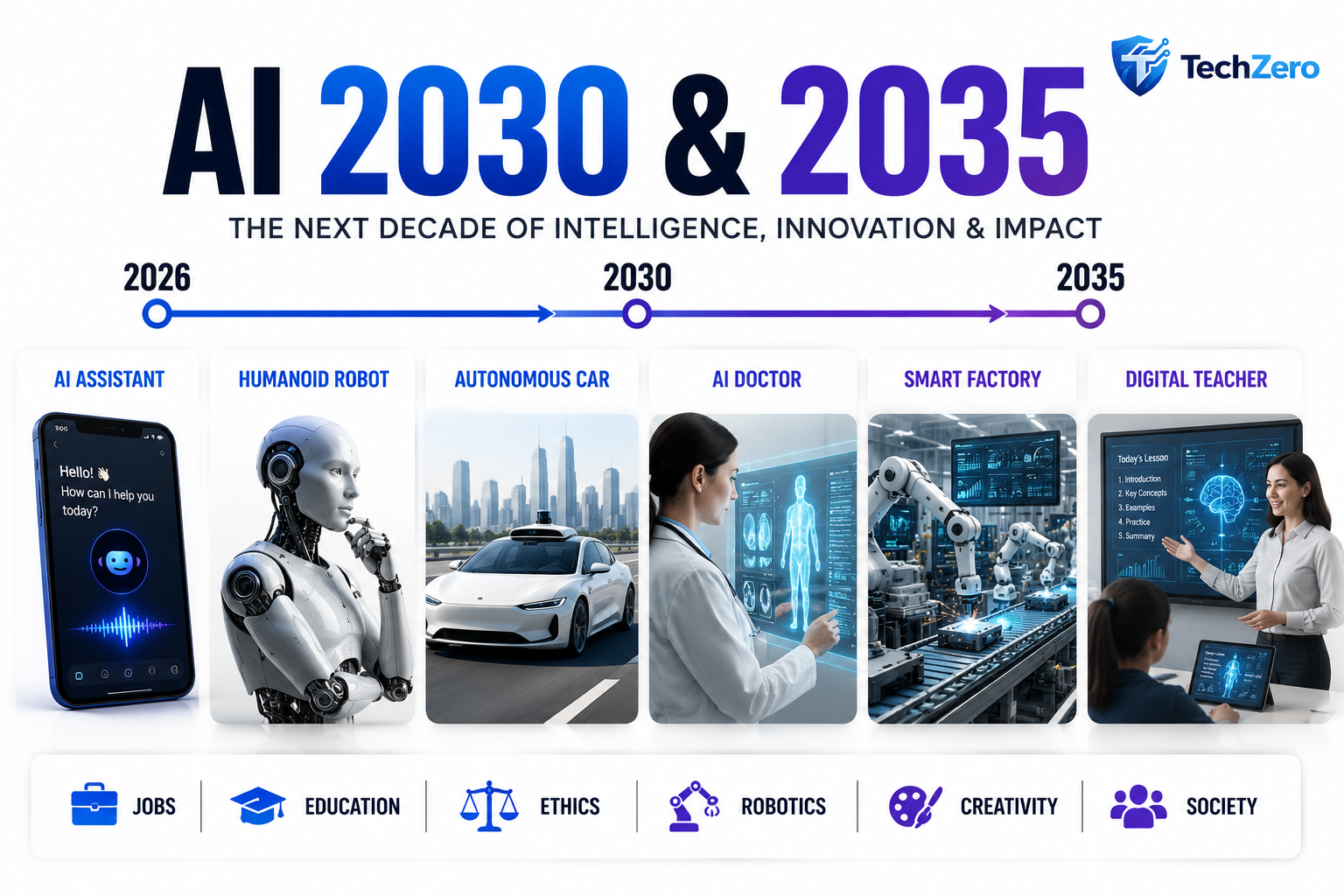

Introduction
Artificial Intelligence has moved faster between 2020 and 2026 than most experts expected.
Just a few years ago, AI was primarily used for:
- Recommendations
- Search engines
- Spam filtering
- Voice assistants
Today, AI can:
- Write software
- Generate videos
- Create realistic images
- Conduct research
- Analyze medical reports
- Act as a personal tutor
- Drive vehicles
- Handle customer support
- Build business plans
The question is no longer whether AI will transform society.
The real question is:
How much of human work, decision-making, creativity, and daily life will AI eventually absorb?
No one can predict the future perfectly. However, by examining current trends, technical limitations, economic incentives, and human behavior, we can make educated forecasts about what AI may look like in 2030 and 2035.
The Current State of AI in 2026
Today’s AI systems are impressive but far from perfect.
They can:
- Reason
- Summarize
- Generate content
- Write code
- Create images
- Assist in decision-making
Yet they still struggle with:
- Long-term planning
- Physical tasks
- Common-sense reasoning
- Reliability
- Truthfulness
Modern AI is more like an extremely knowledgeable intern than a flawless expert.
But every year, the gap narrows.
AI in 2030: The Next Five Years
By 2030, AI will likely become invisible.
People won’t “use AI.”
Instead, AI will simply exist inside everything.
Personal AI Assistants Will Become Standard
Today’s chatbots will evolve into persistent digital companions.
Your AI assistant may:
- Know your calendar
- Understand your work
- Manage travel
- Handle email
- Negotiate appointments
- Monitor finances
Instead of searching for information, people will increasingly ask their personal AI agent.
AI Will Become a Second Brain
Knowledge workers will begin relying heavily on AI memory.
AI systems may remember:
- Conversations
- Projects
- Preferences
- Goals
Humans will increasingly outsource memory and organization.
The smartphone became an external memory device.
AI may become an external thinking device.
Software Development Will Change Dramatically
Many coding tasks will be automated.
Developers will spend less time writing code and more time:
- Designing systems
- Reviewing outputs
- Solving business problems
The best engineers will become AI amplifiers rather than code typists.
Education Will Become Personalized
AI tutors may provide:
- Infinite patience
- Individual attention
- Personalized learning paths
Every child could effectively have access to a private tutor.
This may become one of AI’s greatest contributions to humanity.
Healthcare Will Improve
AI may assist in:
- Diagnosis
- Drug discovery
- Radiology
- Preventive care
Doctors won’t disappear.
Instead, doctors equipped with AI may outperform those without it.
AI Video Will Replace Many Traditional Productions
Creating a video may become as simple as writing a paragraph.
Entire advertisements, documentaries, and animations may be generated by AI.
The barrier between imagination and creation will shrink dramatically.
AI in 2035: The Next Ten Years
Predicting ten years ahead is much harder.
However, some trends appear likely.
AI Agents Will Manage Most Digital Work
Many repetitive office tasks could become fully autonomous.
Examples:
- Scheduling
- Reporting
- Data analysis
- Documentation
- Customer support
Humans may increasingly supervise rather than execute.
Autonomous Businesses May Appear
Imagine:
- AI marketing
- AI sales
- AI customer support
- AI accounting
A small company may generate millions in revenue with only a handful of employees.
This could redefine entrepreneurship.
Robotics Will Become Practical
AI without robotics is incomplete.
By 2035, we may see robots handling:
- Warehousing
- Cleaning
- Delivery
- Manufacturing
- Elder care
Physical labor may begin experiencing the same transformation that knowledge work is experiencing today.
Scientific Discovery Could Accelerate
AI may contribute to breakthroughs in:
- Medicine
- Materials science
- Energy
- Climate technology
The pace of innovation itself may increase.
This could be one of AI’s most important long-term benefits.
The Opportunities
Opportunity 1: Massive Productivity Growth
Every major technological revolution increased productivity.
AI may become the largest productivity multiplier in human history.
Opportunity 2: Democratization of Expertise
A person in a small town could access:
- Legal guidance
- Medical knowledge
- Education
- Business advice
Previously available only to wealthy individuals.
Opportunity 3: Better Education
Personalized tutors for billions.
Opportunity 4: Better Healthcare
Earlier diagnosis.
Lower costs.
Greater accessibility.
Opportunity 5: Increased Creativity
AI may empower creators rather than replace them.
One individual could produce:
- Movies
- Games
- Books
- Software
at previously impossible scales.
The Threats
Threat 1: Job Displacement
The most obvious concern.
Roles most vulnerable:
- Data entry
- Basic coding
- Routine customer support
- Content generation
- Administrative work
The transition period may be painful.
Threat 2: Misinformation
AI-generated content may become indistinguishable from reality.
Society may struggle to determine:
- What is real
- What is fake
Trust may become increasingly valuable.
Threat 3: Concentration of Power
The most capable AI systems require enormous resources.
A small number of organizations could gain outsized influence.
Threat 4: Dependency
Humans may become overly dependent on AI.
The risk is not AI becoming smarter.
The risk is humans becoming less capable.
Threat 5: Privacy
Future AI systems may know more about individuals than any institution in history.
Balancing convenience and privacy will become critical.
The Bottlenecks Holding AI Back
Many people assume exponential growth will continue forever.
Reality is more complicated.
Computing Power
Training advanced AI requires enormous infrastructure.
Energy and chips remain constraints.
Data Quality
AI eventually runs out of high-quality training data.
Synthetic data helps but introduces new challenges.
Reasoning Reliability
Today’s models still make mistakes.
Reliability remains a major challenge.
Physical World Understanding
AI excels digitally.
The physical world remains harder.
Ethics and Human Behavior
Technology alone does not determine outcomes.
Human behavior does.
Key questions include:
- Who controls AI?
- Who benefits?
- Who regulates it?
- How transparent should it be?
The answers will shape society as much as the technology itself.
The Future of Work
Work will not disappear.
Work will evolve.
History shows that technology eliminates some jobs while creating others.
Future skills may include:
- Critical thinking
- Leadership
- Creativity
- Communication
- Systems thinking
- AI collaboration
People who learn to work with AI will likely outperform those who ignore it.
The Future of Education
Memorization may become less important.
Problem solving may become more important.
Students may increasingly learn:
- How to ask questions
- How to evaluate answers
- How to verify information
AI may transform not only what we learn but how we learn.
The Future of Relationships
AI companions may become common.
Some people may develop emotional attachments to digital entities.
This raises fascinating ethical and psychological questions.
Technology may increasingly blur the line between human and machine interaction.
Will AI Become Conscious?
Perhaps the most controversial question.
Current AI systems show no evidence of consciousness.
They process information.
They do not experience existence.
Whether future systems will ever become conscious remains unknown.
Even experts disagree.
Editor’s Take
As someone working in technology and observing AI’s rapid evolution, I believe both the optimists and pessimists are partially correct.
AI will almost certainly eliminate some jobs.
It will also create opportunities we cannot yet imagine.
The biggest mistake is assuming the future will look exactly like today.
The second biggest mistake is assuming humans will become irrelevant.
Throughout history, technology has changed how people work, not why they work.
The winners of the AI era will not necessarily be those with the highest IQ.
They will be those who adapt fastest, learn continuously, and understand how to combine human strengths with machine intelligence.
Final Verdict
By 2030, AI will likely become a trusted digital assistant.
By 2035, AI may become an essential layer of civilization itself.
The opportunities are enormous:
- Better education
- Better healthcare
- Greater productivity
- Increased creativity
The risks are equally significant:
- Job displacement
- Misinformation
- Dependency
- Privacy concerns
The future of AI will not be determined solely by technology.
It will be determined by the choices humanity makes while building and using it.
The next decade may become one of the most transformative periods in human history.