The Ultimate Guide to Maximum Electricity Savings with Air Conditioners: How to Buy, Use, and Maintain an AC Efficiently

Introduction
Air conditioners are no longer luxury appliances in India. Rising temperatures, longer summers, increasing humidity, and changing weather patterns have made ACs an essential household appliance for millions of families.
Unfortunately, many homeowners discover a harsh reality shortly after purchasing an AC: the electricity bill.
A modern air conditioner can account for 30% to 70% of a household’s summer electricity consumption. Yet surprisingly, most people waste thousands of rupees every year simply because they choose the wrong AC, install it incorrectly, operate it inefficiently, or neglect basic maintenance.
The good news is that significant savings are possible.
With the right purchase decision, proper installation, intelligent operation, and routine maintenance, you can reduce AC electricity consumption by 20% to 50% without sacrificing comfort.
This guide explains everything you need to know about maximizing electricity savings while enjoying a cool and comfortable home.
Understanding How Air Conditioners Consume Electricity
Before discussing savings, it helps to understand where electricity is actually used.
An air conditioner consumes power primarily through:
- Compressor
- Indoor blower fan
- Outdoor condenser fan
- Electronics and sensors
The compressor is the biggest electricity consumer.
In many systems, the compressor accounts for over 80% of total energy usage.
This is why almost every electricity-saving technique ultimately focuses on reducing compressor workload.
The Biggest Mistake People Make
Most buyers focus only on:
- Cooling speed
- Brand
- Discount
- Tonnage
Very few focus on:
- Annual electricity consumption
- Energy efficiency
- Long-term operating costs
A ₹5,000 cheaper AC can easily cost ₹20,000–₹30,000 more in electricity over its lifetime.
The cheapest AC is rarely the cheapest AC to own.
Inverter vs Non-Inverter AC
Non-Inverter AC
Traditional ACs work like a switch.
The compressor:
ON → Full Power
OFF → No Power
The cycle repeats continuously.
This results in:
- Higher power consumption
- Larger temperature swings
- More noise
- Increased wear
Inverter AC
Inverter ACs continuously adjust compressor speed.
Instead of repeatedly turning ON and OFF, they operate intelligently.
Benefits include:
- Lower electricity bills
- More consistent cooling
- Quieter operation
- Longer compressor life
For most households today, inverter ACs are the obvious choice.
Understanding Star Ratings
India’s BEE Star Rating system helps consumers compare efficiency.
Generally:
1 Star = Lowest Efficiency
5 Star = Highest Efficiency
A 5-star inverter AC can save thousands of rupees annually compared to a 3-star model.
However, buyers should not blindly chase star ratings.
The actual annual consumption figure is more important.
Always compare:
Annual Energy Consumption (Units/Year)
rather than stars alone.
Choosing the Right AC Capacity
This is one of the most critical decisions.
Small AC in Large Room
Problems:
- Compressor runs continuously
- Poor cooling
- High electricity usage
- Shorter lifespan
Oversized AC
Problems:
- Frequent cycling
- Higher purchase cost
- Reduced dehumidification
General Recommendations
Up to 120 sq ft
1 Ton
120–180 sq ft
1.5 Ton
180–250 sq ft
2 Ton
Factors like:
- Top floor exposure
- Sunlight
- Number of occupants
- Large windows
may require larger capacities.
Why Room Insulation Matters More Than AC Brand
Many homeowners spend ₹50,000 on an AC and ignore a ₹500 curtain.
This is a mistake.
Heat enters through:
- Windows
- Doors
- Walls
- Roof
The AC must remove this heat continuously.
Reducing heat gain directly lowers electricity consumption.
Use Blackout Curtains
One of the highest-return investments.
Benefits:
- Reduced solar heat gain
- Faster cooling
- Lower compressor usage
Particularly useful for:
- West-facing rooms
- South-facing rooms
- Top-floor apartments
Seal Air Leaks
Common leakage points:
- Window gaps
- Door gaps
- AC sleeve gaps
Cool air escaping means your AC works harder.
Simple weather strips often provide measurable savings.
Best Temperature Setting
Many people set:
18°C
believing it cools faster.
This is false.
An AC cools at nearly the same rate regardless of the target temperature.
Setting 18°C simply forces the compressor to run longer.
Ideal Temperature
Most energy experts recommend:
24°C to 26°C
This range balances:
- Comfort
- Efficiency
- Electricity savings
Every degree below 24°C increases power consumption significantly.
Use Ceiling Fans Alongside AC
One of the easiest ways to save electricity.
Fans help distribute cool air.
Benefits:
- Improved comfort
- Faster perceived cooling
- Higher thermostat settings possible
Many users find:
26°C + Fan
feels similar to:
22°C without a fan
while consuming far less electricity.
Sleep Mode Is Underrated
During sleep:
- Metabolism decreases
- Body temperature changes
The room does not need aggressive cooling.
Sleep Mode gradually raises temperature.
Benefits:
- Better comfort
- Reduced power consumption
- Lower nighttime electricity usage
Smart Scheduling Saves Money
Avoid:
Running the AC all day.
Instead:
- Cool occupied rooms
- Use timers
- Use schedules
Smart scheduling can reduce annual costs dramatically.
Clean Filters Every Month
Dirty filters are one of the biggest causes of energy waste.
When filters clog:
- Airflow decreases
- Cooling efficiency drops
- Compressor runs longer
Cleaning takes:
5 minutes
and can improve performance immediately.
Maintain Outdoor Unit Clearance
Outdoor units require airflow.
Avoid:
- Storing objects nearby
- Blocking ventilation
- Enclosing units
Poor airflow causes:
- Higher pressure
- Reduced efficiency
- Greater electricity consumption
Annual Professional Servicing
At least once per year:
- Coil cleaning
- Refrigerant check
- Drain cleaning
- Electrical inspection
This often pays for itself through improved efficiency.
Common Myths
Myth 1: Lower Temperature Cools Faster
False.
18°C does not cool faster than 24°C.
Myth 2: Turning AC On and Off Saves Power
Usually false.
Frequent restarts often increase compressor stress.
Myth 3: Bigger AC Is Always Better
False.
Proper sizing matters more.
Myth 4: Fan Mode Is Useless
False.
Fan mode helps circulate air efficiently.
Best AC Features for Electricity Savings
When buying a new AC, prioritize:
Inverter Compressor
Most important feature.
High ISEER Rating
Higher is better.
Convertible Cooling
Allows adjustment of compressor capacity.
Sleep Mode
Reduces overnight consumption.
Smart Scheduling
Automatic operation.
Eco Mode
Useful for long operating hours.
Which Brands Are Known for Efficiency?
Popular efficient options include:
- Daikin
- Mitsubishi Electric
- Panasonic
- Hitachi
- LG
- Carrier
The exact model matters more than the brand.
Always compare:
- ISEER
- Annual Consumption
- Warranty
- Service Network
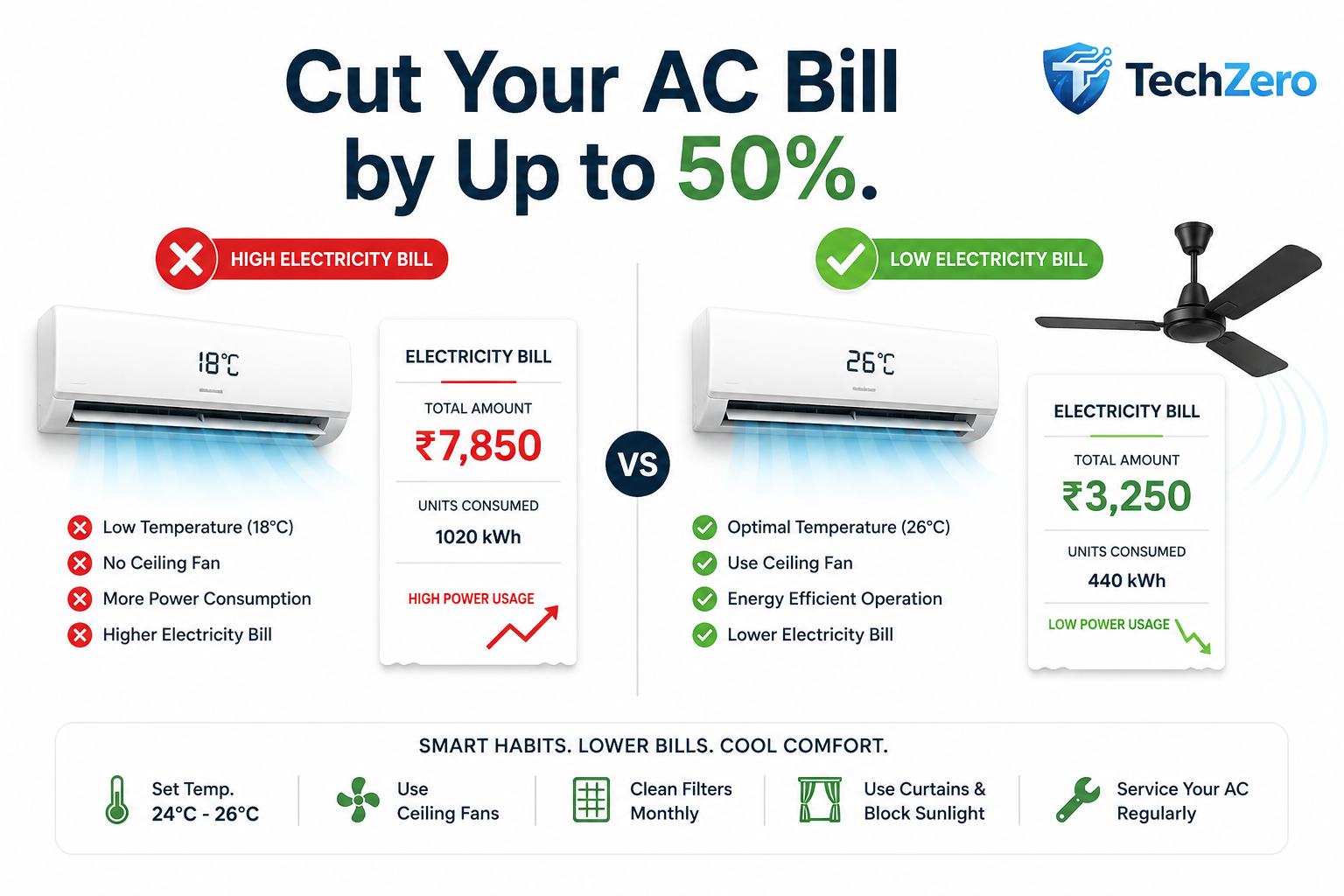
How Much Can You Actually Save?
Consider two households.
House A:
- Wrong AC size
- Dirty filters
- 20°C setting
- No curtains
House B:
- Properly sized inverter AC
- Monthly maintenance
- 26°C setting
- Ceiling fan
- Blackout curtains
Difference:
20% to 50% lower electricity consumption is entirely possible.
Editor’s Take
Many consumers obsess over buying the latest 5-star inverter AC and then unknowingly waste electricity through poor usage habits.
In my experience, the biggest savings come from behavior rather than hardware.
A properly maintained inverter AC running at 26°C with a ceiling fan and good curtains will often outperform a premium flagship AC operating inefficiently.
The smartest investment is not always a more expensive air conditioner.
Often, it is:
- Better curtains
- Better insulation
- Regular cleaning
- Smarter thermostat settings
These changes cost little but deliver savings every month.
Final Verdict
If your goal is maximum electricity savings:
- Buy an inverter AC.
- Choose the correct tonnage.
- Prioritize high ISEER ratings.
- Set temperature between 24°C and 26°C.
- Use ceiling fans.
- Install blackout curtains.
- Clean filters monthly.
- Service the AC annually.
- Use Sleep Mode.
- Avoid chasing extremely low temperatures.
The most efficient air conditioner is not necessarily the most expensive model. It is the one that is correctly sized, properly maintained, intelligently operated, and installed in a room designed to minimize heat gain.
Follow these principles and your AC can remain comfortable, reliable, and surprisingly economical for many years.