
The Short Answer
If current rumours prove accurate, the M6 MacBook Pro with OLED display could become the biggest MacBook upgrade since Apple introduced Apple Silicon in 2020. Multiple reports point to a major redesign featuring OLED technology, a thinner chassis, possible touch support, and next-generation M6 chips.
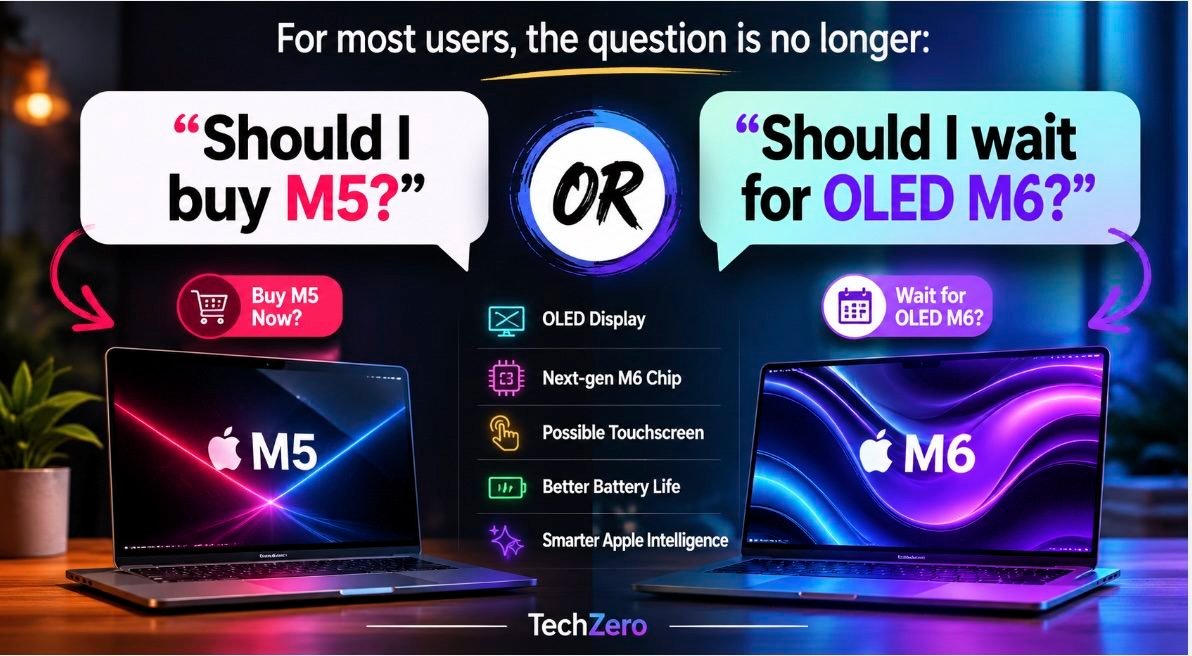
For most users, the question is no longer:
Expected Launch Timeline
Current industry reports suggest:
| Model | Expected Timeline |
|---|---|
| M5 MacBook Air | Available |
| M5 MacBook Pro | 2026 |
| OLED M6 MacBook Pro | Late 2026 to Early 2027 |
| OLED MacBook Air | Likely 2027+ |
Most analysts currently place the first OLED MacBook Pro launch somewhere between late 2026 and early 2027.
Biggest Expected Upgrades
1. OLED Display
This is the headline feature.
Current MacBook Pros use:
- Mini-LED
Expected M6 OLED models may offer:
- Perfect blacks
- Better HDR
- Improved contrast
- Richer colors
- Better battery efficiency
Similar benefits are already visible on the latest iPad Pro OLED models.
2. Thinner and Lighter Design
Apple hasn’t significantly redesigned the MacBook Pro since 2021.
Rumors suggest:
- Slimmer chassis
- Reduced weight
- Smaller display bezels
Potentially making it the thinnest Pro model in years.
3. Touchscreen MacBook
This would be huge.
For years Apple resisted touchscreen Macs.
Recent reports suggest Apple may finally introduce:
- Touch-enabled OLED display
- Enhanced touch gestures
- Better iPad-Mac workflow
Though this remains one of the most debated rumors.
4. M6 Chip
Expected benefits:
- Higher AI performance
- Better battery life
- Faster GPU
- Improved thermal efficiency
Several reports indicate Apple could move to more advanced manufacturing technology, delivering a meaningful jump over M5.
5. Better AI Performance
By the time M6 arrives:
- Apple Intelligence will be more mature
- More on-device AI processing
- Better photo editing
- Improved Siri
- Faster local LLM execution
This could be one of the most practical upgrades for everyday users.
6. New Camera Design
Rumors include:
- Smaller cutout
- Dynamic Island-inspired implementation
- Hole-punch camera
Nothing is confirmed, but Apple appears to be exploring alternatives to the current notch.
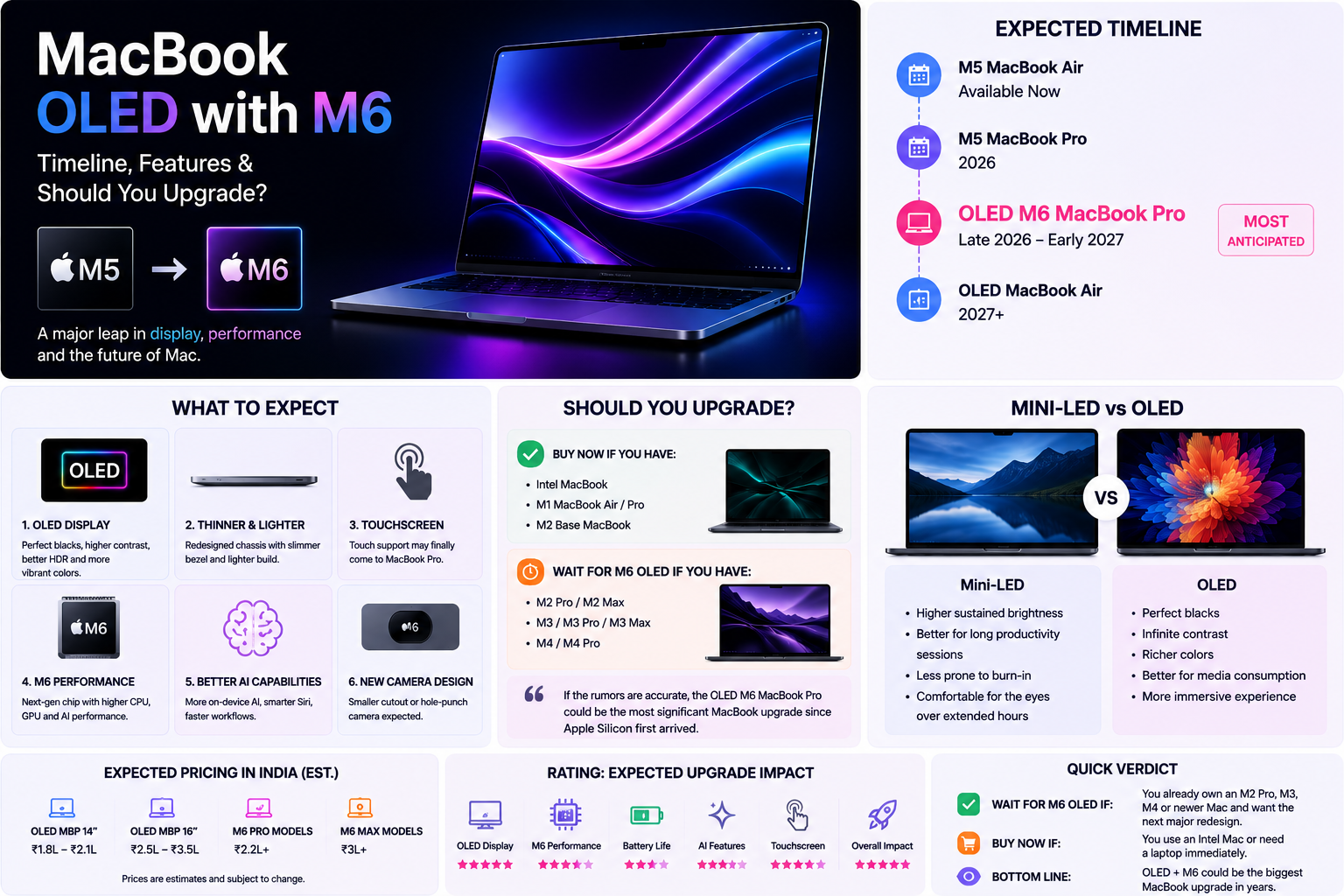
Expected Pricing (India)
| Model | Estimated Price |
|---|---|
| OLED MacBook Pro 14 | ₹1.8–2.1 Lakh |
| OLED MacBook Pro 16 | ₹2.5–3.5 Lakh |
| M6 Pro Models | ₹2.2 Lakh+ |
| M6 Max Models | ₹3 Lakh+ |
Expect prices to increase due to:
- OLED panel costs
- New manufacturing processes
- Premium positioning
These are estimates, not official Apple pricing.
Should You Upgrade?
Buy Now If You Have
✅ Intel MacBook
✅ M1 MacBook Air
✅ M1 MacBook Pro
✅ M2 Base MacBook
The current M4 and M5 machines are already incredibly fast.
Waiting another year may not make sense.
Wait for M6 OLED If You Have
✅ M2 Pro
✅ M3 Pro
✅ M3 Max
✅ M4 Pro
These machines are already excellent.
The OLED redesign may deliver a much more noticeable upgrade than M5.
For iPad Pro Users
The OLED M6 MacBook could be the first Mac that starts to feel closer to the iPad experience:
- OLED display
- Possible touch support
- Better Apple Intelligence
- More seamless workflow
If Apple actually introduces touch, the line between iPad Pro and MacBook Pro becomes much blurrier.
Conclusion in General
Wait for M6 OLED If:
- You already own an M2 Pro, M3, M3 Pro, M4, or newer Mac.
- You care about display quality.
- You want the next major redesign.
Buy Now If:
- You are still using Intel Macs.
- You need a laptop immediately.
- Your current machine struggles with your workflow.
Final Rating of Expected Upgrade
| Feature | Upgrade Level |
|---|---|
| OLED Display | ⭐⭐⭐⭐⭐ |
| M6 Performance | ⭐⭐⭐⭐ |
| Battery Life | ⭐⭐⭐⭐ |
| AI Features | ⭐⭐⭐⭐ |
| Touchscreen (if true) | ⭐⭐⭐⭐⭐ |
| Overall Impact | ⭐⭐⭐⭐⭐ |
If the rumors are accurate, the OLED M6 MacBook Pro could be the most significant MacBook upgrade since Apple Silicon first arrived, making it one of the few future Apple products genuinely worth waiting for.
Editor’s Take: Living with Both a MacBook Pro and an iPad Pro
As someone who currently uses a 14-inch MacBook Pro with the M4 Pro chip alongside a 13-inch iPad Pro with Apple’s Tandem OLED display, I have had the opportunity to experience both Mini-LED and OLED technologies extensively in real-world productivity scenarios.
Contrary to what many people might expect, I don’t automatically consider OLED to be superior for every use case. While the iPad Pro’s Tandem OLED display delivers stunning contrast, perfect blacks, and an incredible media consumption experience, I still find the Mini-LED display on the MacBook Pro more comfortable for extended productivity sessions that last several hours. For writing, project management, research, coding, spreadsheets, and multitasking throughout the day, the MacBook Pro’s display remains easier on my eyes and better suited to sustained work.
Today, owning both devices still makes sense because each serves a distinct purpose. The MacBook Pro remains my primary productivity machine, while the iPad Pro excels as a portable creative and consumption device. However, the rumored OLED MacBook and the continued evolution of iPadOS are making me question whether that separation will continue indefinitely.
The biggest factor worth watching is the combination of a touchscreen MacBook and the ongoing development of iPadOS 27 and beyond. If Apple continues to blur the line between macOS and iPadOS, we may eventually reach a point where many users no longer need both devices. We’re not there yet, but for the first time, the possibility feels realistic enough to keep an eye on.
Another practical consideration is portability. Although the 14-inch MacBook Pro is relatively compact, its weight of approximately 1.6 kg becomes noticeable during long sessions on a couch, recliner, or in bed. The iPad Pro remains significantly more comfortable for casual use, reading, media consumption, and light productivity away from a desk.
Apple’s Sidecar feature deserves mention as well. While it has improved over the years, I still find it too inconsistent and limited to become a true replacement for a dedicated dual-device workflow. In its current state, I cannot comfortably leave work on my MacBook and expect to seamlessly continue it on the iPad without encountering compromises. The experience is useful, but it still feels more like a convenient feature than a mature workflow solution.
For that reason, my personal recommendation is simple: if you already own a recent Apple Silicon MacBook, the rumored OLED M6 MacBook may be one of the few future Apple products genuinely worth waiting for. Not just because of the display technology, but because it could represent the beginning of a larger shift in how Apple’s laptops and tablets evolve together over the next several years.
— Ravi Ranjan, Founder & Editor, TechZero
