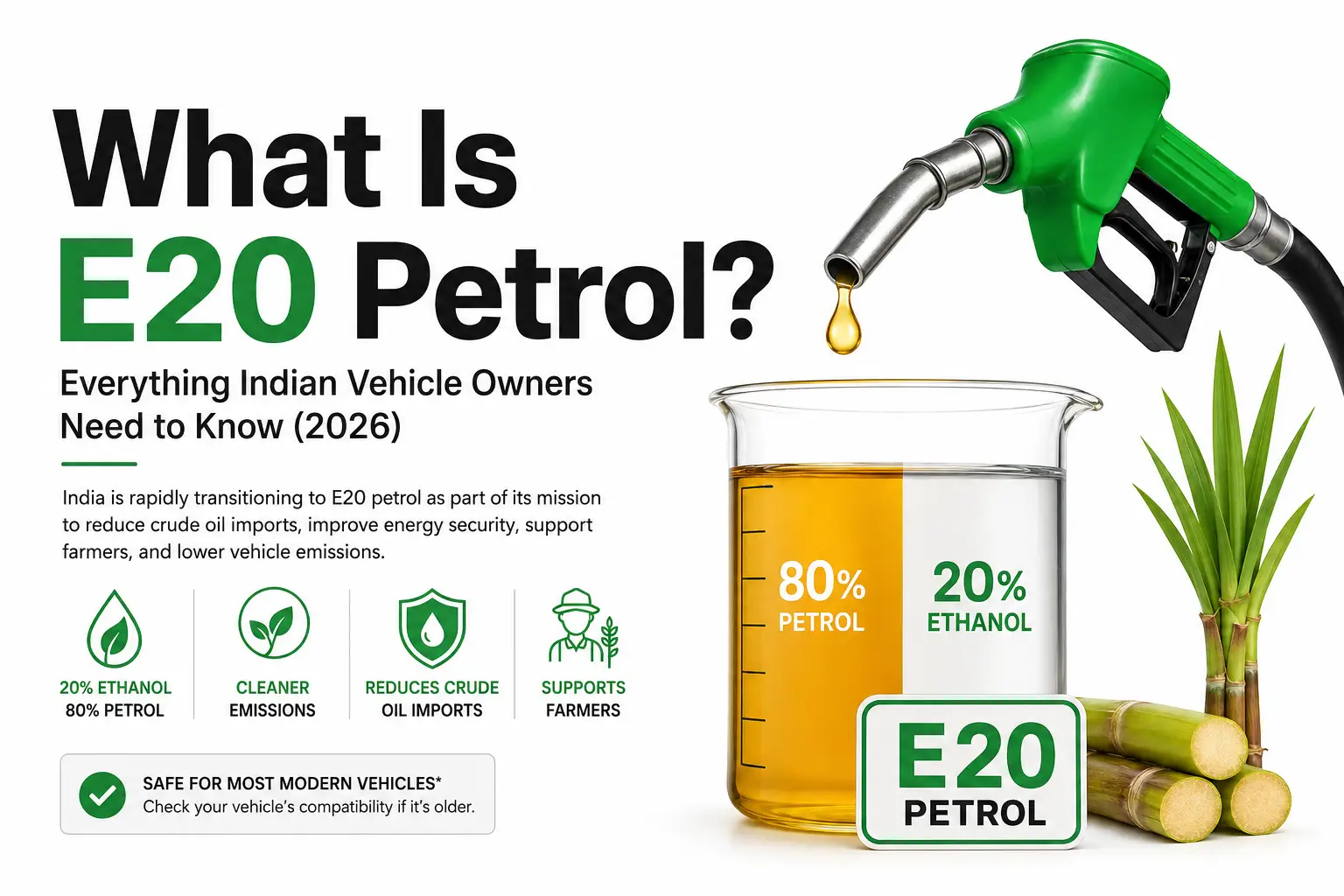

India has embraced E20 petrol nationwide—but what exactly is it? Will it reduce mileage, damage your engine, or save the environment? Here’s everything you need to know before your next fuel stop.
📌 Quick Summary
If you’ve filled up your vehicle recently, you’ve probably noticed E20 Petrol appearing at fuel stations across India. The “E20” label simply means the petrol contains 20% ethanol and 80% conventional petrol.
India introduced E20 as part of its strategy to reduce crude oil imports, lower carbon emissions, and support domestic agriculture. While most new vehicles are designed to run safely on E20, owners of older cars and motorcycles should understand its implications before making the switch.
Key Takeaways
- E20 contains 20% ethanol and 80% petrol.
- Ethanol is a renewable fuel produced from sugarcane, maize, damaged food grains and agricultural feedstock.
- Modern BS6 Phase 2 vehicles are designed to use E20 safely.
- Older vehicles may experience compatibility issues over long-term use.
- Expect a small reduction in fuel economy because ethanol contains less energy than petrol.
- E20 helps India reduce crude oil imports and lower emissions.
- It is an important step toward cleaner mobility, not a replacement for electric vehicles.
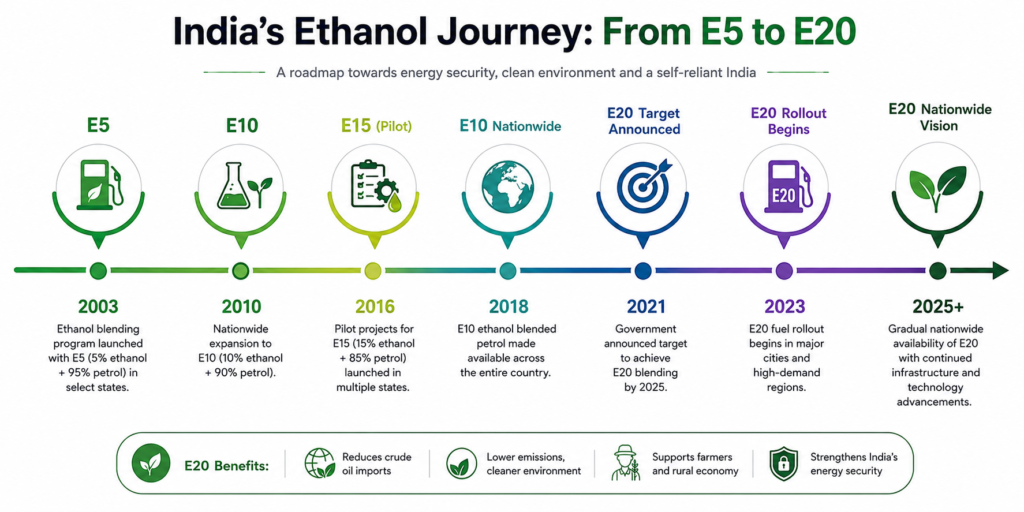
Why Are You Suddenly Seeing E20 Petrol?
Until a few years ago, petrol sold in India contained only small amounts of ethanol. Although ethanol blending had existed for decades, the percentage remained relatively low because production capacity, vehicle compatibility, and fuel distribution infrastructure were still developing.
Everything changed when the Government of India accelerated the Ethanol Blended Petrol Programme. Instead of gradually reaching higher blending targets over the next decade, India expanded ethanol production, upgraded storage and transportation facilities, and worked closely with automobile manufacturers to prepare vehicles for higher ethanol concentrations.
As a result, E20 petrol is now becoming the new normal across the country.
For most consumers, the transition is almost invisible. You still drive to the petrol station, fill your tank, and continue your journey. The real transformation is happening behind the scenes—in refineries, ethanol distilleries, fuel depots, engine design laboratories, and national energy policy.
The introduction of E20 is not simply about changing fuel. It represents a long-term strategy to reduce India’s dependence on imported crude oil while making better use of domestic agricultural resources.
What Exactly Is E20 Petrol?
E20 is simply a blend consisting of:
- 80% Petrol
- 20% Ethanol
The letter “E” stands for Ethanol, while the number indicates the percentage of ethanol in the fuel.
Unlike petrol, which is refined from crude oil extracted from underground reserves, ethanol is a renewable biofuel produced from agricultural crops and plant-based materials. Every litre of E20 therefore contains a renewable component that reduces the amount of fossil fuel required.
The concept is similar to mixing two compatible liquids. Instead of using 100% petrol, fuel companies blend ethanol in carefully controlled proportions before the fuel reaches retail petrol pumps.
What Is Ethanol?
Ethanol (chemical formula C₂H₅OH) is a type of alcohol that has been used as an automotive fuel for more than a century. It burns cleanly, has a naturally high octane rating, and can be produced from renewable agricultural feedstocks.
Unlike the alcohol used in beverages, fuel ethanol is specially processed and denatured so that it cannot be consumed.
Where Does India’s Ethanol Come From?
India primarily produces ethanol using:
- Sugarcane juice
- Sugarcane molasses
- Maize (corn)
- Broken rice
- Damaged food grains
- Agricultural residues (second-generation biofuels)
Using multiple feedstocks allows ethanol production to continue even when one particular crop experiences fluctuations in yield.
In the future, India is expected to increase the use of agricultural waste and cellulosic biomass, reducing dependence on food crops while expanding renewable fuel production.
Petrol vs Ethanol
Although both fuels power internal combustion engines, their physical and chemical properties differ considerably.
| Property | Petrol | Ethanol |
|---|---|---|
| Source | Crude Oil | Agricultural Feedstocks |
| Renewable | ❌ No | ✅ Yes |
| Oxygen Content | Very Low | High |
| Octane Rating | High | Higher |
| Energy per Litre | Higher | Lower |
| Carbon Footprint | Higher | Lower Lifecycle Emissions |
The higher oxygen content helps ethanol burn more completely inside the engine, while its lower energy density explains why fuel economy may decrease slightly.
Why Is India Switching to E20?
The transition to E20 is driven by a combination of economic, environmental, and strategic objectives rather than a single reason.
Reducing Crude Oil Imports
India imports the majority of its crude oil requirements. Every increase in global oil prices directly affects the country’s import bill, foreign exchange reserves, and overall economy.
By replacing part of every litre of petrol with domestically produced ethanol, India can reduce dependence on imported crude oil and improve long-term energy security.
Although ethanol cannot completely replace petrol, even a 20% blend significantly reduces the quantity of fossil fuel required nationwide.
Supporting Indian Farmers
India frequently produces surplus sugarcane beyond domestic demand. Instead of allowing excess production to depress sugar prices, part of the crop can be diverted toward ethanol manufacturing.
This creates an additional revenue stream for:
- Farmers
- Sugar mills
- Ethanol distilleries
- Rural industries
The policy therefore strengthens both the agricultural and energy sectors simultaneously.
Lowering Vehicle Emissions
Ethanol contains oxygen within its molecular structure, allowing fuel to burn more completely during combustion.
This can reduce emissions of:
- Carbon Monoxide (CO)
- Unburnt Hydrocarbons (HC)
- Certain particulate pollutants
While E20 is not a zero-emission fuel, it contributes to lower overall lifecycle greenhouse gas emissions than conventional petrol.
Improving Energy Security
Producing fuel within India makes the country less vulnerable to geopolitical conflicts, shipping disruptions, and international oil price volatility.
For a nation with one of the world’s fastest-growing vehicle populations, strengthening domestic fuel production is a long-term strategic priority.
💡 TechZero Fact
Brazil pioneered large-scale ethanol blending several decades ago and today has millions of flex-fuel vehicles capable of running on petrol, ethanol, or any mixture of the two. India’s programme builds upon many lessons learned from global biofuel initiatives while adapting them to Indian agricultural conditions.
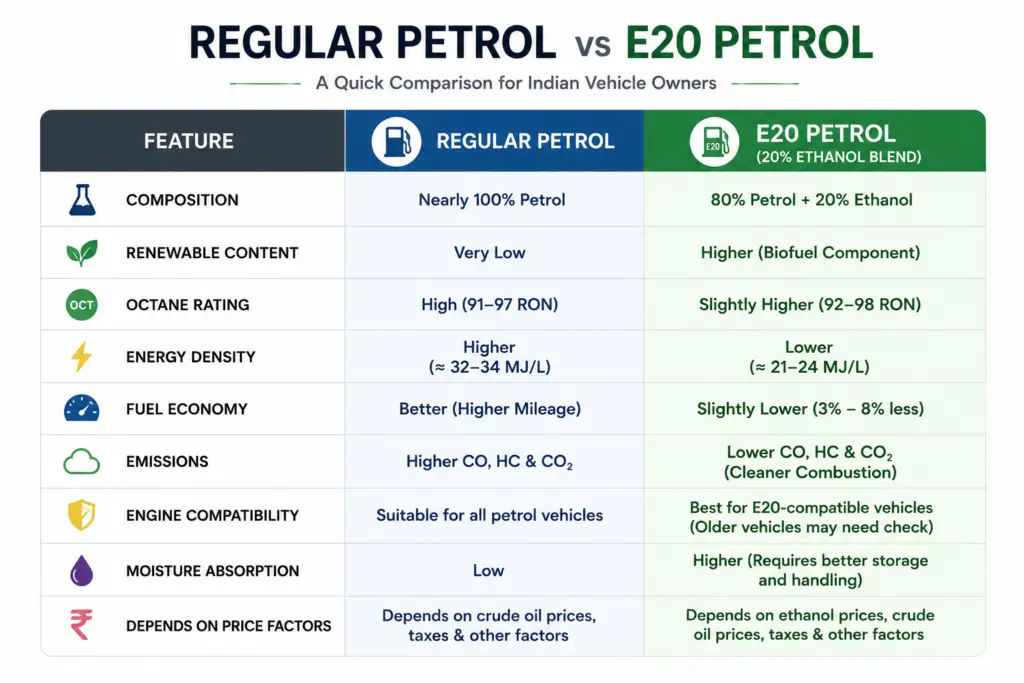
How Is E20 Different from Regular Petrol?
Although E20 looks almost identical to regular petrol, its composition and performance characteristics are different.
| Feature | Regular Petrol | E20 Petrol |
|---|---|---|
| Petrol Content | Nearly 100% | 80% |
| Ethanol Content | Minimal | 20% |
| Renewable Content | Low | Higher |
| Octane Rating | High | Slightly Higher |
| Energy Density | Higher | Slightly Lower |
| Carbon Emissions | Higher | Lower |
| Fuel Economy | Slightly Better | Slightly Lower |
The higher octane rating improves resistance to engine knocking, while the lower energy density means vehicles generally require slightly more fuel to travel the same distance.
For most drivers, however, these differences are relatively small during everyday driving.
Why Does Ethanol Affect Mileage?
Every litre of ethanol contains less usable energy than a litre of petrol.
As a result, the engine injects slightly more fuel to generate the same amount of power.
This is the primary reason why E20 may deliver marginally lower mileage than conventional petrol.
Modern engines designed specifically for E20 recover part of this difference through improved combustion, optimized ignition timing, and updated engine control software.
Can You Use E20 in Your Vehicle?
The answer depends mainly on when your vehicle was manufactured.
Older Vehicles
Vehicles built before ethanol-compatible materials became common may contain:
- Rubber fuel hoses
- Plastic seals
- Older fuel pumps
- Aluminium fuel system components
Over prolonged exposure, higher ethanol concentrations can accelerate wear in these materials.
Occasional use is unlikely to cause immediate problems, but owners of older vehicles should consult the manufacturer’s recommendations before regularly using E20.
Modern Vehicles
Most modern passenger cars and motorcycles have been designed with ethanol-compatible materials throughout the fuel system.
Manufacturers have upgraded:
- Fuel tanks
- Fuel lines
- Rubber seals
- Gaskets
- Fuel pumps
- Fuel injectors
These improvements allow vehicles to operate safely on E20 over their expected service life.
BS6 Phase 2 Vehicles
Vehicles manufactured under India’s latest BS6 Phase 2 emission norms are generally engineered with E20 compatibility in mind.
Many manufacturers have also optimized engine calibration specifically for E20 fuel, allowing the engine to maintain smooth performance while minimizing the fuel economy penalty associated with ethanol.
Will E20 Reduce Mileage?
The most common concern among Indian motorists is whether E20 petrol will reduce fuel economy. The short answer is yes—but only slightly.
Ethanol contains approximately 30–35% less energy per litre than conventional petrol. Since engines require a certain amount of energy to produce power, a vehicle running on E20 needs to inject slightly more fuel to generate the same output.
In real-world conditions, most drivers can expect a mileage reduction of around 3% to 8%, depending on:
- Vehicle model
- Engine technology
- Engine calibration
- Driving style
- Traffic conditions
- Road conditions
The difference is usually more noticeable during highway driving than city driving, although actual results vary.
Fortunately, modern E20-compatible engines are specifically calibrated to minimize this reduction. Manufacturers have optimized ignition timing, fuel injection, and compression characteristics so that drivers experience little difference in everyday performance.
Myth vs Reality
| Myth | Reality |
|---|---|
| E20 drastically reduces mileage. | Most vehicles experience only a modest reduction of around 3–8%. |
| Every vehicle loses the same mileage. | Mileage loss depends on engine design and calibration. |
| Higher octane means better mileage. | Higher octane improves knock resistance, not fuel economy. |
Does E20 Damage Engines?
This is perhaps the biggest misconception surrounding ethanol-blended fuels.
The answer depends largely on the age and design of the vehicle.
For modern E20-compatible vehicles, E20 does not damage the engine. These vehicles have been engineered using materials specifically designed to withstand higher ethanol concentrations.
However, ethanol behaves differently from petrol.
It:
- Absorbs moisture from the atmosphere.
- Acts as a mild solvent.
- Can affect certain older rubber and plastic components.
- May accelerate corrosion in untreated metal parts.
These characteristics required automobile manufacturers to redesign several fuel system components.
Why Older Vehicles May Face Issues
Older vehicles were never designed with higher ethanol blends in mind.
Potential long-term concerns include:
- Rubber hose deterioration
- Seal and gasket wear
- Corrosion in untreated aluminium components
- Fuel filter clogging due to cleaning action of ethanol
- Moisture accumulation in fuel systems
These problems generally develop over extended periods rather than immediately after switching to E20.
If you own a vehicle manufactured before widespread ethanol compatibility standards, consult your owner’s manual or manufacturer before regularly using E20.
Why Modern Vehicles Are Different
Today’s vehicles use ethanol-resistant materials such as:
- Advanced fluorocarbon rubber
- Improved polymer seals
- Corrosion-resistant fuel pumps
- Stainless steel components
- Updated fuel injectors
- Advanced Engine Control Units (ECUs)
Modern ECUs continuously monitor combustion and adjust fuel injection and ignition timing to ensure smooth engine operation regardless of minor fuel composition differences.
Advantages of E20 Petrol
Although discussions often focus on mileage, E20 provides several long-term benefits.
Cleaner Emissions
Because ethanol contains oxygen, combustion is generally more complete, helping reduce harmful exhaust pollutants such as carbon monoxide and unburnt hydrocarbons.
Reduced Dependence on Imported Oil
India imports a large percentage of its crude oil requirements. Every litre of domestically produced ethanol replaces a portion of imported fossil fuel.
Better Energy Security
Producing fuel within the country reduces exposure to geopolitical instability and international oil price fluctuations.
Support for Indian Agriculture
Ethanol production creates an additional market for:
- Sugarcane
- Maize
- Damaged food grains
- Agricultural by-products
This helps improve farmer incomes while strengthening rural industries.
Renewable Fuel
Unlike crude oil, ethanol is produced from renewable biological resources that can be replenished every growing season.
Higher Octane Rating
Ethanol naturally has a high octane value, improving resistance to engine knocking when engines are designed to utilize it.
Challenges of E20 Petrol
Like any energy transition, E20 also presents certain challenges.
Slightly Lower Mileage
Lower energy density means vehicles generally consume a little more fuel.
Older Vehicle Compatibility
Some older vehicles may require upgraded fuel system components for long-term reliability.
Fuel Storage
Because ethanol absorbs moisture more readily than petrol, storage and transportation infrastructure requires improved moisture control.
Agricultural Balance
Expanding ethanol production must be carefully balanced with food security, water availability, and sustainable farming practices.
Infrastructure Investment
Oil Marketing Companies (OMCs) have invested significantly in:
- Ethanol storage facilities
- Blending terminals
- Distribution networks
- Quality monitoring systems
These investments are essential for ensuring consistent fuel quality across the country.
Frequently Asked Questions
Can I mix E20 with normal petrol?
Yes. Mixing fuels with different ethanol concentrations is generally safe for compatible vehicles. Your fuel tank already mixes new fuel with the remaining fuel inside the tank every time you refuel.
Is E20 compulsory?
India is progressively expanding E20 availability as part of its national fuel strategy. Availability may still vary depending on region and fuel station.
Is E20 safe for motorcycles?
Most newer motorcycles designed for E20 compatibility can use it safely. Owners of older motorcycles should consult their manufacturer before regular use.
Will E20 make my engine more powerful?
Not necessarily. Although ethanol has a higher octane rating, engines must be specifically tuned to take advantage of this property.
Will petrol become cheaper because of ethanol?
Not necessarily. Retail fuel prices depend on crude oil prices, taxes, refining costs, ethanol procurement prices, transportation costs, and government policy.
Does E20 increase engine maintenance?
Modern E20-compatible vehicles generally do not require additional maintenance beyond the manufacturer’s recommended service schedule.
Can E20 be used in classic or vintage cars?
Owners of classic vehicles should exercise caution because older fuel systems may contain materials that are not designed for prolonged exposure to higher ethanol concentrations.
Will E20 replace petrol completely?
No. E20 is a blend of petrol and ethanol. It is intended to reduce fossil fuel consumption rather than eliminate petrol entirely.
TechZero Verdict
E20 petrol represents one of the most significant changes to India’s automotive fuel ecosystem in recent decades. Rather than introducing an entirely new fuel, it gradually replaces part of conventional petrol with a renewable alternative produced from Indian agricultural resources.
For owners of modern BS6 Phase 2 vehicles, the transition is largely seamless. The slight reduction in fuel economy is generally outweighed by the broader national benefits of improved energy security, reduced crude oil imports, cleaner emissions, and stronger support for India’s agricultural economy.
Owners of older vehicles should understand their vehicle’s compatibility before regularly using E20, but there is no reason for unnecessary concern or panic. Automobile manufacturers have spent years redesigning fuel systems to accommodate higher ethanol blends, and today’s vehicles are increasingly engineered with future fuel standards in mind.
As India continues its journey toward cleaner mobility through ethanol, flex-fuel technologies, hybrids, and electric vehicles, E20 should be viewed not as the final destination but as an important milestone in the country’s long-term energy transition.