Artificial Intelligence is no longer a futuristic concept. It is already writing emails, generating code, creating videos, analyzing data, and handling customer support conversations. As AI capabilities improve, many professionals are asking the same question:
Will AI take my job?
The answer is more nuanced than a simple yes or no.
AI is unlikely to replace entire professions overnight. Instead, it will automate specific tasks, allowing companies to do more with fewer people. Jobs that are repetitive, predictable, and rules-based face the highest risk. Roles requiring creativity, human judgment, emotional intelligence, leadership, and hands-on expertise are far more likely to survive and thrive.
Let’s look at the jobs most vulnerable to AI disruption and those that appear relatively safe through 2030.
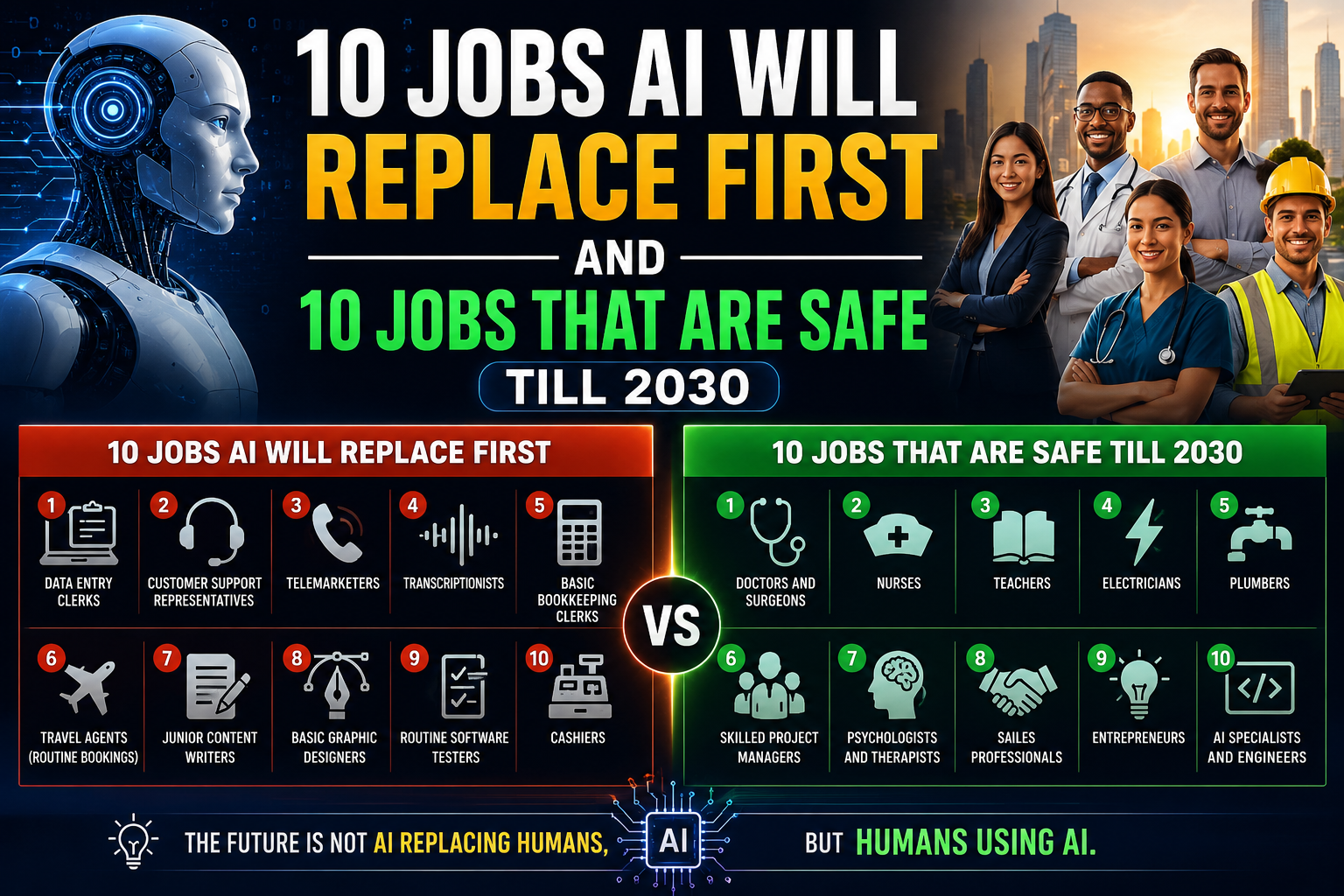
10 Jobs AI Is Most Likely to Replace First
1. Data Entry Clerks
AI can already extract information from documents, invoices, forms, and emails with impressive accuracy.
Risk Level: Very High
2. Basic Customer Support Representatives
Modern AI chatbots can answer FAQs, process requests, and provide 24/7 support without breaks.
Risk Level: Very High
3. Telemarketers
AI voice agents can make calls, qualify leads, and follow scripts at scale.
Risk Level: Very High
4. Transcriptionists
Speech-to-text systems have become remarkably accurate and continue to improve.
Risk Level: High
5. Basic Bookkeeping Clerks
AI-powered accounting software can categorize expenses, reconcile accounts, and generate reports automatically.
Risk Level: High
6. Travel Agents Handling Routine Bookings
AI assistants can compare flights, hotels, and itineraries within seconds.
Risk Level: High
7. Junior Content Writers Producing Generic Content
Basic blogs, product descriptions, and social media posts can already be generated by AI.
Risk Level: High
8. Basic Graphic Designers
Simple advertisements, banners, thumbnails, and social media creatives are increasingly being generated using AI tools.
Risk Level: Medium-High
9. Routine Software Testers
Automated testing tools can create and execute test cases with minimal human intervention.
Risk Level: Medium-High
10. Cashiers
Self-checkout systems and AI-powered retail technology are reducing the need for traditional cashier roles.
Risk Level: Medium-High
10 Jobs Likely To Be Safe Until 2030
1. Doctors and Surgeons
AI can assist diagnosis but patients still trust trained medical professionals for critical decisions.
Safety Level: Very High
2. Nurses
Healthcare requires empathy, communication, physical presence, and real-world decision-making.
Safety Level: Very High
3. Teachers
Technology can assist learning, but inspiring, mentoring, and managing students remains a deeply human task.
Safety Level: High
4. Electricians
Physical problem-solving in unpredictable environments remains extremely difficult for AI and robots.
Safety Level: High
5. Plumbers
Every home presents unique challenges that require hands-on expertise.
Safety Level: High
6. Skilled Project Managers
AI can create schedules and reports, but stakeholder management, conflict resolution, negotiation, and leadership remain human strengths.
Safety Level: High
7. Psychologists and Therapists
Human connection, trust, empathy, and ethical judgment are difficult to automate.
Safety Level: High
8. Sales Professionals
Relationship-building and complex negotiations continue to depend heavily on human interaction.
Safety Level: Medium-High
9. Entrepreneurs
Business creation requires vision, risk-taking, leadership, and adaptability.
Safety Level: High
10. AI Specialists and Engineers
Ironically, the people building and managing AI systems are among the biggest beneficiaries of the AI revolution.
Safety Level: Very High
What This Means for Your Career
The biggest mistake is assuming that AI will replace humans entirely.
A more accurate prediction is this:
People who use AI will replace people who do not.
Regardless of your profession, learning how to work alongside AI tools will become a critical skill over the next decade.
Focus on developing:
- Critical thinking
- Communication skills
- Leadership abilities
- Creativity
- Domain expertise
- AI literacy
These capabilities are far harder to automate and will remain valuable even as technology advances.
Final Thoughts
The future of work is not humans versus AI.
It is humans working with AI.
Jobs built around repetitive tasks face increasing pressure, while careers requiring judgment, empathy, creativity, leadership, and hands-on expertise are likely to remain resilient through 2030 and beyond.
Instead of fearing AI, the smartest strategy is to learn it, use it, and position yourself where human skills matter most.